Housing price decline

Search documents
2026年开始,如果房价出现“暴跌”,没有人能逃脱这4个“命运”
Sou Hu Cai Jing· 2026-01-08 13:19
房子已经很久不是简单的遮风避雨了,它和家庭资产、消费结构、人情往来、人生规划甚至城市竞争力 全都绑在一起。所以一旦出现"暴跌"这种极端场景,影响绝不会只落在账面上,而是会像多米诺一样, 一片片砸过去。有人感觉赚了,有人感觉亏了,有人突然轻松,有人瞬间压力上头。 假设从2026年开始,房价真出现了明显的下跌,那日子会怎么变?不少老房东常说:"涨也好跌也好, 总有人笑有人愁",但有四种"命运"基本躲不开。 第一个命运:账面资产缩水 房价如果真下来了,最先感受到的就是资产变薄。比如一套原本估值300万的房子,如果市场价格掉到 240万,看上去只是一个数字变化,但现实里意味着抵押贷款额度变低、再融资难度变大、资产负债表 以前不少家庭买房不是为了住,而是为了替存款保值,这种情况下,房价一掉,心态很容易崩。就像你 把钱存在了一个自己不能随时取出的"保险箱"里,结果打开发现里面少了一截,虽然暂时不卖不亏,但 对很多人来说,负面情绪和焦虑才是最难承受的。 过去有房的人习惯把房子当"压舱石",但一旦价格失重,压舱石就变成了"沉重石"。 变得难看。 第二个命运:刚需买房变得更理性 房价如果真开始往下走,那些原本焦虑地看房、抢房、 ...


警惕房价持续下跌!
Sou Hu Cai Jing· 2025-12-17 00:54
Group 1 - The core viewpoint is that housing prices in major cities are in a deep downward adjustment, with no signs of stabilization [2] - The overall trend of housing prices has been declining, with many cities experiencing price drops exceeding 30%, and some even over 40% or 50% [2] - The decline in housing prices poses risks comparable to those associated with high housing prices, necessitating vigilance [2] Group 2 - The impact of declining housing prices is widespread, as residential properties constitute over 60% of household assets, leading to a cautious attitude towards spending and investment [3] - The sluggish consumer market is partly attributed to the ongoing decline in the real estate market and continuous price drops [3] - The real estate industry has a long supply chain, and its downturn negatively affects related industries, contrary to the belief that a decline in real estate could benefit other sectors [3] Group 3 - There is a call for increased support for the real estate sector to stabilize housing prices and promote healthy market development [4] - The need to stabilize housing prices and expectations is emphasized to ensure the healthy and stable development of the real estate market [4]
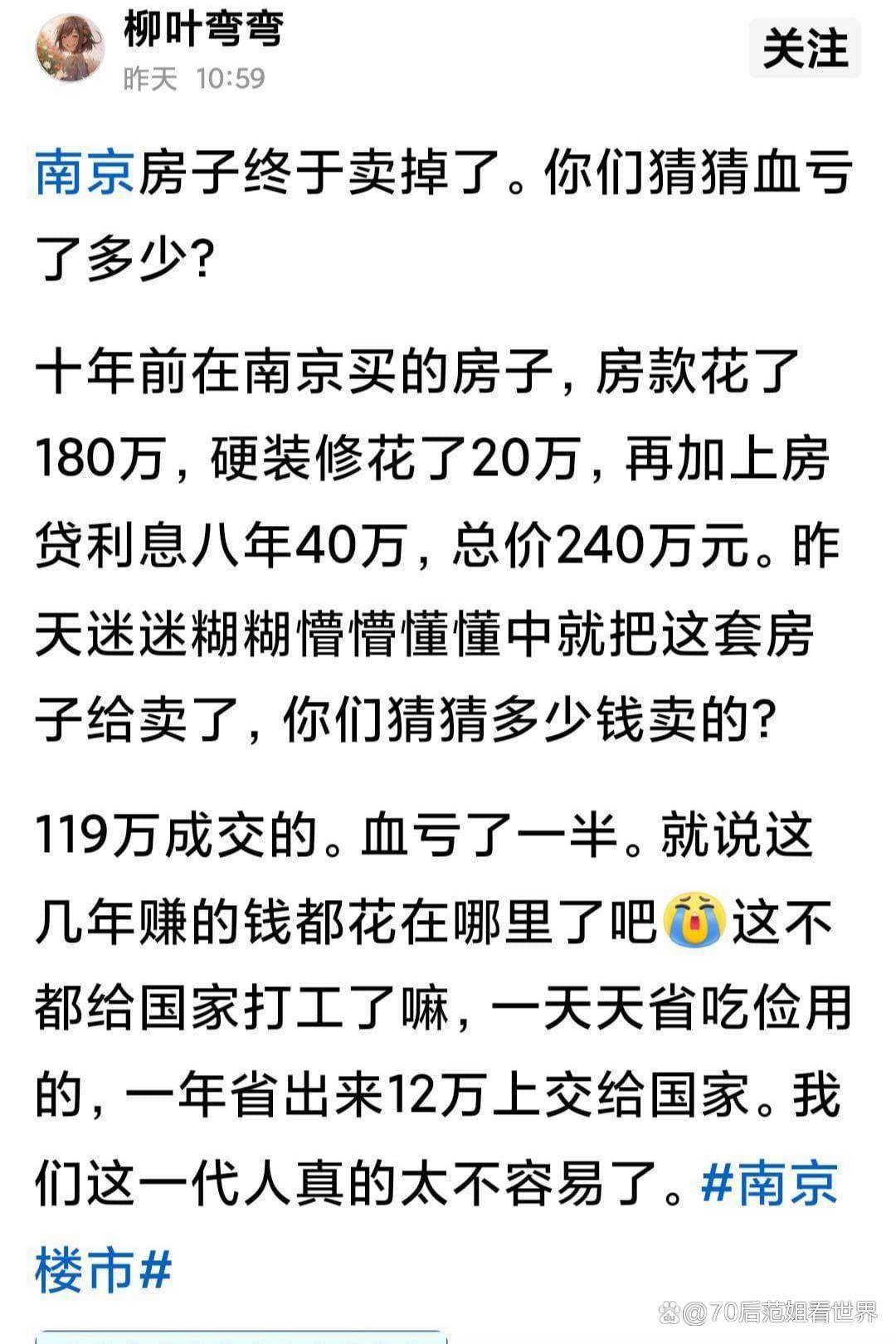
南京的房子终于卖掉了!你们猜猜血亏了多少?
Sou Hu Cai Jing· 2025-06-05 09:53
Core Viewpoint - The article discusses the decline in housing prices in first-tier cities, particularly focusing on a case in Nanjing where a homeowner sold their property at a significant loss, highlighting the broader trend of decreasing property values and the impact on homeowner confidence [1]. Group 1: Housing Market Trends - First-tier cities, traditionally seen as stable in terms of property values, are now experiencing price declines, as evidenced by a homeowner in Nanjing selling a property for 119 million after purchasing it for 180 million ten years ago [1]. - The current market conditions are described as unfavorable for sellers, with some homeowners expressing relief at being able to sell at all, fearing that prices may drop further in the coming years [1]. Group 2: Homeowner Experiences - A specific case is presented where a homeowner's total investment in a Nanjing property reached approximately 240 million, including purchase price, renovations, and interest, but the property was sold for only 119 million, indicating a substantial financial loss [1]. - Comments from other homeowners reveal a shared sentiment of financial loss, with some reporting losses of over 100 million within a year, reflecting a widespread feeling of being "cut down" in the market [7][8]. Group 3: Market Sentiment - The decline in housing prices is not just a financial issue but also a psychological one, as the drop in prices has eroded homeowner confidence, leading to concerns about the overall economic environment and consumer spending [8].