Inflationary risks

Search documents
Gold and Silver Plunge as Iran War Damps Rate-Cut Hopes
Yahoo Finance· 2026-03-19 12:58
Group 1 - Gold prices have declined for seven consecutive sessions, influenced by the escalating conflict in the Middle East, which has driven oil prices higher and diminished the likelihood of a near-term US interest rate cut [1][2] - Silver has experienced a significant drop, slumping more than 10% [1] - The ongoing war has raised inflationary risks due to soaring crude and gas prices, making rate cuts by the Federal Reserve and other central banks less probable, which negatively impacts gold as it does not yield interest [1][3] Group 2 - Gold-backed exchange-traded funds (ETFs) have seen persistent outflows recently, which has contributed to the downward pressure on gold prices; demand for these ETFs is particularly sensitive to changes in interest rates [4] - Despite the recent downturn, gold is still up nearly 6% year-to-date, although upward momentum has stalled as the prospects for a near-term rate cut have diminished [7] - Spot gold was reported at $4,564.16 per ounce, down 5.3%, while silver was at $67.21, reflecting a more than 10% decline [7]
X @Bloomberg
Bloomberg· 2026-03-08 23:10
Gold fell, pressured by inflationary risks as oil spiked above $110 a barrel and the war in the Middle East extended into a second week https://t.co/tZxKNNgwUF ...
Dow Futures Rise, Nasdaq Slips And Crude Gains Amid Ongoing Unrest In Iran - Invesco QQQ Trust, Series 1 (NASDAQ:QQQ)
Benzinga· 2026-01-09 06:14
Market Overview - Dow Jones Industrial Average futures increased by 0.01%, while S&P 500 and Nasdaq 100 futures decreased by 0.01% and 0.03% respectively, indicating a divergence in market sentiment influenced by geopolitical tensions in the Middle East [1] - Crude oil prices rose, with West Texas Intermediate (WTI) futures for February delivery climbing 0.64% to $58.13 per barrel, driven by fears of supply disruptions due to unrest in Iran [2] Energy Sector - The Iranian regime is facing significant threats, leading to increased risk premiums in energy markets as traders hedge against potential disruptions in oil supply, particularly through the Strait of Hormuz [2][3] - The Iranian government's internet blackout to suppress dissent has further escalated concerns in the energy sector [3] Precious Metals - Precious metals experienced a slight pullback after reaching historic highs, with spot gold trading at $4,460.77, down 0.37%, and silver at $76.53, down 0.61% [4] - Support and resistance levels for gold are identified at $4,410-4,355 and $4,525-4,560 respectively, while silver has support at $75.10-73.45 and resistance at $80.05-82.40 [5] Cryptocurrency Market - Bitcoin's price hovered around $90,873, experiencing a slight decline of 0.19% amid heightened volatility linked to reports of the Iranian Ministry of Defence liquidating military assets for cryptocurrency [6] - The situation highlights the utility of cryptocurrencies in circumventing traditional banking systems, although it raises regulatory concerns that keep Bitcoin's price below the $100,000 mark [6]


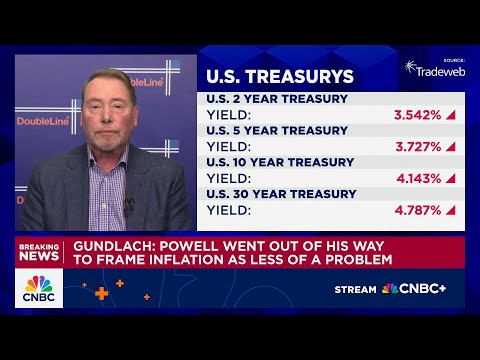
DoubleLine's Jeffrey Gundlach: I don't feel like that was a hawkish cut
CNBC Television· 2025-12-10 21:14
Fed Policy Stance - The market interprets the Fed's recent actions as a dovish meeting rather than a hawkish cut, despite the rate cut [1][2][7][10] - The Fed is perceived to be more focused on employment risks, specifically the potential rise in unemployment, than on inflationary pressures [6] - The Fed seems to downplay inflationary risks, suggesting good progress on inflation, if not for tariffs [3][4][5] Quantitative Easing (QE) and Tightening (QT) - The Fed has unexpectedly ramped up QE by $40 billion, after a period of QT, raising hopes for further QE if needed [7] Interest Rate Dynamics - Despite the Fed dropping rates by 175 basis points since September, the 2-year Treasury rate remains unchanged [6] - The Fed funds rate is now in line with the 2-year Treasury yield [5][6] - Long-term interest rates, such as the 30-year Treasury, have risen by approximately 75 basis points since the Fed started cutting rates [8][9] - The 2s30s Treasury curve has steepened to around 123-124 basis points, approaching the year's high of 130 basis points [10] Economic Assessment - The Fed estimates that monthly jobs gains are overstated by approximately 60,000, suggesting a potentially weaker labor market than reported [2] - The market believes that cutting interest rates is not helpful for long-term interest rates [9] - Cutting rates by 175 basis points has not helped the housing market [8]
X @Bloomberg
Bloomberg· 2025-09-23 13:55
Monetary Policy - Morocco left interest rates unchanged for a second quarter [1] - The decision reflects a cautious approach, remaining on guard for inflationary risks [1] Geopolitical Risk - Tensions in the broader Middle East are a key factor influencing monetary policy decisions [1]
Summers Says Fed Cut May Be 'Playing With Fire'
Bloomberg Television· 2025-08-01 21:25
Monetary Policy Stance - The Fed decided to preserve flexibility amidst risks of both economic downturn and inflationary pressures from tariffs and economic strength [1] - The Fed's prudent action was to avoid excessive moves that could sacrifice credibility, as reversing such errors would be difficult [4] - A prior rate cut of 50 basis points led to a 75 basis point increase in the ten-year rate, impacting mortgage rates [2] - The market will reflect substantial economic weakness in rates, reducing the urgent need for rate cuts [8] Interest Rate Debate - There is debate regarding whether to have a 25 basis point rate cut in July, or two or three rate cuts this year [4] - The industry questions the merit of cutting rates to the 1% range, deeming it a dangerous idea given the current market and economic strength [4] - Dissenters within the Fed, appointed by different individuals, may see underlying economic weakness requiring preemptive action [6][7] Economic Outlook - The economy faces risks of a downturn, but if such an error is made, it is easily correctable [1][3] - Sacrificing credibility by moving excessively would be a much more damaging and difficult to reverse error [4]