
Investment Tax Credits

Search documents
PowerBank Announces Safe Harbor of 15 Distributed Solar and Energy Storage Projects in New York State
Prnewswire· 2025-12-02 12:07
Core Insights - PowerBank Corporation has executed equipment procurement agreements for 15 late-stage distributed solar and energy storage projects in New York, expected to provide approximately 67 MW DC of solar power and 11 MWh of energy storage [1][2] - The total construction value of these projects is estimated at US$168 million, with potential tax credits valued at US$65 million [2][4] - The projects are designed to meet the IRS Physical Work Test before the July 4, 2026 deadline, ensuring eligibility for federal Investment Tax Credits under the One Big Beautiful Bill Act of 2025 [1][4] Project Details - The projects will power the equivalent of 7,500 homes and are part of New York's goal to achieve 10 GW of distributed solar and 6 GW of energy storage by 2030 [1][6] - PowerBank has established strong relationships with Tier 1 suppliers to secure necessary equipment, with commercial operation expected over the next several years, subject to permits and financing [3][5] Investment Tax Credits - Investment Tax Credits (ITC) for solar projects have been available since 2006, providing a 30% tax credit for qualifying installations, with additional bonus adders possible [4] - The One Big Beautiful Bill Act specifies that projects starting construction before July 4, 2026, will remain eligible for these tax credits, which is crucial for the financial viability of the projects [4][5] Company Background - PowerBank Corporation is an independent renewable energy project developer focusing on distributed and community solar projects in North America, with a development pipeline exceeding 1 GW and over 100 MW of completed projects [8]



EQNR's US Wind Projects Incur $955M Impairment Over Regulatory Changes
ZACKS· 2025-07-25 14:42
Core Insights - Equinor ASA has reported impairment costs of $955 million related to its U.S. offshore wind projects, primarily due to regulatory changes and increased tariff exposure [1][4][5] - The regulatory environment under the Trump administration has negatively impacted the offshore wind industry, leading to a loss of synergies for future projects [2][3] - The Biden administration has provided federal support for renewable energy, contrasting with the previous administration's suspension of offshore wind leases [3] Financial Impact - The impairment charges significantly affected Equinor's net operating income in the second quarter, with $763 million attributed to the Empire Wind 1 project and the South Brooklyn Marine Terminal [4][8] - The remaining impairment amount is linked to the lease of the Empire Wind 2 project, which is now uncertain due to the withdrawal of tax credits [4][5] Regulatory Challenges - The withdrawal of investment tax credits has made new offshore wind projects less attractive, contributing to the impairment charges [5][6] - U.S. tariffs on steel have increased the cost of the Empire Wind project by $300 million, further complicating its financial viability [7] Project Viability - The South Brooklyn Marine Terminal was expected to support multiple wind farms, but current regulatory conditions have diminished its potential value [6] - Without tax credits, the development of Empire Wind Phase 2 is unlikely to proceed, raising concerns about the project's future [7][8]


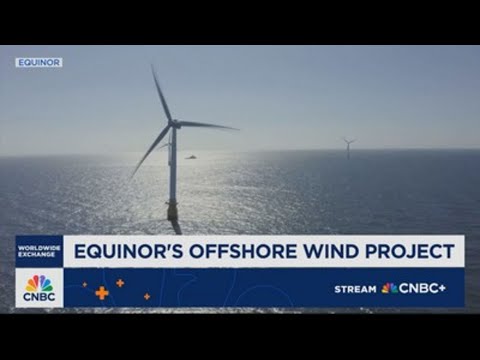
Offshore wind’s future uncertain as Congress targets federal subsidies
CNBC Television· 2025-06-26 11:32
Project Overview - Ecuador is redeveloping the South Brooklyn Marine Terminal for the Empire Wind One offshore wind project [1] - The Empire Wind One project will consist of 54 turbines, each 951 feet tall, generating 810 megawatts of power, enough to power 500,000 homes [1] - Ecuador is investing approximately $5 billion in the project, including $1 billion for the marine terminal redevelopment [1] - The project is expected to be fully operational by 2027 [4] Economic Impact - The project is creating over 1,000 union jobs [1] Challenges and Incentives - The offshore wind industry in the US has faced challenges due to high costs and complex supply chains [3] - Federal incentives are helping to offset costs, with Ecuador expecting to recoup 40% of the project's cost through investment tax credits [3] - Proposed changes to tax credits in Congress could significantly reduce incentives for future projects, potentially stifling the industry [3] Regulatory Hurdles - The project faced a temporary setback when President Trump issued a stop work order in April, but the order was reversed on May 19th [2] Strategic Positioning - Ecuador is relying on other offshore wind projects utilizing its specialized marine terminal, which is equipped to handle custom vessels and large cranes [3]
Shoals Technologies Group (SHLS) 2025 Conference Transcript
2025-06-24 13:35
Summary of Shoals Technologies Group (SHLS) Conference Call Company Overview - **Company**: Shoals Technologies Group (SHLS) - **Industry**: Clean Energy, specifically Solar Energy Solutions Key Points and Arguments Demand and Market Activity - Demand for solar projects remains very strong, with many EPC (Engineering, Procurement, and Construction) customers having full project pipelines [4][5] - The solar industry has adapted to ongoing challenges such as labor availability, supply chain issues, and permitting delays [6][7][8] Regulatory Environment - The regulatory environment is currently volatile, with changes in tariffs and investment tax credits (ITC) creating uncertainty [10][11] - The availability of ITC is expected to phase out, which could increase costs for solar projects, but demand for energy remains strong [12][13] - The company does not participate in the 45X manufacturers credits but remains optimistic about its business model [14][15] Foreign Entity of Concern (FIOC) Provision - The FIOC provision may favor Shoals by limiting competition from foreign entities, particularly from China [16][18] - Shoals manufactures all eBOS (electrical balance of systems) solutions in the U.S., positioning itself well in a domestic-focused market [17][18] Competitive Landscape - Shoals differentiates itself from competitors by offering manufactured solutions that are tested for quality, unlike insulation piercing connectors (IPCs) that require field installation [20][22] - The company is working to educate developers on the long-term benefits of its solutions compared to IPCs [25][28] Master Supply Agreements (MSAs) - Shoals has secured significant MSAs, including a 12-gigawatt deal with Blattner and a 12-gigawatt deal with UGT for international projects [29][30] - MSAs provide predictability for project timelines and supply chain management, allowing for better investment in facilities and growth [31][32] International Expansion - Shoals is targeting international markets, including Australia and Saudi Arabia, while also responding to U.S. customer demands for global projects [38][40] Warranty Issues - The company is addressing warranty issues related to defective wire and is on track to complete remediation work this year [41][42] Data Center Demand - There is a growing demand for energy driven by data centers, which is expected to continue in the coming years [45][46] - Shoals is exploring ways to adapt its products for data center applications [47] Gross Margins and Financial Outlook - The company targets gross margins in the mid-30s to high-30s percentage range in the near term, with a long-term goal of exceeding 40% [49][52] - Shoals is focused on maintaining operating profits and cash flows while managing expenses [51][54] Capital Allocation and Growth Strategy - The primary focus is on organic growth, with potential for inorganic acquisitions to enhance product offerings [60][61] - Share repurchases are also considered, but the priority remains on business growth and facility investments [62] Additional Important Content - The company is expanding its involvement with developers to ensure long-term benefits of its products are recognized [36][37] - Shoals is actively working on battery energy storage solutions, which are becoming increasingly important in solar projects [56][58]
