
Investment Themes

Search documents
X @CoinMarketCap
CoinMarketCap· 2025-12-23 16:20
LATEST: ⚡ BlackRock has named Bitcoin one of the three major investment themes of 2025 alongside Treasury bills and Magnificent 7 tech stocks, with the firm's Bitcoin ETF closing out 2025 with $68.3 billion in assets. https://t.co/XUdsNoNiVp ...
X @Cointelegraph
Cointelegraph· 2025-12-23 03:00
🔥 BULLISH: $13 trillion BlackRock lists Bitcoin as one of 2025's biggest investment themes alongside T-bills and the Mag 7 in its year-end investment wrap. https://t.co/yljE0uat5w ...
X @Bloomberg
Bloomberg· 2025-12-10 13:14
Two of the biggest investment themes of the year so far have been the precious metals boom, with gold and silver soaring, and endless speculation over just how bubbly the AI sector is. Is 2026 heading for more of the same? https://t.co/fhI7ym6wD8 ...
Thomas: We’re at peak 18-year-olds, and that will reshape the U.S. economy
CNBC Television· 2025-12-09 12:44
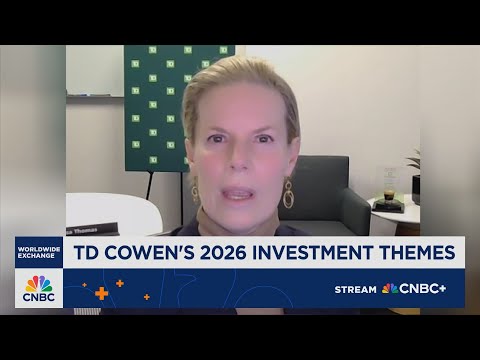
THIS IN HER 2026 INVESTMENT THEMES IS LISA THOMAS, MANAGING DIRECTOR AND DEPUTY HEAD OF GLOBAL RESEARCH AT TD COWEN. LISA, GOOD MORNING. GOOD TO SEE YOU. >> HEY, GOOD TO SEE YOU, FRANK.>> SO YOU CAME OUT WITH SOME SOME OUTLOOKS FOR 2026. HOW MUCH OF THIS IS DEPENDENT ON NOT ONLY GETTING A CUT TODAY, BUT THE FED CONTINUING TO CUT. >> YOU KNOW THEY'RE REALLY NOT.THESE ARE THE LONGER TERM THEMES RIGHT. SO EACH YEAR WE REALLY TRY TO PULL BACK THE APERTURE AT TD COWAN AND LOOK AT THE BROAD INVESTMENT THEMES THAT ...


5 New ETFs That Capture 2025's Biggest Investment Themes
Etftrends· 2025-10-13 14:33
Core Insights - The article discusses the emergence of new funds in response to shifting interest rates, evolving credit markets, and increasing investor interest in alternative assets [1] Group 1: Market Trends - Interest rates have been fluctuating, impacting investment strategies and fund launches [1] - Credit markets are evolving, necessitating new financial products to cater to changing investor needs [1] - There is a growing appetite among investors for alternative assets, prompting the introduction of several new funds [1]
The $10 Trillion AI Revolution: Why It’s Bigger Than the Industrial Revolution
Sequoia Capital· 2025-08-28 09:01
AI Revolution Thesis - Sequoia believes the AI revolution is comparable to the industrial revolution, presenting a significant transformation [1][2] - The cognitive revolution represents a $10 trillion (10 to the 13th power) opportunity [1][8] - Startups are crucial in specializing general AI technologies for specific applications [6] Commercial Opportunity - The AI-driven automation of the US services market, currently at approximately $20 billion, holds a $10 trillion potential [8] - The cognitive revolution can expand the market to include large, standalone public companies built around AI in the services space [12] Investment Trends - Work is shifting towards higher leverage (100+%) on tasks with less certainty in outcomes, requiring human correction [13][14][15] - Real-world measurement is becoming the new gold standard for proving AI excellence, surpassing academic benchmarks [15][16][17] - The industry forecasts at minimum a 10x increase in compute (flops) per knowledge worker, with optimistic views suggesting 1000x to 10,000x consumption [20] Investment Themes - Persistent memory, including long-term memory and consistent AI identity, is critical for AI's expansion into more work functions [21][22][23] - Seamless communication protocols between AIs, beyond initial protocols like MCP, will yield major applications [24][25] - AI voice is currently viable due to increased fidelity and decreased latency, with applications in both B2C and enterprise sectors [27][28][29] - AI security presents a huge opportunity across development, distribution, and user layers, potentially involving numerous AI security agents per person/agent [30][31][32][33] - Open source's ability to compete with state-of-the-art foundation models is critical for a free, open AI future [34][35][36]

每周资金流向:周期性板块获支撑,防御性板块受压制-Weekly Fund Flows_ Cyclicals Supported, Defensives Depressed
2025-07-28 02:18
Summary of Global Fund Flows Industry Overview - The report discusses global fund flows for the week ending July 23, focusing on equity and fixed income markets, highlighting trends in investor behavior across different regions and sectors. Key Points Fund Flows into Equities - Global equity funds experienced modest inflows of $6 billion, an increase from $5 billion in the previous week [1] - Mixed flows were observed across G10 countries; US and Japan equity funds faced net outflows, while Euro area equity funds saw net inflows [1] - There is a notable trend of repatriation from US assets, with foreign demand for US equities significantly slowing down, particularly in Europe and Asia [1][2] - Emerging Markets (EM) saw strong demand, particularly in South Korea, which had the highest inflows, while Taiwan experienced the largest outflows [1] Fund Flows into Fixed Income - Global fixed income funds saw robust inflows of $27 billion, up from $17 billion the previous week, with both government and corporate credit products benefiting [1] - Over the past four weeks, bank loans have attracted the strongest inflows as a percentage of Assets Under Management (AUM) [1] - Investors have begun net purchasing inflation-protected securities in the last two weeks [1] Sector-Level Insights - There is a clear preference for cyclical sectors over defensive ones since early July, with industrials and financials attracting the strongest net inflows [1] - The divergence between flows into cyclicals and defensives has become more pronounced, indicating a shift in investor sentiment [1][4] Money Market and FX Flows - Money market fund assets increased by $14 billion [1] - Cross-border foreign exchange (FX) flows were strong, with the Euro attracting significant net foreign inflows [1] - In Asia, the Singapore Dollar (SGD), Taiwan Dollar (TWD), and Hong Kong Dollar (HKD) saw the strongest foreign inflows recently [1] Summary of Fund Flow Data - Total equity inflows for the four-week period amounted to $29.084 billion, with a weekly inflow of $5.798 billion [2] - Total fixed income inflows reached $86.605 billion, with a weekly inflow of $26.965 billion [2] - Money market funds had a total of $74.716 billion in inflows, with a weekly inflow of $13.707 billion [2] Additional Observations - The report indicates a shift in investor focus towards cyclical sectors, which may present potential investment opportunities [1][4] - The slowdown in foreign demand for US equities could pose risks for US markets, particularly if the trend continues [1][6] Conclusion - The current trends in global fund flows suggest a cautious but strategic repositioning by investors, favoring cyclical sectors and fixed income products while showing hesitance towards US equities. The data indicates potential opportunities in emerging markets and cyclical sectors, while also highlighting risks associated with the US market's attractiveness to foreign investors.