
Job market weakness

Search documents
Raises Are Getting Harder To Come By
Investopedia· 2026-02-11 01:00
Core Insights - Wage growth has slowed, with private-sector salaries rising only 0.7% in Q4 2025, the slowest increase since Q2 2021, indicating a shift in the job market favoring employers [1][1][1] - Year-over-year wage growth stands at 3.4%, consistent with Q1 but down from Q3, reflecting a tougher job market as job openings have decreased and unemployment has risen [1][1][1] - The Employment Cost Index's weak growth in Q4 aligns with a broader trend of a softening labor market, leading to reduced pressure on employers to raise wages [1][1][1] Economic Implications - The slowdown in wage growth may prompt the Federal Reserve to consider cutting interest rates to stimulate hiring and mitigate rising unemployment [1][1][1] - Despite the slowdown, average wages are still growing faster than inflation, which rose 2.7% in 2025, suggesting a positive outlook for workers in terms of purchasing power [1][1][1] - Wage growth has not been evenly distributed, with higher-income households seeing a 3.7% increase in after-tax wages, while lower-income households only experienced a 0.9% increase [1][1][1] Job Market Context - The job market is currently facing challenges due to tariffs and uncertainty in trade policy, which have led businesses to reduce hiring and expansion plans [1][1][1] - A forthcoming report from the Bureau of Labor Statistics is expected to provide further insights into job creation and unemployment rates for January 2026 [1][1][1]


Economist Mark Zandi sees the Fed surprising with three rate cuts in first half of 2026
CNBC· 2025-12-31 17:02
Core Viewpoint - The Federal Reserve is expected to lower interest rates aggressively in early 2026 due to labor market weakness, inflation uncertainty, and political pressure, according to Moody's Analytics chief economist Mark Zandi [1][2]. Group 1: Labor Market and Economic Conditions - The job market is still flagging, particularly in early 2026, which will lead to insufficient job growth and rising unemployment, prompting the Fed to cut rates [2]. - Zandi anticipates three cuts of a quarter percentage point each before mid-year 2026, contrasting with market expectations of only two cuts later in the year [1][3]. Group 2: Federal Reserve's Outlook - Current market pricing indicates a first cut not until at least April 2026, with a second cut likely around September, while Fed officials are even more cautious, expecting only one cut throughout the year [3][4]. - The Fed's individual officials' expectations suggest a tepid pace for any potential reductions, with recent minutes indicating that the decision for a cut was a close call [4]. Group 3: Political Influence - The potential for President Trump to reshape the Fed's hierarchy adds uncertainty, as he currently has three appointees on the board and is likely to appoint another loyalist soon [5][6]. - Trump's advocacy for lower interest rates may lead to increased political pressure on the Fed, especially with midterm congressional elections approaching [7].

Waller says Fed policy still in restrictive territory, sees room to cut rates
Reuters· 2025-12-17 13:40
Core Viewpoint - The U.S. Federal Reserve has the capacity to lower interest rates due to increasing weakness in the job market [1] Group 1 - Federal Reserve Governor Christopher Waller highlighted the potential for interest rate cuts in response to labor market conditions [1]

Wall Street cheers bad news on jobs, sending stocks higher and betting that a soft labor market will force Powell’s hand in December
Fortune· 2025-11-05 17:32
Market Performance - Stocks rose on Wall Street, with the S&P 500 increasing by 0.5%, the Dow Jones Industrial Average rising by 62 points (0.1%), and the Nasdaq composite up by 0.8% [1] - The gains were driven by big technology stocks, with Nvidia rising by 1.6% and Alphabet increasing by 2.4% [2] Company Earnings - McDonald's shares rose by 2% following the return of its popular Snack Wraps, contributing positively to sales in Q3 [3] - International Flavors & Fragrances saw a 4.7% increase in stock price after exceeding quarterly profit forecasts [3] - Axon Enterprise's stock fell by 11.9% due to weaker profit forecasts than expected [3] - Live Nation Entertainment's shares dropped by 7.8% after its results did not meet analysts' expectations [3] Economic Indicators - A monthly ADP report indicated that private payrolls rose more than expected in October, providing insight into the job market [5] - The services sector expanded more than anticipated in October, although employment within that sector was still contracting [5] - The economic growth in October persisted despite the government shutdown, as noted by Comerica Bank's chief economist [6] Federal Reserve Outlook - The Federal Reserve is concerned about the weaker job market, which has influenced its decision to cut benchmark rates twice this year [7] - There is a mixed outlook regarding future rate cuts, with a 65% chance of a December rate cut now forecasted, down from 90% prior to the last cut [8] Bond Market - Treasury yields rose, with the 10-year Treasury yield increasing to 4.15% from 4.09% and the two-year Treasury yield rising to 3.62% from 3.58% [9]
ISM services index shows weak job market in September
MarketWatch· 2025-10-03 14:09
Core Insights - Employment contracted in September for the fourth consecutive month according to the Institute for Supply Management [1] Employment Trends - The contraction in employment indicates a continuing trend of job losses in the sector [1]

Fed lowers interest rates, signals more cuts ahead; Miran dissents
Yahoo Finance· 2025-09-17 10:07
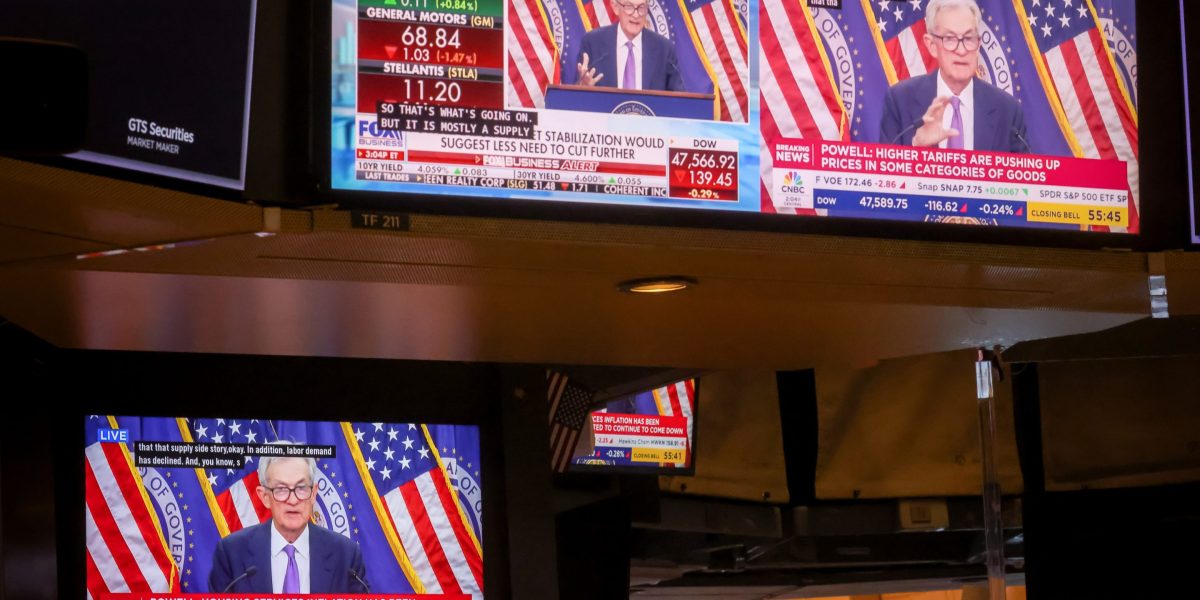
Core Points - The Federal Reserve has reduced interest rates for the first time since December, responding to rising unemployment risks and indicating further cuts may follow [1][3] - The current benchmark interest rate is now set in the range of 4.00%-4.25% [3] - Fed Chair Jerome Powell emphasized the importance of monitoring inflation while addressing maximum employment concerns [4] Economic Indicators - The job market is showing signs of weakness, with higher unemployment rates among minorities and a declining workweek [1][5] - Recent job creation is below the break-even rate needed to maintain the current unemployment rate, with minimal hiring from businesses [4][6] - Payroll growth is nearing stall speed, indicating a potential slowdown in the labor market [6] Political Context - The decision to cut rates was influenced by political dynamics, including President Trump's attempts to influence the Fed's Board of Governors [2][7] - New Fed Governor Stephen Miran cast a dissenting vote, reflecting differing views on the extent of necessary rate cuts [2]
Hermann: The economy is not in recession
Youtube· 2025-09-12 11:38
Economic Outlook - The economy is not in recession, and the expected easing from the Fed is likely to support market sentiment in the coming months, limiting equity market downside [3][12] - A strong earnings backdrop and positive forward earnings guidance from market leaders contribute to a constructive market setup for the next six months [2][3] Federal Reserve and Market Dynamics - The upcoming resumption of the Fed's easing cycle is a key focus, with expectations of a potential rate cut driven by weakness in the labor market [1][2] - Concerns about the independence of the Fed, particularly in light of political pressures, could impact market reactions, especially in the long end of the yield curve [5][6] Market Concentration and Valuation - The concentration of a few leading companies in the S&P 500, particularly the "MAG 7," is not viewed as a problem due to strong earnings supporting their valuations [7][8] - The artificial intelligence theme driving market leaders is seen as a less interest rate-sensitive factor, potentially shielding the market from disruptions related to easing expectations [8][9] Labor Market and Consumer Impact - Recent jobless claims have shown a slight increase, indicating potential weakness in the labor market, which could affect consumer spending [9][10] - A significant deterioration in the labor market is necessary to confirm a sustained easing cycle, with current inflation risks still present [11][12] Sector Analysis - Financials are identified as a potential beneficiary of expected rate cuts, particularly if a bull steepener occurs in the yield curve [14][15] - The financial sector may benefit from a more favorable net interest margin environment and potential financial deregulation in the coming months [15]