Lending rate cut

Search documents
Good news for borrowers: EMIs set to drop as these banks cut lending rates - Major banks cut lending rates
The Economic Times· 2025-12-22 06:36
Core Viewpoint - State Bank of India (SBI) has announced reductions in its External Benchmark Lending Rate (EBLR) and Repo Linked Lending Rate (RLLR), effective December 15, 2025, which is expected to lower EMIs for eligible customers [1][2] Group 1: EBLR Changes - SBI's EBLR has been reduced from 8.15% plus Credit Risk Premium (CRP) and Bank Spread (BSP) to 7.90% plus CRP and BSP, indicating a 25-basis-point cut in the benchmark component [1] Group 2: RLLR Changes - SBI's RLLR has been decreased from 7.75% plus CRP to 7.50% plus CRP, which is directly linked to the RBI's repo rate [2] - The final interest rate for borrowers will still depend on their individual risk profile and applicable spreads, but the reduction is anticipated to result in lower EMIs for eligible customers [2]


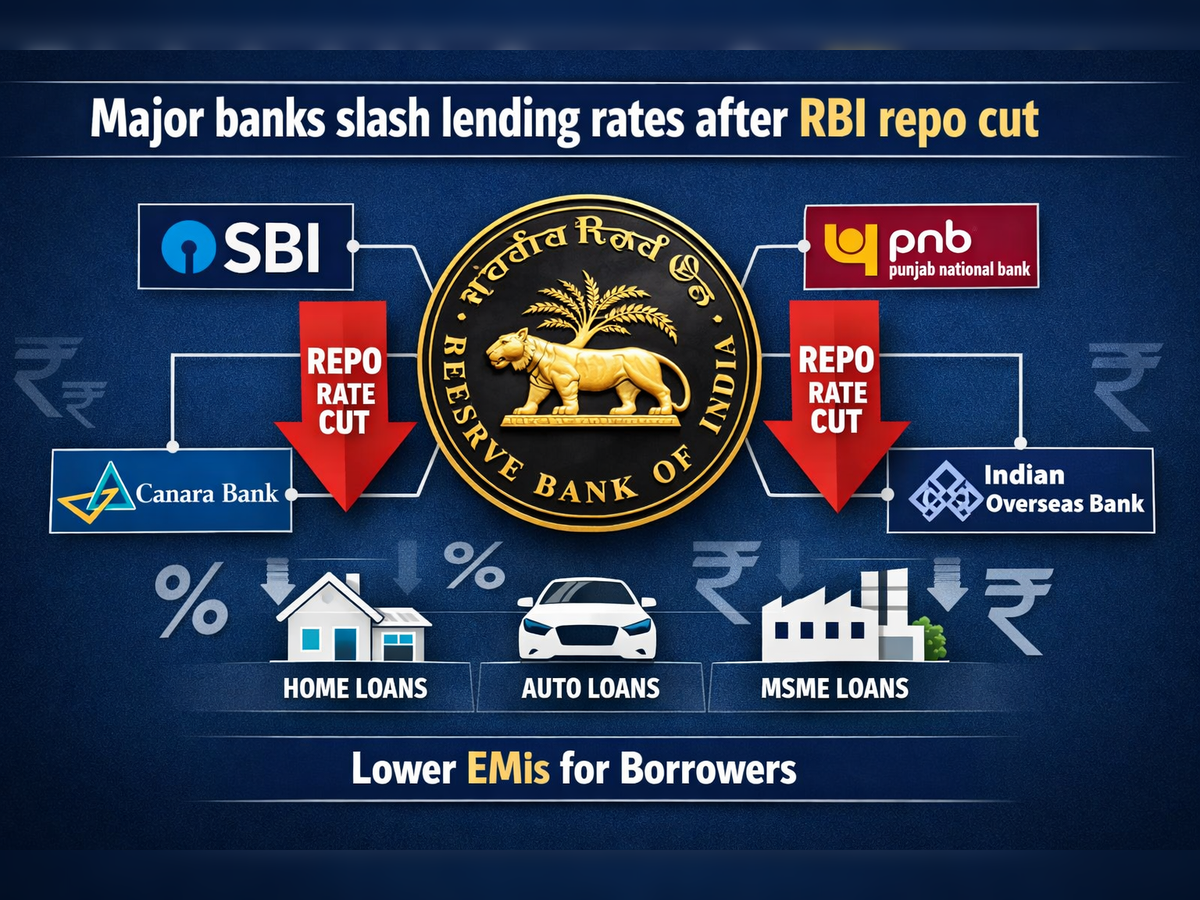
Major banks cut lending rates: After RBI trims repo rate, SBI, PNB, Canara Bank, and IOB lower borrowing costs
The Economic Times· 2025-12-17 11:58
Core Viewpoint - Several major banks in India have reduced their Repo Linked Lending Rates (RLLR) following a 25 basis point cut in the RBI's repo rate, leading to potential lower EMIs for borrowers [1][6]. Group 1: Canara Bank - Canara Bank has cut its RLLR by 25 basis points from 8.25% to 8%, effective December 12, 2025 [1]. - Existing borrowers will see a reduction in their EMIs or loan tenure based on their loan agreements [1]. Group 2: Punjab National Bank - Punjab National Bank has reduced its RLLR from 8.35% to 8.10%, effective December 6, 2025, including a bank spread of 10 basis points [1]. Group 3: Indian Overseas Bank - Indian Overseas Bank has revised its RLLR to 8.10%, effective December 15, 2025, with a one-year MCLR at 8.80% and a three-year MCLR at 8.85% [2]. Group 4: State Bank of India - State Bank of India has reduced its EBLR from 8.15% plus Credit Risk Premium (CRP) to 7.90% plus CRP, and its RLLR from 7.75% plus CRP to 7.50% plus CRP, effective December 15, 2025 [3]. - The final interest rate will depend on individual risk profiles and applicable spreads, but the cuts are expected to lower EMIs for eligible customers [3]. Group 5: Bank of Baroda - Bank of Baroda's effective BRLLR will decrease from 8.15% to 7.90%, effective December 6, 2025, providing slight relief to borrowers [4]. Group 6: Indian Bank - Indian Bank has reduced its RLLR from 8.20% to 7.95%, effective December 6, 2025 [5]. Group 7: Bank of India - Bank of India has cut its Repo Based Lending Rate (RBLR) from 8.35% to 8.10%, effective December 5, 2025, in response to the RBI's repo rate cut [6]. Group 8: Bank of Maharashtra - Bank of Maharashtra has reduced its home loan rates from 7.35% to 7.10% and car loan rates from 7.70% to 7.45%, waiving all processing fees on these loans [6].
SBI home loan EMIs to reduce as PSU bank cuts lending rates: Check latest SBI EBLR, MCLR, base rates
The Economic Times· 2025-12-13 02:33
Group 1: MCLR Adjustments - SBI has revised its Marginal Cost of Funds-based Lending Rate (MCLR) across various tenors, resulting in modest reductions for borrowers [1][6] - The overnight and one-month MCLR rates have been cut from 7.90% to 7.85% each, while the three-month rate has been trimmed from 8.30% to 8.25% [1][6] - The six-month MCLR now stands at 8.60%, down from 8.65%, and the one-year benchmark has been lowered from 8.75% to 8.70% [1][6] - Two-year and three-year MCLR rates have been reduced by 5 basis points each, now at 8.75% and 8.80% respectively [1][6] Group 2: EBLR and RLLR Adjustments - SBI has announced a reduction in its External Benchmark Lending Rate (EBLR) from 8.15% + Credit Risk Premium (CRP) + Bank Spread (BSP) to 7.90% + CRP + BSP, effective December 15, 2025 [3][5] - The benchmark portion of EBLR has decreased by 25 basis points, with the final rate depending on individual CRP and BSP [3][5] - The Repo Linked Lending Rate (RLLR) has been lowered from 7.75% + CRP to 7.50% + CRP, also reflecting a 25-basis point cut [4][5] Group 3: BPLR and Base Rate Adjustments - SBI has revised its Benchmark Prime Lending Rate (BPLR) to 14.65% per annum [6] - The Base Rate has been adjusted to 9.90%, effective December 15, 2025 [6] - These reductions in lending rates are expected to ease borrowing costs and lower EMIs for both retail and corporate customers [6]