Magnetic Separation

Search documents
First Atlantic Nickel to Attend North American Stainless & Special Alloys Conference 2025, Highlighting Pipestone XL Nickel Alloy Project's Smelter-Free Processing and Chromium Byproduct Potential for North America's Critical Alloys Supply Chain
Globenewswire· 2025-11-06 12:01
Core Insights - First Atlantic Nickel Corp. is participating in the North American Stainless & Special Alloys Conference 2025 to showcase its Pipestone XL Nickel Alloy Project, which addresses the increasing demand for nickel, cobalt, and chromium production in North America [1][2][4] - The Pipestone XL Project features awaruite, a naturally magnetic nickel-iron-cobalt alloy mineral with approximately 77% nickel content, allowing for simplified processing methods that reduce energy requirements and environmental impacts [1][6][17] - The discovery of awaruite in Newfoundland represents a significant advancement in addressing supply chain vulnerabilities for the North American stainless-steel industry, which relies heavily on critical minerals [2][5][8] Company Overview - First Atlantic Nickel Corp. is focused on developing the Pipestone XL Nickel Alloy Project, which spans a 30-kilometer area in Newfoundland & Labrador and contains significant deposits of awaruite and chromium [27][28] - The project aims to establish a secure and reliable source of nickel production for various industries, including stainless steel, electric vehicles, aerospace, and defense [28] Industry Context - The North American stainless-steel industry faces strategic vulnerabilities due to its reliance on imported critical minerals such as chromium and nickel, with U.S. net import reliance at 74% for chromium and 83% for nickel [8][9] - The U.S. Geological Survey emphasizes the importance of developing domestic sources of critical minerals to mitigate supply chain risks, particularly for stainless steel production [5][8] Technical Advantages - Awaruite's unique properties allow for smelter-free processing through magnetic separation and flotation, significantly reducing environmental impacts compared to traditional nickel processing methods [6][10][17] - Recent drilling results confirm the scale and consistency of mineralization at the Pipestone XL Project, with significant nickel grades and potential for high-grade concentrate production [12][13] Supply Chain Implications - The Pipestone XL Project enables complete domestic processing of critical minerals, reducing dependence on overseas smelting and enhancing supply chain resilience for North American stainless steel producers [9][10] - The concentration of global critical mineral supply creates vulnerabilities for producers in North America and other G7 economies, highlighting the need for secure domestic sources [9][11]


First Atlantic Nickel Reports Phase 2X Results from Pipestone XL Nickel Alloy Project: Drilling Proves 800 Meters of Newly Expanded 4km Target at RPM Zone, Doubling Strike Length
Globenewswire· 2025-10-23 08:01
Core Insights - First Atlantic Nickel Corp. has announced significant results from its Pipestone XL Nickel Alloy Project, particularly from drill hole AN-25-08, which has doubled the confirmed strike length of the RPM Zone to 800 meters and confirmed the continuity of awaruite nickel mineralization [1][4][13]. Group 1: Drill Results and Geological Insights - Drill hole AN-25-08 achieved an average of 1.35% nickel over 480 meters with a mass pull of 8.79%, resulting in a magnetically recoverable nickel grade of 0.12% [1][4][12]. - The RPM Zone now spans a 4-kilometer continuous target area, with 800 meters confirmed through Phase 2X drilling, indicating significant expansion potential [2][5][13]. - Drill hole AN-25-07, despite sub-optimal orientation, returned 0.97% nickel over 486 meters, providing valuable geological information about the westward-dipping system [6][21][22]. Group 2: Structural Understanding and Future Drilling - The refined understanding of the westward-dipping ultramafic body will optimize future drilling orientations, particularly emphasizing the need for eastward drilling to effectively test the mineralized structure [7][9][10]. - The systematic DTR surface sampling program has outlined multiple priority expansion opportunities within the 4-kilometer target area, including a 2-kilometer northern extension and a 1-kilometer southern extension [8][10][13]. Group 3: Metallurgical Testing and Critical Minerals - DTR testing has shown that chromium and cobalt are magnetically recovered alongside nickel, with chromium values ranging from 1.27% to 2.3% across drill holes, enhancing the project's strategic value [10][29][31]. - The ongoing metallurgical development program aims to optimize the recovery of these critical minerals, contributing to North American supply-chain security [10][31][41]. Group 4: Project Overview and Strategic Importance - The Pipestone XL Nickel Alloy Project is located within a 30-kilometer-long ultramafic ophiolite trend, characterized by disseminated awaruite mineralization, with only 20% of the target area currently drill-tested [37][38][41]. - The project aligns with North American critical mineral objectives, positioning it as a strategic asset for the domestic battery supply chain [38][43].

First Atlantic Nickel Reports Phase 2X Results from Pipestone XL Nickel Alloy Project: Drilling Proves 800 Meters of Newly Expanded 4km Target at RPM Zone, Doubling Strike Length
Globenewswire· 2025-10-23 08:01
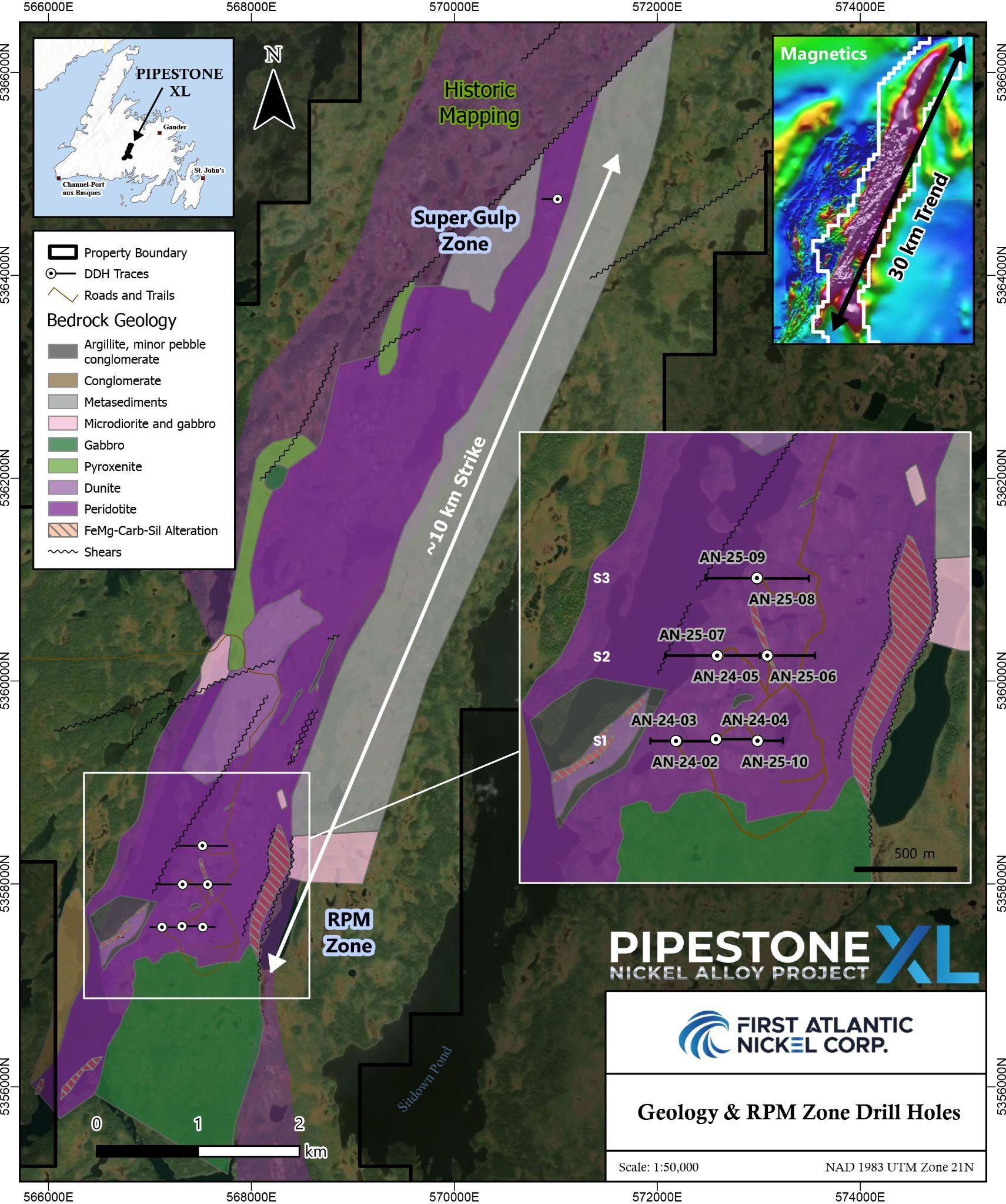
Core Insights - First Atlantic Nickel Corp. has reported significant drilling results from the Pipestone XL Nickel Alloy Project, confirming a 800-meter strike length of magnetically recoverable awaruite nickel mineralization within an expanded 4-kilometer target area. Group 1: Drill Results and Target Area Expansion - Drill hole AN-25-08 has successfully doubled the drill-confirmed strike length of the RPM Zone to 800 meters, returning 480 meters averaging 1.35% nickel in magnetic concentrate, with an average magnetically recoverable nickel grade of 0.12% over the entire drill hole [4][14]. - The RPM Zone now encompasses an expanded 4-kilometer continuous target area, with Phase 2X drilling confirming magnetically recoverable awaruite nickel mineralization in all holes drilled to date [5][14]. - The integration of Phase 2X drilling results with surface sampling and geological mapping has refined the understanding of the westward-dipping ultramafic body hosting awaruite mineralization, indicating significant expansion potential in the remaining ~3.2 kilometers of the target area [3][5]. Group 2: Metallurgical Testing and Critical Minerals - Davis Tube Recovery (DTR) testing has shown that chromium and cobalt are magnetically recovered alongside nickel, with chromium values ranging from 1.27% to 2.3% across drill holes at the RPM Zone [11][27]. - The ongoing metallurgical development program aims to optimize magnetic separation processes to produce high-grade nickel concentrates while assessing the potential to recover chromium and cobalt as valuable byproducts, enhancing the strategic value of the project [11][29]. - The co-recovery of multiple critical minerals through simple magnetic processing could contribute to North American supply-chain security and reduce reliance on foreign sources [11][29]. Group 3: Future Drilling and Structural Understanding - The refined understanding of the westward-dipping structure from Phase 2X drilling will be applied to retarget the Super Gulp Zone, located ~10 kilometers north of the RPM Zone, with future eastward-oriented drilling expected to effectively test the true width of the mineralized structure [10][22]. - The successful results from drill holes AN-25-07 and AN-25-08 have confirmed the need for eastward-oriented drilling to optimize future exploration efforts across the project [7][10].
First Atlantic Nickel Announces Expanded 4-Kilometer Strike Length at RPM Zone from DTR Surface Sampling at Pipestone XL Nickel Alloy Project
Globenewswire· 2025-10-21 10:00
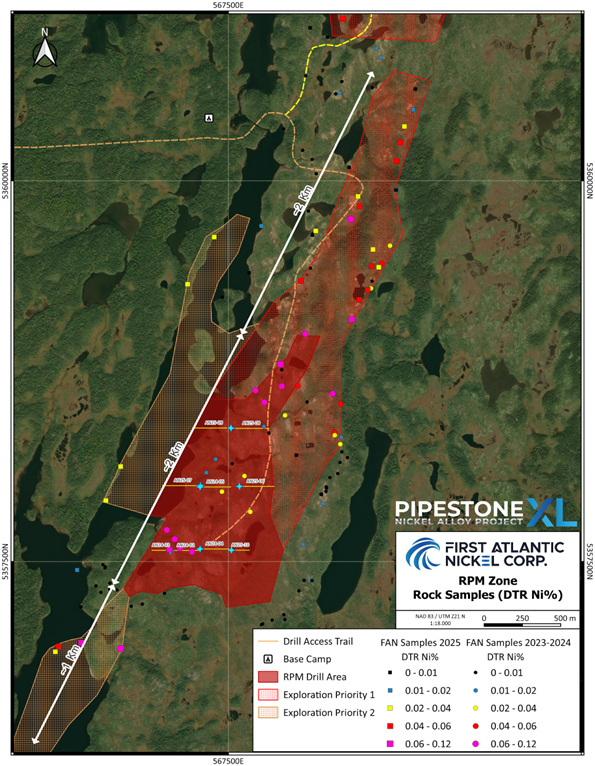
Core Insights - First Atlantic Nickel Corp. has successfully expanded the RPM Zone target area to a continuous 4-kilometer strike length within the 30-kilometer nickel trend at its Pipestone XL Nickel Alloy Project, confirming awaruite mineralization over a north-south strike length of 800 meters [1][4][5] Group 1: Exploration and Sampling Results - The systematic DTR surface sampling program has doubled the strike length of the RPM Zone target area to approximately 4 kilometers, with an additional 2 kilometers of continuous mineralization identified to the north [4][5] - Surface sampling results from the northern extension show comparable DTR nickel values to the initial RPM discovery area, with an average DTR grade of 0.12% magnetically recoverable nickel [2][6] - A new southern extension of approximately 1 kilometer has been identified, where previously mapped volcanic units have been reclassified as ultramafic peridotites hosting awaruite mineralization [8][9] Group 2: Geological Insights and Future Drilling Plans - Phase 2X drilling and geological mapping have defined a westward-dipping ultramafic structure hosting awaruite nickel mineralization, indicating that future drilling will target eastward to effectively test the true width of the mineralized zone [5][11] - A regional deformation structure beneath Pipestone Pond has been interpreted, providing a new structural framework that opens additional exploration opportunities for both north-south strike extensions and further expansion westward [13][14] - Positive DTR results from peridotite outcrops west of Pipestone Pond have expanded the potential RPM target width to approximately 1.2 kilometers, significantly broader than the previously defined 750-meter width [9][10] Group 3: Awaruite Characteristics and Strategic Importance - Awaruite, a naturally occurring nickel-iron-cobalt alloy, has an average nickel grade of approximately 76%, significantly exceeding the typical 25% nickel grade of pentlandite, making it easier to concentrate [21][22] - The sulfur-free nature of awaruite eliminates the need for conventional processing methods, reducing environmental impacts and enhancing the potential for sustainable nickel production [22][30] - The U.S. Geological Survey has recognized the strategic importance of awaruite deposits, noting their potential to alleviate prolonged nickel concentrate shortages [31]
First Atlantic Nickel Doubles RPM Zone Strike Length to 800 Meters at Pipestone XL Nickel Alloy Project with 491 Meter Awaruite (Ni3Fe) Intercept in Phase 2X Drilling
Globenewswire· 2025-09-25 08:30
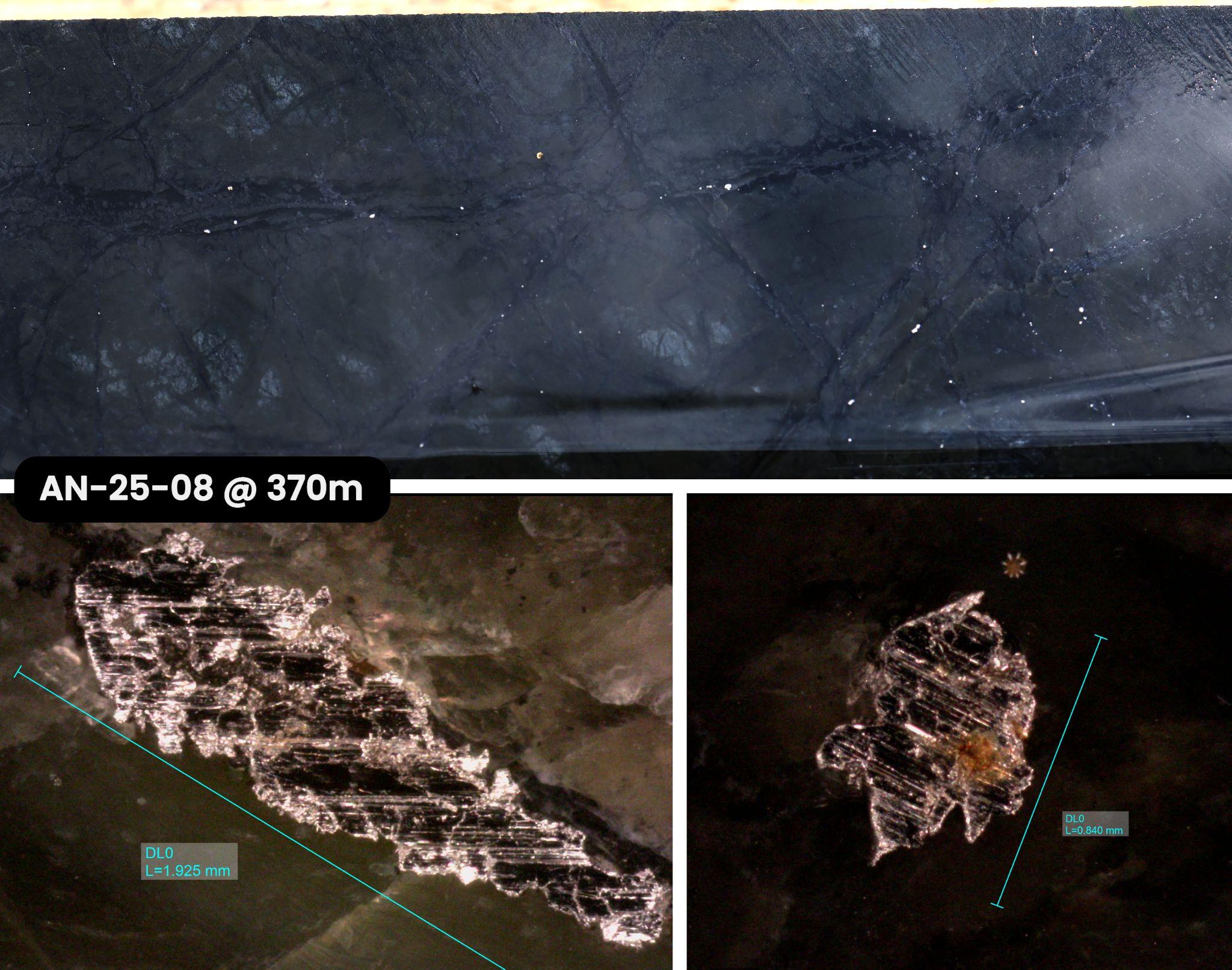
Core Insights - First Atlantic Nickel Corp. has reported significant progress in its Phase 2X drilling program at the Pipestone XL Nickel Alloy Project, confirming the continuity of awaruite mineralization with drill hole AN-25-08 intersecting 491 meters of large grain, visibly disseminated awaruite, extending the RPM Zone strike length to 800 meters, which is double the length drilled in Phase 1 [1][8][34] Drilling Results - Drill hole AN-25-08 on Line S3 has successfully established an 800-meter continuous north-south strike length at the RPM Zone, marking a 2X increase from the original Phase 1 discovery [8] - The intersection contains the largest disseminated awaruite grains identified to date, with individual grains reaching up to approximately 2,000 microns in length, which is double the previous record of 1,000 microns [7][8] - The Phase 2X drilling has confirmed continuous awaruite mineralization across three drill sections (S1, S2, and S3), each spaced approximately 400 meters apart, with the RPM Zone remaining open in all directions [2][8] Metallurgical Testing - Davis Tube Recovery (DTR) testing from the RPM Zone has returned magnetic concentrate grades averaging 1.38% nickel and 1.67% chromium, with an average DTR nickel grade of 0.12% and a mass pull of 9.08% [3][8] - The DTR testing results indicate robust mineralization and enhanced magnetic recovery potential due to the distinctive chain formation of awaruite grains migrating into magnetite veining [7][8] Geological Insights - The updated geological model suggests that the Pipestone Ophiolite Complex consists of laterally extensive layers of peridotites or harzburgites that dip to the west, with optimal drill orientation considered to be east-dipping at angles between 45-65 degrees [17][18] - Initial east-dipping drill holes have intersected higher concentrations of awaruite nickel mineralization in harzburgites compared to dunites, providing a more complete profile of the deposit [19] Future Plans - The Phase 2X program is designed to test beyond a 1-kilometer strike length, with multiple updates on drilling and project developments expected in the coming weeks [8][34]
First Atlantic Nickel Doubles RPM Zone Strike Length to 800 Meters at Pipestone XL Nickel Alloy Project with 491 Meter Awaruite (Ni3Fe) Intercept in Phase 2X Drilling
Globenewswire· 2025-09-25 08:30
Core Insights - First Atlantic Nickel Corp. has reported a significant drill hole intersection of 491 meters of visibly disseminated awaruite mineralization at the RPM Zone within its Pipestone XL Nickel Alloy Project, extending the strike length to 800 meters, which is double the length drilled during Phase 1 [1][8][6] Drilling and Mineralization - The Phase 2X drilling program is expanding the RPM Zone with long intersections of visibly disseminated awaruite mineralization, confirming continuity across three drill sections spaced approximately 400 meters apart [2] - Drill hole AN-25-08 has established an 800-meter north-south strike length at the RPM Zone, with the largest disseminated awaruite grains identified to date, reaching up to ~2,000 microns in length, which is double the previous record [6][7][8] Metallurgical Testing - Samples from Phase 2X drill holes have been submitted for whole-rock assay analysis and Davis Tube Recovery (DTR) metallurgical testing, with DTR testing returning average magnetic concentrate grades of 1.38% nickel and 1.67% chromium [3][8] - The average DTR nickel grade calculated across all reported drill holes is 0.12%, with a mass pull of 9.08% [3][8] Geological Model and Exploration - A new geological model suggests that the Pipestone Ophiolite Complex consists of laterally extensive layers of peridotites or harzburgites, with optimal drill orientation being east-dipping at angles between 45-65 degrees to better test the mineralized zones [18][19] - Initial east-dipping drill holes have intersected higher concentrations of awaruite nickel mineralization in harzburgites compared to dunites, providing a more complete profile of the deposit [20] Future Plans and Updates - The Phase 2X program aims to test beyond a 1-kilometer strike length, with multiple updates on drilling and project developments expected in the coming weeks [8][2] - The company is positioned to meet the growing demand for responsibly sourced nickel, aligning with new US Electric Vehicle requirements that stipulate no critical minerals processed by foreign entities [37][38]
First Atlantic Nickel Reports 366 Meters of 1.46% Nickel in Magnetic Concentrate From Third RPM Zone Step-Out Drill Hole, Opening Eastern Expansion Discovery Potential
Globenewswire· 2025-06-24 13:00
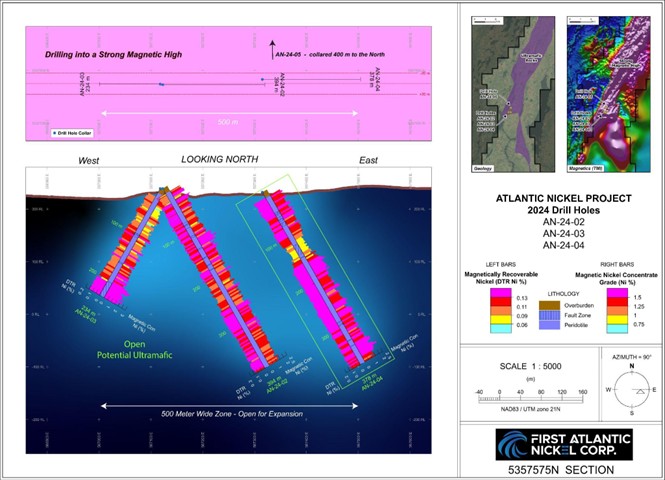
Core Insights - First Atlantic Nickel Corp. announced positive Davis Tube Recovery (DTR) metallurgical test results from drill hole AN-24-04, indicating significant nickel and chromium grades in the RPM Zone of the Atlantic Nickel Project [1][6][7] - The results from the first three drill holes demonstrate consistent metallurgical performance, confirming a lateral width of at least 500 meters of disseminated awaruite mineralization [2][6][8] - Awaruite's unique properties allow for environmentally sustainable magnetic separation, eliminating the need for energy-intensive smelting processes, thus enhancing the potential for a secure domestic nickel supply chain [3][17][20] Summary by Sections Drill Results - Drill hole AN-24-04 returned 366 meters averaging 1.46% nickel and 1.56% chromium in magnetic concentrate, with peak grades reaching 2.42% nickel and 4.59% chromium [1][6][7] - The average mass pull for this hole was 9.53%, indicating effective magnetic separation [6][8] - The first three drill holes have shown consistent results, with grades of 1.37%, 1.32%, and 1.46% nickel, and mass pulls of 9.49%, 9.12%, and 9.53% respectively [2][6] Mineralization and Expansion Potential - The DTR results confirm a mineralized footprint of approximately 500 meters in width, with drill hole AN-24-04 establishing the eastern direction toward Chrome Pond as a high-priority target for further exploration [2][16] - The ongoing Phase 2 drilling program aims to expand the mineralization in all directions, supported by improved infrastructure and equipment optimizations [16][29] Awaruite Characteristics and Processing - Awaruite, a nickel-iron alloy with approximately 75% nickel, can be processed through magnetic separation, avoiding the costly and environmentally harmful smelting processes required for traditional nickel ores [3][17] - This processing method aligns with the U.S. Inflation Reduction Act's requirements for critical minerals, potentially benefiting North American electric vehicle manufacturers [17][20] Strategic Importance - The development of awaruite resources is crucial for reducing dependence on foreign nickel processing, particularly from countries like China, which dominate the global nickel market [20][29] - Awaruite's cleaner processing methods could enhance the resilience and security of North America's critical minerals supply chain, particularly for the stainless steel and electric vehicle industries [20][29]
First Atlantic Nickel Extends Strike Length of RPM Zone Discovery by 400 Meters, Intersecting .23% Nickel Over 396 Meters in Fourth Drill Hole
GlobeNewswire News Room· 2025-05-14 10:00
Core Insights - First Atlantic Nickel Corp. has reported positive assay results from drill hole AN-24-05, confirming a 400-meter north-south mineralized strike length at the RPM Zone, with an average of 0.23% nickel and 0.29% chromium over 396 meters [1][4][7] - The Phase 1 drilling program has established a 400-meter by 500-meter mineralized footprint at the RPM Zone, with all four drill holes ending in mineralization, indicating significant potential for further expansion [2][5][11] - Phase 2 drilling commenced on May 7, 2025, targeting extensions of the RPM Zone in multiple directions, with ongoing metallurgical testing to assess the suitability of the mineralization for commercial processing [2][10][17] Phase 1 Drilling Results - Drill hole AN-24-05 intersected 396 meters grading 0.23% nickel and 0.29% chromium, starting after 6 meters of overburden [4][6] - The hole reached a total depth of 402 meters and ended in mineralization, indicating further expansion potential [4][7] - Awaruite mineralization was consistently observed across all Phase 1 holes, reinforcing the potential for additional discoveries [5][22] Phase 2 Drilling Program - The fully funded Phase 2 program aims to expand the mineralized footprint established in Phase 1, with strategic step-out drilling planned in various directions [10][11] - The program will explore deeper mineralization and assess geological continuity between the RPM Zone and nearby areas [12][11] - Enhanced drilling capabilities and full road access are expected to improve efficiency and reduce costs during the Phase 2 program [11][10] Metallurgical Testing - Davis Tube Recovery (DTR) testing is underway for drill holes AN-24-04 and AN-24-05 to evaluate magnetically recoverable nickel content [17][22] - Initial DTR results from earlier holes indicated an average of ~1.35% nickel in magnetic concentrates, supporting a low-energy processing approach [17][22] - The processing method aligns with sustainable development objectives and North America's critical minerals strategy, particularly in light of new regulations under the US Inflation Reduction Act [22][31] District-Scale Potential - The RPM Zone is part of a 30-kilometer ultramafic ophiolite nickel trend, with significant exploration upside across the region [2][5] - Historical drilling and recent discoveries have confirmed the presence of awaruite mineralization across a 26-kilometer strike length within the Atlantic Nickel Project [5][22] - Awaruite's unique properties allow for cleaner processing compared to conventional nickel sources, enhancing North America's domestic critical minerals supply chain [22][25]