Market Value Reconstruction

Search documents
深圳楼市刚需仍是主力!4万/㎡占比最大
Sou Hu Cai Jing· 2026-02-06 19:41
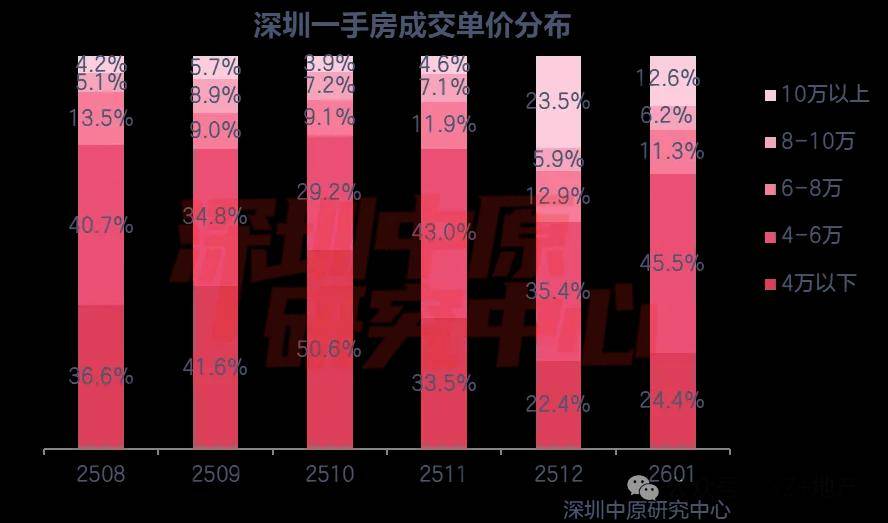
Core Viewpoint - The Shenzhen real estate market in January 2026 shows a significant shift towards residential properties, which dominate the market despite an overall decline in new home transactions, indicating a change in buyer sentiment and market confidence [1][2]. Group 1: New Home Market Performance - The total number of new home transactions in January was only 1,692 units, a substantial month-on-month decline of 34.9% [1]. - Luxury homes saw a drastic drop in transactions, with only 229 units sold, down 71.7% from the previous month, while business apartments fell by 86.9% with only 56 units sold [1]. - Residential properties accounted for 88.6% of total transactions, with 1,499 units sold, despite a slight month-on-month decrease of 9.4% [1][2]. Group 2: Supply and Pricing Dynamics - Only 8 new projects were launched in January, a decrease of 14 from the previous month, with only 4 being residential [2]. - The average selling price of new residential properties was 81,208 yuan per square meter, showing a slight decline but remaining high [2]. - The inventory of new residential properties reached 3.187 million square meters, with a depletion cycle extending to 16.34 months, an increase of 1.04 months from the previous month [2]. Group 3: Transaction Structure and Buyer Behavior - The price range of 40,000 to 60,000 yuan per square meter accounted for 45.5% of transactions, a significant increase of 10.2% month-on-month, indicating a shift towards more affordable housing [3]. - The segment of homes priced between 300,000 to 500,000 yuan led the market with a 41.3% share, reflecting the demand from the new middle class in Shenzhen [5]. - The second-hand housing market saw a rise in transactions, with 5,281 units sold, a 6.9% increase, marking the highest level in nine months [5]. Group 4: Market Trends and Future Outlook - The market is experiencing a structural shift from high-end luxury properties to more affordable options, driven by tighter credit conditions and a focus on asset liquidity [5]. - The second-hand market is showing signs of recovery, with increased transaction volumes despite a decline in the leading index [5][7]. - As the Spring Festival approaches, new supply is expected to remain low, potentially leading to a seasonal decline in transaction volumes in February [2][7].