Micro LED转印工艺

Search documents
香港科技大学开发新型MicroLED转印工艺
WitsView睿智显示· 2026-03-31 04:31
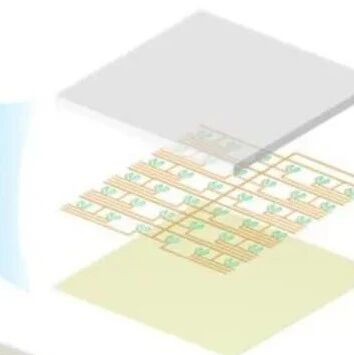
Core Viewpoint - A new Micro LED transfer process has been developed by a research team at Hong Kong University of Science and Technology (Guangzhou), utilizing a dynamic programmable transfer head and localized heating to control the viscosity of polymers [2]. Group 1: Technology Development - The new tool can selectively handle various geometrical shapes of devices, addressing critical issues in constructing complex microsystems [4]. - The transfer system has been proven to selectively sort and transfer Micro LEDs sized 45×25 micrometers, arranging them into custom layouts without degrading performance [4]. - The research team successfully transferred semiconductor chips, 90-nanometer thick copper films, and 50-micrometer diameter polystyrene microspheres with high placement accuracy, achieving a positional deviation of less than 0.7 micrometers and a rotational error of less than 0.04 radians [4]. Group 2: Mechanism and Process - A special polymer was formulated that undergoes a rapid physical transition at 44 degrees Celsius, changing from a rigid plastic state to a rubber state [4]. - During the transfer process, the stamp is pressed against the device array, activating specific heaters to melt the polymer in approximately 60 milliseconds, allowing it to bond with the selected chip [4]. - The polymer cools and hardens in about 40 milliseconds, physically locking the chip in place, and can be reactivated to release the chip when needed, with an adhesion strength ratio exceeding 190:1 [4]. Group 3: Future Research Directions - The research team is exploring ways to scale up the micro-heater array, facing challenges such as thermal crosstalk due to densely packed heaters [5]. - To address this issue, researchers plan to use thinner polymer layers and introduce active matrix driving circuits, similar to those used in commercial flat-panel TVs, to manage large-scale arrays without overly complex wiring [5].