Overbought territory

Search documents
Dollar slump lifts precious metals complex to fresh high
BusinessLine· 2026-01-28 14:44
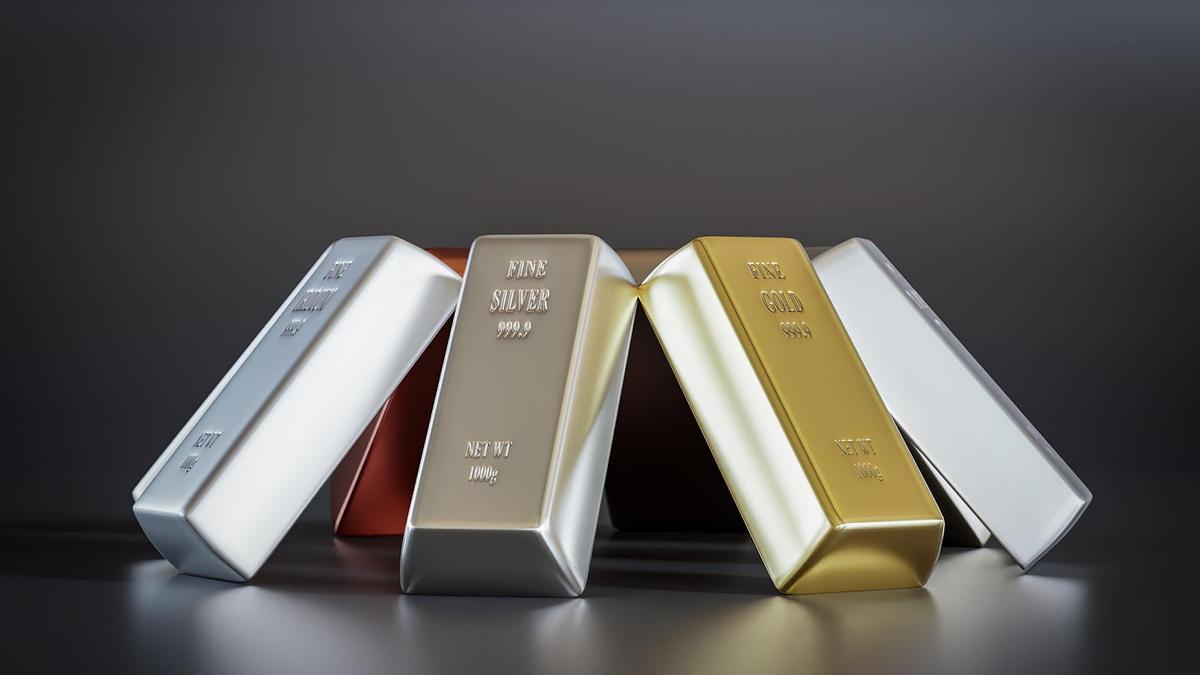
Core Viewpoint - The decline of the dollar to a four-year low has provided momentum for precious metals, with mixed reactions from analysts regarding future price movements [1] Precious Metals Prices - Gold reached $5,295 per ounce, with April futures peaking at $5,344 before settling [2] - Silver prices fluctuated, starting over $115 per ounce and ending at $113.93, while March futures were at $114.20 [3] - Platinum recovered to $2,655.50 per ounce after a significant drop, and palladium rose to $2,015.50 [3] Price Forecasts - BMI has raised its gold price forecast for 2026 to an average of $4,600 per ounce, expecting it to remain between $4,500 and $5,500 in the coming weeks [4] - Goldman Sachs indicated a potential upside risk to its gold forecast of $5,400 per ounce by December 2026, while Deutsche Bank suggested prices could reach $6,900 [6] - Société Générale anticipates gold at $6,000 per ounce by the end of 2026, and Morgan Stanley sees potential for prices to exceed $5,700 [6] Market Dynamics - The silver market remains tight, with elevated implied lease rates near 3%, indicating strong demand [8] - In India, retail demand for silver is increasing, but the gold-to-silver ratio is at a four-year low, suggesting silver may be expensive relative to gold [9] - BMI expects silver prices to ease as supply tightness diminishes and industrial demand peaks, particularly from China's solar industry [10] Speculative Interest - Citigroup forecasts that spot silver could surge to $150 per ounce in the next three months, driven by Chinese buying [11] - Analysts describe silver as "gold squared," indicating its heightened volatility and potential for significant price movements [12] Year-to-Date Performance - Year-to-date gains for precious metals include gold up 22%, silver up 58%, platinum up 28%, and palladium up 19% [13]


What's Next For Garmin Stock?
Forbes· 2025-08-01 10:10
Core Insights - Garmin has regained attention due to a significant Q2 earnings beat and an elevated full-year guidance, despite a recent stock decline of approximately 5% [2][4] - The stock's decline is attributed to profit-taking and technical fatigue after a nearly 30% surge since April, moving into overbought territory [5][6] - Analysts express caution regarding potential deceleration in the second half of the year, despite the company's optimistic outlook [6] Financial Performance - Garmin reported Q2 FY2025 revenue of $1.81 billion, a 20% year-over-year increase, with adjusted EPS of $2.17, surpassing Wall Street predictions [4] - The company upgraded its full-year forecast to $7.1 billion in revenue and $8.00 in EPS [4] - Over the past three years, Garmin has achieved an 8.7% compound annual growth rate in revenue, with a recent 12-month revenue growth of 18.1% to $6.5 billion [8] Valuation Metrics - Garmin's P/E ratio is 27.3, compared to 22.8 for the S&P 500, indicating a premium valuation [7] - The P/S ratio stands at 6.6 versus the S&P's 3.1, and the price-to-free cash flow ratio is 35.0 compared to 20.3 [7] - The current stock price reflects much of the positive news already, suggesting a stretched valuation [7] Financial Stability - Garmin's operating margin is 25.2% and net margin is 22.8%, significantly exceeding S&P 500 averages [8] - The company has a cash-to-assets ratio of 27.3% and a low debt-to-equity ratio of 0.3%, indicating strong financial stability [8] Historical Performance - Garmin's stock has historically faced challenges during market downturns, with a 56% decline post-2022 inflation shock, exceeding the S&P 500's 25.4% drop [9] - During the COVID-19 crash in 2020, Garmin shares fell 38.6%, again surpassing the broader market's decline [9] - The stock experienced an 87.7% retreat during the 2008 financial crisis, significantly worse than the S&P's 56.8% decline [9] Long-Term Outlook - Garmin is recognized for its growth, profitability, and financial health, but the short-term outlook appears less attractive following a significant surge [10] - The recent stock decline is viewed as a reassessment of inflated valuations rather than a reflection of business weaknesses [10] - Garmin remains a high-quality name for long-term investment despite short-term volatility [10]