Post-GLP-1 weight maintenance

Search documents
Fractyl Health(GUTS) - 2025 Q4 - Earnings Call Transcript
2026-03-24 21:32
Financial Data and Key Metrics Changes - Research and development expenses decreased to $16.5 million for Q4 2025 from $20.3 million in Q4 2024, primarily due to strategic reprioritization and reduced costs associated with the pausing of the Revitalize-1 study [24] - SG&A expenses increased to $6.8 million for Q4 2025 from $4.9 million in Q4 2024, mainly due to underwriter's commissions related to financing [24] - The net loss for Q4 2025 was $43.7 million compared to $25 million in Q4 2024, with a significant portion of the increase attributed to a non-cash accounting change [25] - Adjusted EBITDA improved to -$21.2 million for Q4 2025 from -$22.1 million in Q4 2024, reflecting a decrease in operating expenses [25] - As of December 31, 2025, the company had approximately $81.5 million in cash and cash equivalents, expected to fund operations into early 2027 [25][26] Business Line Data and Key Metrics Changes - Revita is positioned as a solution for maintaining weight loss after GLP-1 therapy discontinuation, with a focus on a specific patient population that shows a strong treatment effect [4][20] - The pivotal study has enrolled over 300 participants across more than 30 sites, making it the largest sham-controlled GI endoscopy pivotal trial conducted [18] Market Data and Key Metrics Changes - The anticipated population on GLP-1 drugs is projected to exceed 30 million in the coming years, with over 50% expected to lose more than 17.5% of their total body weight [20] - The payer landscape is evolving, with expanded Medicare coverage of GLP-1s increasing the addressable patient population while also intensifying economic pressures on payers [20] Company Strategy and Development Direction - The company aims to submit a de novo classification request for Revita by late Q4 2026, with favorable FDA feedback received on the safety profile [19][20] - Revita is the first FDA breakthrough device designed for post GLP-1 weight maintenance, addressing a significant unmet need in the market [20] - The company plans to file a Category III CPT code application in summer 2026, with expectations for it to be effective by summer 2027 [21][62] Management's Comments on Operating Environment and Future Outlook - Management expressed confidence in the clinical signal of Revita, highlighting a strong dose-response relationship and a clear target population for treatment [28] - The pivotal study is designed to succeed with strong powering and an optimized cohort of patients, aiming for a positive outcome [28] - The company is committed to operating within its existing capital envelope until pivotal data is available, signaling alignment with shareholders [27][28] Other Important Information - The Rejuva program, targeting long-term metabolic remission from a single dose, is advancing with clinical trial applications submitted in the EU and Australia [22] - The company anticipates several key milestones in 2026, including pivotal data readouts and regulatory feedback [23] Q&A Session Summary Question: How is the ablation length determined? - Ablation length is calculated based on the total amount of duodenum ablated during the procedure, with a target minimum of 16 cm established for future procedures [31][33] Question: Does this impact how doctors will be trained in the future? - Physicians are trained to perform at least 10 cm of ablation, with the expectation that they can consistently achieve greater than 14 cm based on the data [34] Question: What is the role of efficacy in the de novo submission? - The de novo pathway determination is primarily a safety consideration, with efficacy being assessed as reasonable assurance of safety and effectiveness [39] Question: How long does it take to train physicians for the procedure? - Training takes less than three to four cases for physicians to perform adequate ablations, with consistency improving as they gain experience [56] Question: Will there be further analysis by length for the REMAIN-1 midpoint cohort? - Yes, further analysis by length will be provided in the upcoming data readouts [60] Question: What is the timeline for the CPT code filing? - The company plans to file for a Category III CPT code in June 2026, with an expected effective date in summer 2027 [62]

Fractyl Health(GUTS) - 2025 Q4 - Earnings Call Transcript
2026-03-24 21:30
Financial Data and Key Metrics Changes - Research and development expenses decreased to $16.5 million for Q4 2025 from $20.3 million in Q4 2024, primarily due to strategic reprioritization and lower personnel-related costs [24] - SG&A expenses increased to $6.8 million for Q4 2025 from $4.9 million in Q4 2024, mainly due to underwriter's commissions from financing [24] - The net loss for Q4 2025 was $43.7 million compared to $25 million in Q4 2024, with a significant portion of the increase attributed to a non-cash accounting change [25] - Adjusted EBITDA improved to negative $21.2 million for Q4 2025 from negative $22.1 million in Q4 2024, reflecting a decrease in operating expenses [25] - As of December 31, 2025, the company had approximately $81.5 million in cash and cash equivalents, expected to fund operations into early 2027 [25] Business Line Data and Key Metrics Changes - Revita, the lead asset, is positioned as a solution for maintaining weight loss after GLP-1 therapy discontinuation, with a focus on a pivotal study designed to validate its efficacy [4][5] - The REMAIN-1 pivotal study has enrolled over 300 participants across more than 30 sites, making it the largest sham-controlled GI endoscopy pivotal trial conducted [17] Market Data and Key Metrics Changes - The anticipated filing via the de novo pathway is expected to coincide with a growing population of over 30 million users of GLP-1 drugs, with more than 50% likely to lose over 17.5% of their total body weight [19] - The payer landscape is evolving, with expanded Medicare coverage for GLP-1s, increasing the addressable patient population and creating economic pressure on payers [20] Company Strategy and Development Direction - The company aims to submit a de novo classification request by late Q4 2026, with favorable FDA feedback received on its safety profile [18] - Revita is positioned as the first FDA breakthrough device designed for post GLP-1 weight maintenance, addressing a significant unmet need in the market [20] - The Rejuva program is advancing separately, targeting long-term metabolic remission from a single dose, with clinical trial applications submitted in the EU and Australia [22] Management's Comments on Operating Environment and Future Outlook - Management expressed confidence in the clinical signal of Revita, highlighting a strong dose-response relationship and a well-structured pivotal study [27] - The company is committed to operating within its existing capital envelope without planned incremental capital raises before pivotal data is available [27] - Management anticipates delivering top-line six-month primary endpoint data in early Q4 2026, which is considered a critical milestone for the company [24][27] Other Important Information - The company plans to file a Category III CPT code application in summer 2026, with expectations for it to take effect in summer 2027 [20] - Transitional Pass-Through Payment via CMS is expected to provide a mechanism to cover the cost of the Revita device, ensuring hospitals can maintain a positive contribution margin [21] Q&A Session Summary Question: How is the ablation length determined? - Ablation length is determined during the procedure, with a target minimum of 16 centimeters established based on previous studies [31][33] Question: Does this impact how doctors will be trained in the future regarding ablation length? - Physicians were trained to perform at least 10 centimeters of ablation, with the expectation that they can consistently achieve greater than 14 centimeters based on the data [34] Question: What role does efficacy play in the de novo submission? - The de novo pathway determination is primarily a safety consideration, with efficacy being assessed under a reasonable assurance of safety and effectiveness [39] Question: How long does it take to train physicians for the procedure? - Training takes less than 3-4 cases to ensure physicians can perform adequate ablation [57] Question: Will there be further analysis by length for the one-year REMAIN midpoint cohort? - Yes, further analysis by length will be provided [62]
Fractyl Health Announces Groundbreaking Data from REMAIN-1 Midpoint Cohort Showing Revita® Maintained Weight Loss After GLP-1 Discontinuation
Globenewswire· 2025-09-26 11:00
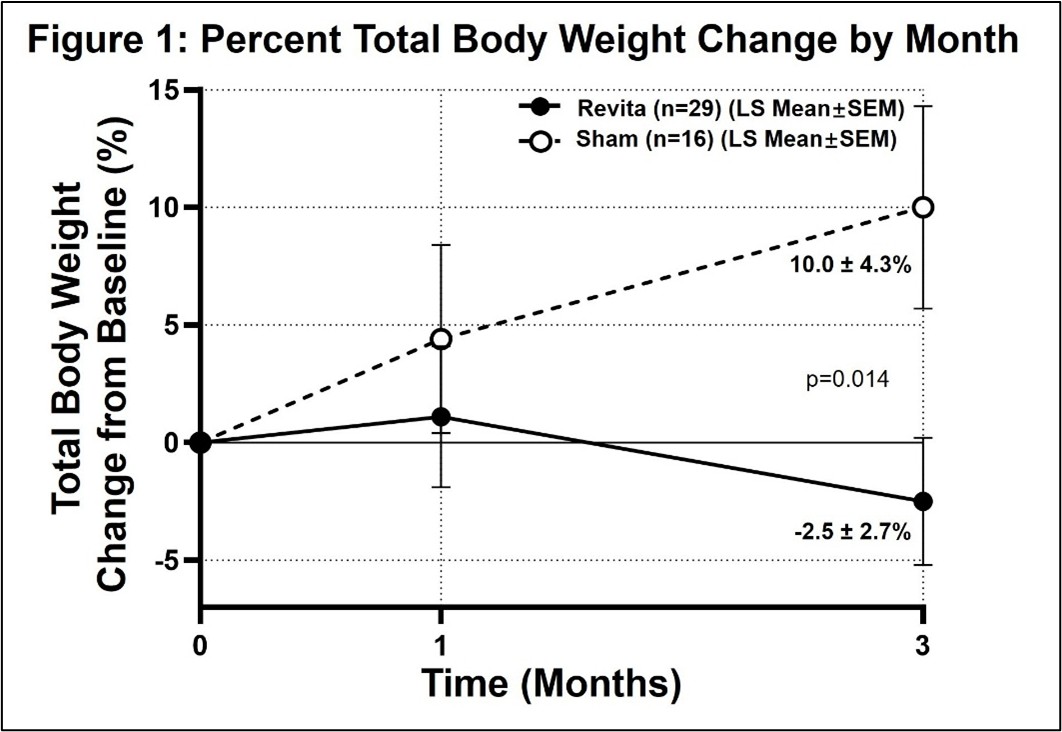
Core Insights - Fractyl Health, Inc. announced significant results from the REMAIN-1 Midpoint Cohort, indicating that Revita may be the first therapy to maintain weight loss after discontinuation of GLP-1 drugs, with Revita-treated patients losing an additional 2.5% total body weight compared to a 10% regain in sham-treated patients, achieving statistical significance (p=0.014) [2][3][8] Study Design and Results - The REMAIN-1 Midpoint Cohort involved 45 participants who had lost at least 15% of their body weight with tirzepatide, randomized to receive either Revita or a sham procedure after stopping the drug [4] - The study met its primary efficacy endpoint at 3 months, showing Revita's effectiveness in promoting further weight loss while ensuring excellent safety and tolerability, with no serious adverse events reported [8][10] Future Milestones - The ongoing REMAIN-1 Midpoint Cohort is expected to provide 6-month data in Q1 2026, while the Pivotal Cohort aims to complete randomization in early 2026, with topline primary endpoint data and potential PMA filing anticipated in H2 2026 [11]