Presidential authority

Search documents
Meet the Press NOW — February 20
NBC News· 2026-02-20 22:58
WELCOME TO MEET THE PRESS NOW, I'M MELANIE ZANONA IN WASHINGTON, WHERE THE PRESIDENT IS LASHING OUT AT THE SUPREME COURT, THREATENING TO USE HIS POWER TO DESTROY ECONOMIC RIVALS AND VOWING A GLOBAL TARIFF IN RESPONSE TO THE SUPREME COURT TODAY DEALING A SERIOUS BLOW TO HIS SIGNATURE ECONOMIC POLICY, STRIKING DOWN MOST OF THE TARIFFS THAT HIS ADMINISTRATION HAS IMPOSED. THE RULING RAISING MANY QUESTIONS ABOUT WHAT COMES NEXT FOR THE WHITE HOUSE'S ECONOMIC AGENDA, AND ALSO WHAT HAPPENS TO THE BILLIONS OF DOLL ...

Trump ‘absolutely fuming’ after Supreme Court ruling striking down tariffs
NBC News· 2026-02-20 22:48
Welcome to Meet the Press Now. I'm Melanie Zona in Washington where the president is lashing out at the Supreme Court, threatening to use his power to destroy economic rivals and vowing a global tariff in response to the Supreme Court today dealing a serious blow to his signature economic policy, striking down most of the tariffs that his administration has imposed. The ruling raising many questions about what comes next for the White House's economic agenda and also what happens to the billions of dollars ...
Three Things Investors Are Watching as the Supreme Court Hears Trump v. Cook
Barrons· 2026-01-20 22:48
Core Viewpoint - The Supreme Court case Trump v. Cook is seen as a significant test of the Federal Reserve's independence from presidential influence, particularly regarding the removal of Fed governor Lisa Cook [1][2] Group 1: Legal and Institutional Context - The case arises from President Trump's unprecedented attempt to remove a Federal Reserve governor, which has not occurred in the central bank's 113-year history [1] - Trump's allegations against Cook include accusations of mortgage fraud, which she has denied [1] Group 2: Investor Sentiment and Focus - Investors are closely monitoring the Supreme Court proceedings to gauge the implications for presidential authority and the legal framework supporting the Federal Reserve [2] - There is particular interest in understanding how the outcome may affect the insulation of monetary policy from political pressures [2]
Supreme Court considers limits of Trump's firings
NBC News· 2025-12-09 14:38
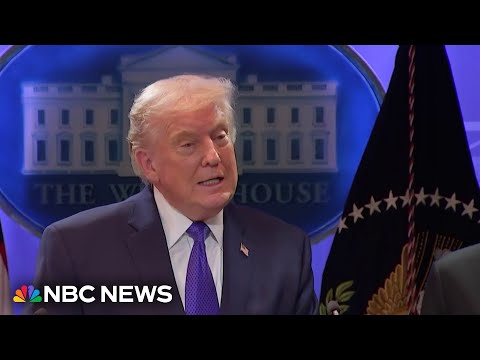
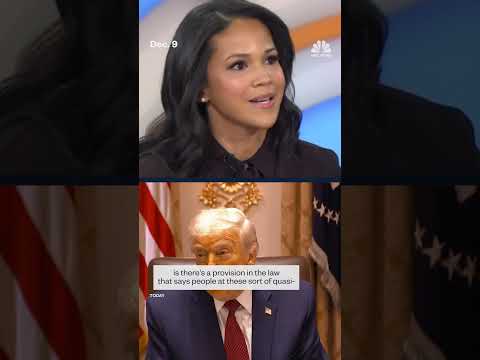
The Supreme Court is signaling what could be a major shift toward expanding presidential authority. During a closely watched hearing, the court's conservative majority appeared likely to side with President Trump and allow the White House to fire officials at independent government agencies without cause. This was a move, if it happens, that would overturn 90 years of president.But the thing the justices are wrestling with is there's a provision in the law that says people at these sort of quasi independent ...
Arguments Over Trump Tariffs Hit Supreme Court
Youtube· 2025-11-05 17:46
Core Argument - The Supreme Court is questioning the Trump administration's legal authority to impose tariffs under the International Emergency Economic Powers Act (IEEPA) and whether such actions can be taken without congressional approval [2][4]. Group 1: Legal Authority and Tariff Imposition - The central questions revolve around President Trump's authority to impose tariffs under IEEPA, which has not been used in this manner before [2]. - Justices are particularly focused on whether the administration can impose tariffs as a revenue-raising measure, which traditionally falls under Congress's authority [3]. - The administration is attempting to frame the tariffs as necessary for addressing foreign threats and national emergencies, rather than as a means of generating revenue [4]. Group 2: National Emergency Declaration - To invoke IEEPA tariffs, the president must declare a national emergency, and justices are questioning the legitimacy of the claimed emergency regarding trade imbalances [4][5]. - The plaintiffs argue that the administration could have utilized other tariff powers, which may become relevant depending on the court's ruling [5]. Group 3: Impact of Tariffs - Approximately 60% of the tariffs implemented during this term are linked to IEEPA, indicating potential widespread implications depending on the court's decision [6]. - The administration is also preparing to use other authorities, such as Section 232 for national security tariffs, suggesting that tariffs are unlikely to be eliminated regardless of the court's ruling [5][6]. Group 4: Public Sentiment and Court Dynamics - There is a notable public presence opposing President Trump's tariffs outside the Supreme Court, reflecting significant public interest in the case [7]. - This case is significant as it is the first time the Supreme Court is addressing a policy with long-term implications rather than just an emergency ruling, highlighting the weight of presidential authority in this context [8].

X @The Economist
The Economist· 2025-10-10 13:20
Over time justices have waved through gradual increases in presidential authority, steadily rewriting an unwritten constitution as they went. How far will they go? https://t.co/EEXBeTvGqS ...
Sen. Cory Booker says ‘all’ of Trump’s Cabinet should resign: Full interview
NBC News· 2025-09-07 13:56
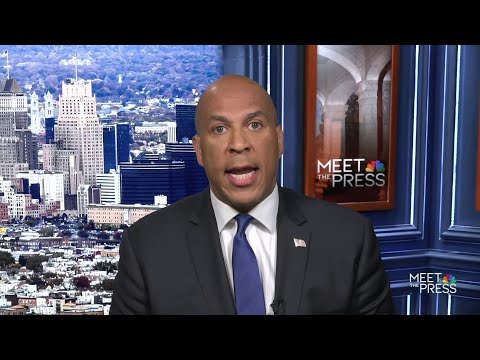
Politics & Policy - Senator Booker criticizes President Trump's unilateral strike against a Venezuelan boat, deeming it an overreach of presidential authority and a violation of the rule of law [2][3][4] - Senator Booker calls for HHS Secretary Kennedy's resignation due to policies making healthcare inaccessible and attacking science-based health decisions [6][7][8] - Senator Booker expresses willingness to work with anyone, including Secretary Kennedy, to improve access to healthy food, but criticizes the Trump administration for harming Americans' health [9][10][11][12][13][14] - Senator Booker advocates for bipartisan action in Congress to ensure accountability and transparency regarding Jeffrey Epstein's case, criticizing Trump's handling of the situation [16][17][18] - Senator Booker states he will fight for Americans' priorities in the budget and blames Republicans for a potential government shutdown, criticizing President Trump's lack of bipartisanship and disregard for constitutional bounds [19][20][21][22] Social Issues - Senator Booker highlights the issue of food access disparities, noting that residents in Newark, New Jersey, struggle to access nutritious foods while being exposed to highly processed foods [12][13]