RWA(Real World Assets-tokenization)

Search documents
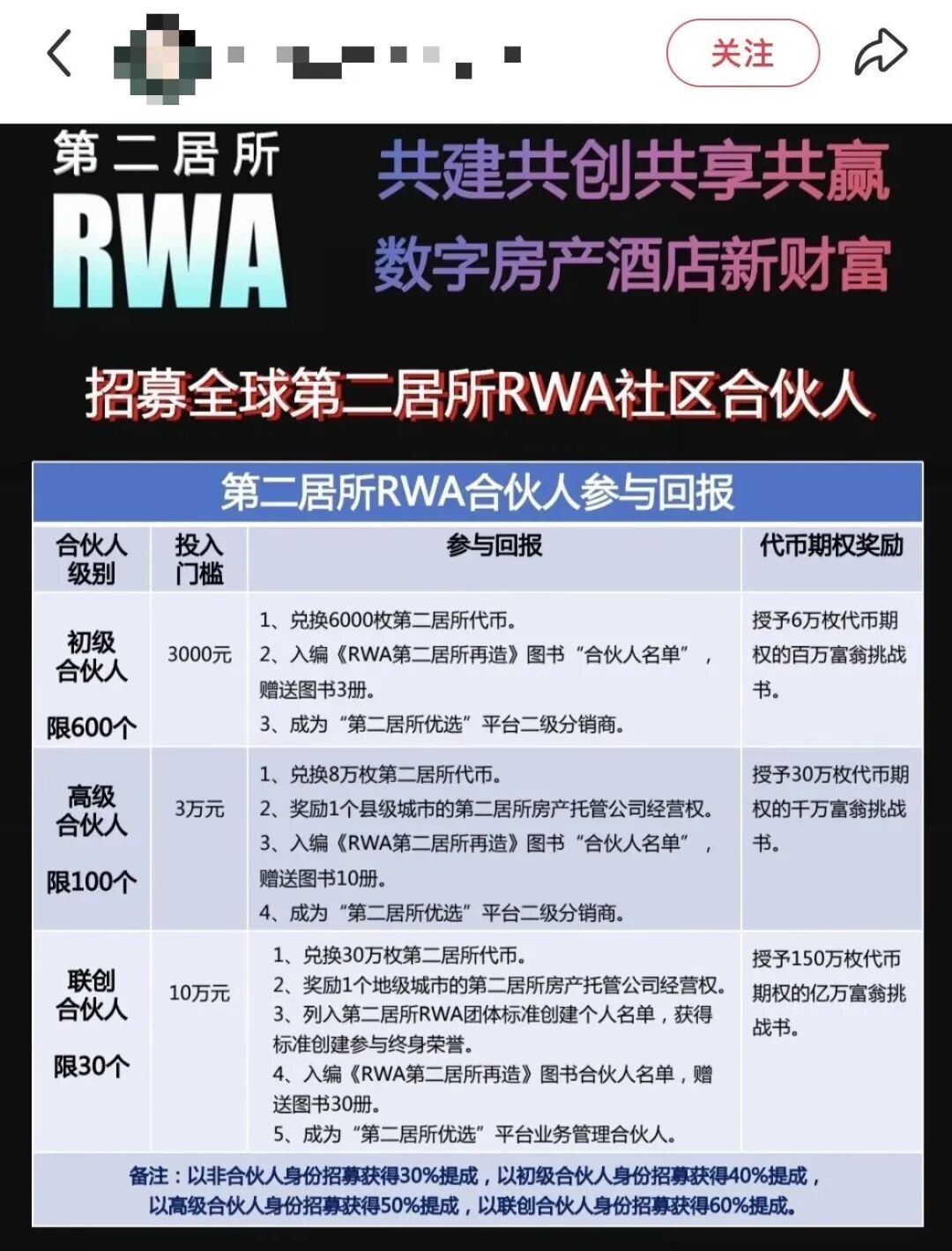
拉1人返1500元,投10万成亿万富翁?第二居所大肆宣传将房产海外代币化
Mei Ri Jing Ji Xin Wen· 2025-10-27 10:56
Core Viewpoint - The article investigates the business model of Shenzhen Second Home Online Information Technology Co., Ltd., which claims to digitize and tokenize idle real estate into tradable on-chain warrants, raising questions about the legitimacy and sustainability of high returns promised to investors [1][2][5]. Group 1: Business Model and Recruitment - Second Home is actively recruiting partners through social media, promising significant returns on investments as low as 3,000 yuan, with claims of becoming millionaires through real estate tokenization [1][2]. - The company offers various partnership tiers, with initial investments ranging from 3,000 yuan to 100,000 yuan, each tier providing different rewards, including tokens and business rights [5][6]. - The recruitment strategy emphasizes attracting new members and generating commissions through referrals, suggesting a multi-level marketing approach [8][6]. Group 2: Tokenization and Asset Claims - The core business involves converting idle real estate into high-value digital assets, which are then fractionally sold in domestic markets while planning to issue corresponding tokens overseas to attract international investors [15][17]. - The company claims to have a blockchain certification for its assets, but industry experts have raised concerns about the authenticity of the underlying assets and the legality of the token issuance in China [17][21]. - Several developers have denied any partnership with Second Home, contradicting the company's claims of collaboration on various real estate projects [22][24][26]. Group 3: Regulatory Concerns - The article highlights significant legal risks associated with the company's operations, particularly regarding compliance with Chinese regulations on token issuance and fundraising [33][39]. - Experts warn that the RWA (Real World Assets) concept is fraught with potential scams and that the lack of a robust regulatory framework could expose investors to substantial risks [41][46]. - Legal professionals emphasize the importance of verifying the authenticity of underlying assets and the potential consequences of multi-level marketing structures in the context of cryptocurrency and token sales [46].