Real Wages

Search documents
Federal Reserve chair says consumers still feel 'squeezed' by high prices
NBC News· 2026-03-18 20:57
real wages have been going up in the United States now for three years roughly. Um but people are not feeling like they're not feeling good about it yet and it will take some years of positive real real earning gains for people to feel good again we think. But you're right, we uh but when you talk to people, they're they they do feel squeezed and you know there there are areas where where uh prices are still going up like insurance, various different kinds of insurance are getting more more and more expensi ...

'NOT A GOOD REPORT': Labor sec acknowledges WEAK February jobs numbers
Youtube· 2026-03-06 17:15
Oil Market - Kuwait is cutting oil production due to a lack of storage capacity for crude oil, with current prices at $87 to $88 per barrel [1] Employment Data - The February jobs report showed a loss of 92,000 jobs, with the unemployment rate rising to 4.4%, contrary to expectations of job growth [2][3] - Economists had predicted an addition of 59,000 jobs, but significant losses were noted in healthcare (28,000 jobs), leisure and hospitality (27,000), construction (11,000), and manufacturing (12,000) [2][3] - Revisions to previous months indicated 69,000 fewer jobs created than initially reported, with December and January seeing downward adjustments of 65,000 and 4,000 jobs respectively [3][13] Sector Analysis - Retail trade was a rare positive, adding 2,300 jobs [3] - Foreign-born workers lost 519,000 jobs, while native-born workers gained 128,000 jobs, indicating a shift in the labor market [4][9] Government Response - The Labor Secretary acknowledged the disappointing job numbers but emphasized ongoing efforts to improve the situation, including investments in workforce training and addressing job losses in construction and manufacturing [6][12] - The administration is focused on creating private sector jobs and ensuring a skilled workforce, with ongoing discussions about labor market demands [10][12] Future Outlook - There is hope for job recovery in the coming months, with a total of 60,000 jobs added over the last two months despite the recent downturn [7][12] - The administration aims to enhance the accuracy of job reporting through the Bureau of Labor Statistics, which is expected to improve under new leadership [15]
Watch CNBC's full interview with White House National Economic Council Director Kevin Hassett
CNBC Television· 2026-02-18 13:44
The New York Federal Reserve claims 90% of the tariff burden is being shouldered by US firms and consumers, but the White House disagrees. Joining us now, White House National Economic Council Director Kevin Hasset. This will be uh Kevin, good to see you.This will be a continuation of a a discussion we had yesterday with uh Ambassador uh with our trade representative Jameson Greer. And we we talked about the whether something's regressive. Uh but we'll we'll try to get in into all of this.Uh and >> we saw a ...
Would The Fonz Run Out of Retirement Funds in 2026?
Yahoo Finance· 2026-01-10 11:04
Core Insights - The article explores whether the fictional character Fonzie from "Happy Days" would have sufficient retirement funds to live comfortably in 2026, assuming he retired around 2000 [1] Group 1: Fonzie's Career and Earnings - Fonzie began his career as a mechanic in the mid-1950s, later transitioning to education as a shop teacher and guidance counselor [2][3] - His early career as a mechanic did not provide substantial earnings, with inflation-adjusted wages for factory workers remaining relatively stagnant from the 1960s to the 1980s [4] - Real wages for American workers peaked in 1973, and Fonzie's modest lifestyle during his mechanic years meant he likely did not save significantly for retirement [5] Group 2: Retirement Planning and Pension - Upon becoming a teacher, Fonzie entered the Wisconsin Retirement System (WRS), a defined benefit pension plan for public school teachers in Wisconsin [6] - The WRS pension can replace approximately 33% to 45% of a teacher's salary, depending on years of service, with Fonzie potentially qualifying for the higher end of this range after 35 years in the system [7] - Assuming a salary of $50,000 at retirement, Fonzie's annual pension would be around $20,000 to $22,000 [7]
How Middle Class Income in 2000 Compares to 2025
Yahoo Finance· 2025-12-29 20:55
The next time you look at your paycheck, multiply it by two. The figure you arrive at could be what your paycheck looks like in 2050 if income trends follow the same pattern as the past 25 years — at least if you belong to the middle class. Nominal wages (the actual dollar amount) have more than doubled since 2000 for middle-income Americans. Real wages adjusted for inflation have risen as well, though not nearly as much. How does middle class income in 2025 compare to 2000? Here’s a closer look. Middl ...
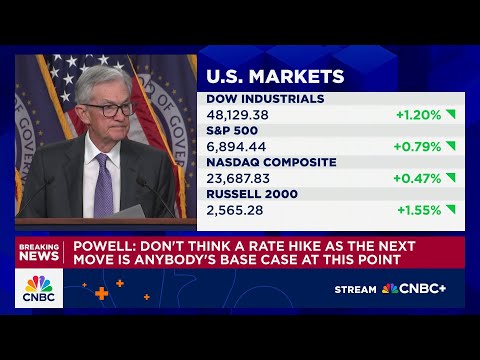
Fed Chair Powell: A lot of high costs are embedded due to higher inflation in 2022 and 2023
CNBC Television· 2025-12-10 20:38
uh tenyear rates have are 50 [clears throat] basis points higher than when you started cutting back in September of 2024 and the yield curve basically has been steepening. Uh why do you think that continuing to cut now especially in the absence of data is going to bring down the yield on the thing that will move the economy the most. >> So we're looking at the real economy and focusing on that.And you have you've got when the when the long bonds move around, you've got to look at why they're moving around. ...
Fed Chair Powell: A lot of high costs are embedded due to higher inflation in 2022 and 2023
Youtube· 2025-12-10 20:38
Economic Outlook - The yield curve has steepened, with ten-year rates being 50 basis points higher since September 2024, raising questions about the effectiveness of continued rate cuts in the absence of new data [1] - Long-term bond movements are influenced by inflation compensation, which remains at comfortable levels consistent with a 2% inflation target over time [2][3] - The increase in rates is not indicative of long-term inflation concerns but may reflect expectations of higher economic growth [4] Public Concerns and Policy Focus - Despite public concern over high prices and inflation, the focus remains on stabilizing the labor market, which appears relatively stable [5] - The Federal Reserve has a robust network of contacts that indicate high costs are largely due to embedded inflation from previous years rather than current inflation rates [6] - The goal is to restore inflation to the 2% target while also fostering a strong economy with rising real wages and job growth [7][8]
We will see a lot more economic growth coming, Art Laffer predicts
Youtube· 2025-11-18 11:02
Economic Growth and Tax Cuts - Wages are rising faster than prices, with real income increasing and grocery prices only rising by 2.1% [2][17] - Economic growth is expected to continue, with potential growth rates reaching 4% to 5% in the near future, positively impacting real wages and the economy [5][14] - The tax cuts enacted in July are anticipated to show significant refunds in the first quarter of the following year, contributing to economic strength [9][27] Inflation and Affordability - The current inflation rate, particularly in grocery prices, is being misrepresented by the media, as prices are barely rising [7][8] - The affordability crisis is being challenged by the increase in real income, which has risen by $1,200 since Trump took office [17][18] - Housing prices are expected to decrease as new housing units come online, which will positively affect the Consumer Price Index (CPI) [10][12] Federal Reserve and Monetary Policy - The Federal Reserve's current policies are criticized for not aligning with economic growth, leading to higher inflation instead of lower prices [4][23] - There is a call for the Federal Reserve to reduce its balance sheet to allow for lower interest rates, which would benefit small and medium-sized businesses [20][21] - Ethical concerns regarding insider trading among Federal Reserve officials have been raised, indicating a need for better compliance and management within the institution [29][34]

NEC Director Hassett on Trump's claims that prices have fallen
CNBC Television· 2025-11-17 17:37
The president uh is constantly saying prices have come down. Now inflation is still 3%. It's still too high.Now oil prices, energy prices, there are certain uh things where they have come down. But when you keep saying prices are falling, that's not true. Uh because inflation is still it's the 3% is on top of all the inflation we had uh during the Biden years.So we got all that inflation plus an additional 3%. And we should I think you should admit that >> a more a more precise way to say it though, Joe, is ...
Wage increases will continue and should give hope for the future, says NEC director Kevin Hassett
CNBC Television· 2025-11-17 13:55
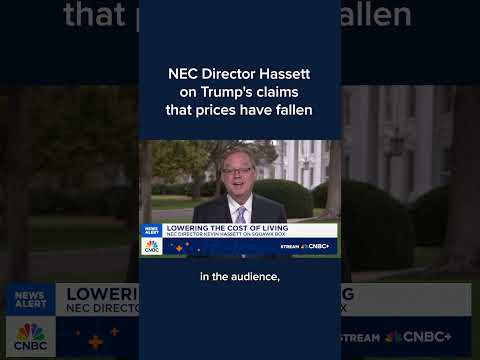
Economic Outlook & Inflation - The discussion revolves around the perception of affordability and the impact of inflation on the US economy [2] - Inflation averaged over 5% during the Biden administration's four years [2] - Current inflation is at 3%, considered still too high [2][5] - Real average weekly wages fell during the Biden years due to inflation [5] - Real wages have increased by approximately $1,200 this year, partially offsetting a $3,000 "hole" created by previous policies [7] Government Policies & Spending - The previous administration's policies are blamed for creating a "big hole" that people are still trying to recover from [3] - Increased government spending is cited as a cause of runaway inflation [4] - Obamacare subsidies are criticized for disproportionately benefiting insurance companies and driving up insurance policy prices [9][10] - The fastest inflation in the economy is attributed to government subsidies for Obamacare insurance [10] Cost of Living - The typical monthly mortgage payment has approximately doubled [3] - The cost of a typical bag of groceries increased from around $400 to $512 during a certain period, with minimal increase since then [3]