
Renewable energy production

Search documents
Coop Pank AS raises subordinated capital from the European Energy Efficiency Fund
Globenewswire· 2025-12-19 16:00
Core Insights - Coop Pank AS has entered into an unsecured subordinated loan agreement with European Energy Efficiency Fund S.A. for 5 million euros, with an interest rate of 6 months' EURIBOR plus 3.25% per annum, repayable in one installment by 31 March 2034 [1] - The loan will be classified as a capital instrument included in the Bank's Tier 2 own funds [2] - The funds will be utilized to support the Bank's growth strategy, focusing on projects that promote energy efficiency or renewable energy production [3] Company Overview - Coop Pank, based in Estonia, is one of the five universal banks operating in the country, with a client base of 225,800 for daily banking services [4] - The strategic shareholder of Coop Pank is Coop Eesti, a domestic retail chain with 320 stores, aiming to enhance the synergy between retail and banking services [4]


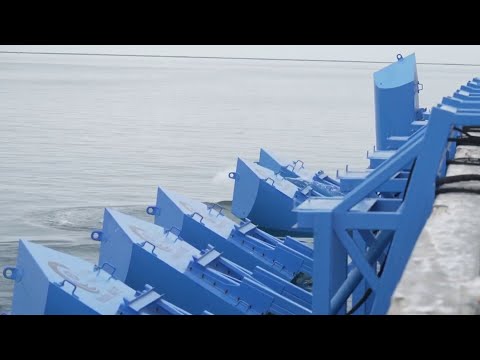
Clean energy program in California turns waves into renewable energy
NBC News· 2025-11-06 04:23
Overview of Eco Wave Power - Eco Wave Power is pioneering onshore wave power technology, representing a novel approach to renewable energy [1][2] - The technology utilizes floaters that generate clean electricity from wave motion, offering a continuous energy source without the need for batteries [1][2] Project and Partnerships - Eco Wave Power has partnered with Alta Sea and Shell Marine Renewable Energy for the first onshore wave power site in the U S [1] - The company has identified 77 potential U S sites with maximum wave wattage for future development [4] Technology and Operation - The system uses floaters that move with the waves, driving hydraulic cylinders to build pressure and power generators [3] - The technology is designed to be simple and easy to maintain, addressing concerns about the complexity and cost of wave energy [5] Potential and Scalability - A commercial project at the Port of Los Angeles could potentially generate up to 60 megawatts of power, enough to power approximately 60 thousand homes [4] - Eco Wave Power already has a power station in Israel connected to the national electrical grid, demonstrating the technology's viability [3] Challenges and Opportunities - Wave energy commercialization has been hindered by concerns about cost, reliability, and operational complexity [5] - Eco Wave Power aims to overcome these challenges by offering a simpler, more cost-effective solution, particularly in locations with existing infrastructure like the Port of Los Angeles [5][6]
Enefit Green production data – April 2025
Globenewswire· 2025-05-16 06:00
Core Insights - Enefit Green's electricity production in April reached 185.1 GWh, marking a 23.5% increase compared to the previous year, driven by new wind and solar farms [1][5] Production Overview - Wind energy production in April was 156.9 GWh, a 17% increase from last year, with new wind farms contributing significantly [1][5] - Solar energy production was 16.7 GWh, nearly 2.7 times higher than last year, primarily due to new solar farms [4][5] - The Iru cogeneration plant produced 11.4 GWh of electricity, reflecting a 20% increase, and thermal energy production was 36.0 GWh, up 18.8% [3][5] Regional Production Breakdown - Estonia's electricity production increased by 57.9% to 102.7 GWh [5] - Lithuania's production rose by 12.8% to 69.9 GWh [5] - Latvia produced 2.3 GWh, a significant increase from zero last year [5] - Poland's production increased by 53.5% to 4.1 GWh [5] - Finland's production saw a decline of 69.1%, dropping to 6.3 GWh [5] Production Challenges - Downregulations due to low electricity prices resulted in 28.2 GWh of unproduced energy from wind farms, with 13.3 GWh from the Finnish market [2] - System services provision in Estonia and Lithuania reduced production by 7.9 GWh [2] - Wind conditions positively impacted production by approximately 4.5 GWh compared to expectations [2] - Solar farms faced downregulation leading to 2.4 GWh of unproduced energy, with grid-related restrictions in Polish solar farms causing an additional 0.6 GWh of unproduced energy [4]
