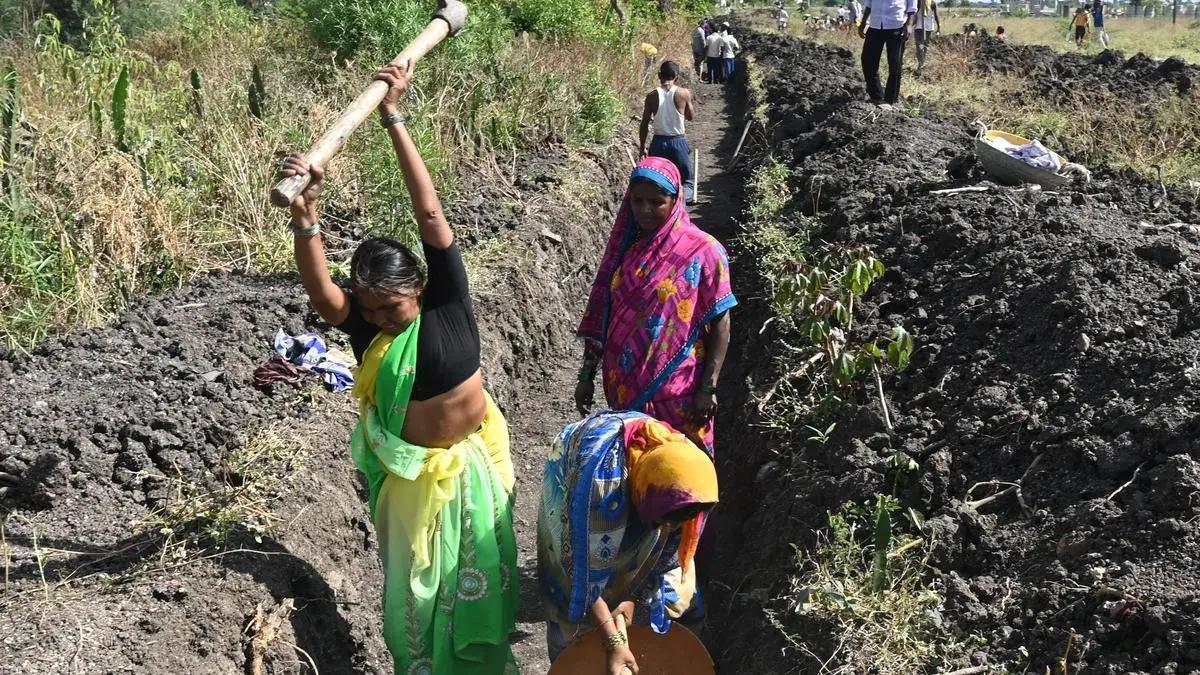
Rural employment expansion

Search documents
VB-G RAM G Act to expand rural employment and cut inefficiencies: SBI report
BusinessLine· 2025-12-29 07:40
Core Insights - The newly enacted VB-G RAM G Act is expected to enhance rural employment by increasing the number of households participating in the scheme and improving work efficiency [1][2] Group 1: Employment Impact - The revamped Act is projected to increase the number of households working under the scheme from 5.8 crore to a higher level, aligning with pre-COVID trends of around 5.0 crore households participating annually [2] - Average days of employment per household are anticipated to rise due to a broader definition of permissible works, with historical data showing an increase from 45.9 days (FY07-FY13) to 50.4 days (FY21-FY25) [3] Group 2: Addressing Demand-Supply Gap - A persistent gap of approximately 14% between work demanded and work provided has been noted since FY20, attributed to misalignment with economic priorities [4] - The VB-G RAM G Act focuses on four key areas: water security, rural infrastructure, livelihood infrastructure, and climate resilience to address this gap [4][5] Group 3: Efficiency and Transparency - Inefficiencies were highlighted, with 5.78 crore households working under MGNREGA in FY25 against a Centre release of Rs 85,334 crore, resulting in an average expenditure of Rs 14,755 per household [6] - Structural weaknesses and misappropriation led to the loss of employment for 1.22 crore households in a single fiscal year [7] - Planned transparency measures include biometric authentication, spatial technology-based planning, and digital monitoring to enhance efficiency [8] Group 4: Consumption and Wage Alignment - The Act is expected to boost consumption by improving wage alignment, addressing gaps in states like Telangana, Rajasthan, and Andhra Pradesh that have reduced demand for work [9] Group 5: Local Governance Engagement - The number of Gram Panchayats with no expenditure decreased from 39,531 in FY15 to 4,797 in FY22, but increased to 9,280 in FY26, indicating a need for more local engagement under the new Act [10]