Supply Shock

Search documents
U.S. economy in a 'multi-dimensional' supply shock environment, says EY Parthenon's Chief Economist
CNBC Television· 2026-04-09 20:52
Let's get more on the economy and today's inflation numbers. Our next guest says the Middle East conflict will exacerbate economic headwinds, making the outlook for the year a bit less favorable. Joining me now is Gregory Do.He is chief economist at EI Parthonon. Uh great to see you, Greg. And you know, I guess arguably you've seen this stagflationary wind kind of blow through uh the economy.At least we expect it to have that effect. Uh what does it mean. Do you think we're going to settle out in terms of a ...

All roads point into higher inflation and slower growth: IMF's Kristalina Georgieva
CNBC Television· 2026-04-09 18:45
Well, what I would say next week is that um all roads go into higher inflation, slower growth, but how much that would be depends on whether the ceasefire holds and turns into a durable peace and how much is the infrastructure damage already done. Uh this shock we know is a negative supply shock. It means it pushes prices up and uh whether that would go to a territory that requires central banks to intervene would really depend on how long it goes.A shorter duration relatively mild impact uh possible for ce ...
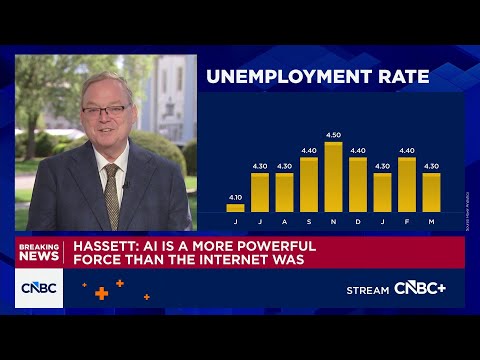
Watch CNBC's full interview with NEC director Kevin Hassett
CNBC Television· 2026-04-06 16:06
HAVE TO HAVE ONE OF THE PARTIES BE WILLING TO SAY YES TO BEFORE THE OTHER ONE DOES. IS THE PRESIDENT IN THAT CAMP OR NOT. MAYBE WE'LL GET SOME INSIGHT AT 1 P.M. >> OKAY. THANK YOU.EAMON. WE'LL BE WATCHING EAMON JAVERS FOR MORE ON THE IMPACT OF ALL THIS TO THE ECONOMY. LET'S BRING IN NSC DIRECTOR KEVIN HASSETT. DIRECTOR HASSETT WELCOME BACK.IT'S GOOD TO SEE YOU. >> THANKS. GREAT TO BE HERE.>> I'M SURE YOU WERE PLEASED WITH THE JOBS NUMBERS 178,000 JOBS ADDED DURING THE MONTH OF MARCH. DO YOU THINK THAT DO YO ...
Fed's Powell Says Long-Term Inflation Expectations Well-Anchored
Youtube· 2026-03-30 16:07
Group 1 - The Federal Reserve's response to rising oil prices involves navigating trade-offs between demand and supply shocks [1][2] - Monetary policy primarily influences demand, with higher rates moderating demand and lower rates stimulating it [2][4] - Supply shocks, such as energy price shocks, typically do not have significant short-term effects on supply, complicating the Fed's response [2][4] Group 2 - Historical energy shocks have been transient, and the effects of monetary policy adjustments often lag, potentially leading to inappropriate economic impacts [3][4] - Continuous monitoring of inflation expectations is crucial, as repeated supply shocks can lead to a general expectation of higher inflation over time [5][6] - The current inflation context shows a trend towards 2% post-pandemic, but the Fed has not consistently maintained this target [6][7]

Oil Could Surge to $200 if Conflict Continues: Energy ETFs in Focus
ZACKS· 2026-03-30 16:00
Core Insights - Macquarie Group warns of potential oil prices spiking to $200 per barrel if the Iran war extends into June and the Strait of Hormuz remains closed, with a 40% probability of this scenario occurring [1][8] - Current Brent crude prices are around $110 per barrel, with the all-time nominal peak being $147.50 in July 2008 [1] Supply Chain Disruption - The conflict involving the U.S., Israel, and Iran has severely disrupted energy flows from the oil-rich Middle East, particularly due to Tehran's near-total closure of the Strait of Hormuz [2] - Prolonged closure of the strait could lead to sharply rising oil prices, potentially destroying demand and rebalancing markets [2] Geopolitical Developments - Donald Trump has delayed potential strikes on Iran's energy infrastructure by 10 days, now set for April 6, while Iran temporarily allowed 10 oil tankers to pass through the strait [3] Infrastructure Damage and Costs - The trajectory of energy prices and supply will depend on the duration of the disruption and the extent of physical damage to energy infrastructure, with repair costs estimated at a minimum of $25 billion [4] - Direct attacks on multibillion-dollar infrastructure may take up to five years to repair, significantly affecting global liquefied natural gas supplies [6] Investment Opportunities - Investors are advised to monitor energy exploration ETFs such as State Street Energy Select Sector SPDR ETF (XLE), iShares US Oil & Gas Exploration & Production ETF (IEO), and Invesco Energy Exploration & Production ETF (PXE) [7] - MLP ETFs like Alerian MLP ETF (AMLP) offer yields as high as 7.44% annually, but if the Iran conflict de-escalates soon, these ETFs may experience a decline, though not to pre-war levels [7][8]

Knapp: FOMC Needs to Cushion Jobs Market Amid AI & Economic Risks
Youtube· 2026-03-19 20:00
Economic Overview - The economy was weak prior to the onset of the war, with expectations of a recovery not materializing as anticipated [2][4] - The consensus view that growth would broaden due to tax incentives and recovery in consumption has not unfolded as expected [3][4] Inflation and Market Reactions - The Federal Reserve's misinterpretation of tariffs and their impact on inflation has led to market volatility, with cyclical stocks declining and inflation expectations falling [5][6] - The recent increase in oil prices is seen as a significant factor affecting economic performance, potentially leading to job losses [7][8] AI and Employment - The impact of AI on job losses is complex, with some companies using AI as a reason for layoffs while still maintaining or increasing productivity [10][14] - Wage trends indicate that the highest income brackets are experiencing wage declines, which may be influenced by AI [12][13] Investment Opportunities - There is a potential opportunity for U.S. manufacturing due to ongoing supply shocks, supported by tax incentives from recent legislation [17][18] - The banking sector may benefit from proposed reductions in capital requirements, which could enhance return on equity and facilitate private sector lending [19][20] Fixed Income Strategy - Fixed income investors are advised to focus on the two-year part of the yield curve, as the Federal Reserve is expected to ease later this year [21]
Markets hold steady but oil risks threaten growth outlook
CNBC Television· 2026-03-19 14:58
Welcome back. Let's tee up the trading day ahead and bring in our all-star panel. Mike Xandandy, Mark Xandy is chief economist at Moody's Analytics.David Zervos is chief market strategist at Jeffre and a CNBC contributor and Matt Powers is managing partner at P advisory group. Gentlemen, it's great to have you all here. David Zeros, I'm going to start with you.Um because as goes oil and energy prices, so goes the rest of the market right now and it seems to be driving Fed policy, too. Your thoughts. Well, M ...

X @Bloomberg
Bloomberg· 2026-03-18 14:10
Oil hasn’t fully priced in the supply shock of the US-Israeli war on Iran, said Carlyle’s Jeff Currie, who described the global energy market’s current upheaval as the “mirror image of Covid” https://t.co/Jj4noeau8K ...
全球经济-伊朗战争引发的供应冲击主要局限于能源领域-Global Economics Comment_ Supply Shocks from the War in Iran Are Mostly Limited to Energy
2026-03-16 02:26
Summary of Key Points from the Conference Call Industry Overview - The analysis focuses on the impact of the war in Iran, particularly on the energy sector and its implications for global economics [2][3][4]. Core Insights and Arguments 1. **Impact on Global GDP and Inflation**: - Higher oil prices are projected to lower global GDP by 0.3% and increase headline inflation by 0.5-0.6 percentage points over the next year, with a smaller increase of 0.1-0.2 percentage points in core inflation [3][4]. - The forecast for global growth has been adjusted to 2.6% from 2.9% prior to the war, with headline inflation expected to rise to 2.9% on a Q4/Q4 basis [4]. 2. **Central Bank Sensitivity**: - The recent selloff in front-end rates indicates that global central banks are likely to be more sensitive to inflation due to the memory of post-pandemic supply disruptions [5][6]. 3. **Concentration of Supply Shock**: - The current supply shock is primarily concentrated in the energy sector, unlike the broader supply chain crisis observed in 2021-2022 [6][38]. - Non-energy trade with Gulf economies is limited, accounting for only 1% of global trade, which reduces the potential impact on non-energy supply chains [8]. 4. **Limited Production Bottlenecks**: - Although Gulf exporters have a significant share in global production of certain chemicals and metals, the likelihood of severe bottlenecks is low. Current price increases for these products suggest only a minimal impact on global inflation [13][17][18]. 5. **Shipping Disruptions**: - Shipping disruptions similar to those experienced in 2021-2022 are less likely to occur. Non-tanker ocean shipping costs have decreased since the start of the war, while airfreight prices have risen significantly [29][34]. 6. **Potential Production Disruptions**: - Methanol is identified as a potential source of production disruption due to its role in producing industrial adhesives and solvents. The loss of Iran's production capacity could have downstream ripple effects [20]. 7. **Inflationary Pressures**: - The analysis suggests that while there are upward pressures on prices due to supply disruptions, the overall impact on global inflation is expected to be limited. If current price levels persist, there could be a 0.1 percentage point boost to global headline inflation over the next 12 months [25][37]. Other Important Considerations - The report emphasizes that the major risks to global supply and inflation are confined to the energy sector, which mitigates the risk of severe supply chain disruptions and inflationary effects similar to those seen in 2021-2022 [37][38]. - The analysis also highlights that the economic exposure to energy shocks today is less than it was in 2022, although there are potential non-linear effects if the energy crisis escalates [38].
Wall Street Is Taking Control of Bitcoin
Coin Bureau· 2026-03-12 14:00
Imagine a silent war being waged for control over the base layer of the world's most important cryptocurrency. For months, Black Rockck has been the undisputed king of the Bitcoin ETF market, hoarding over 52.7% billion in assets under management. But a new regulatory filing has just revealed that another Wall Street titan is preparing to launch a direct assault on that empire.and their strategy threatens to completely monopolize the remaining liquid supply of Bitcoin. My name is Guy and you're watching the ...