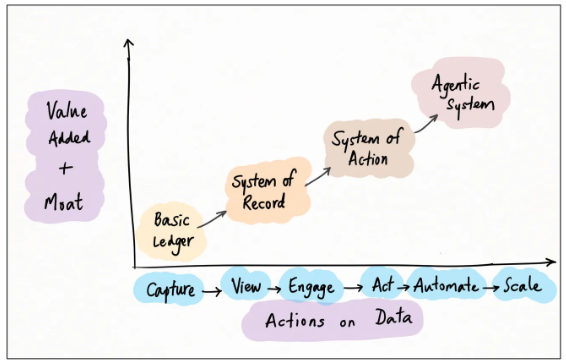
System of Action

Search documents
DocuSign, Inc. Q4 2026 Earnings Call Summary
Yahoo Finance· 2026-03-18 12:30
Management characterizes fiscal 2026 as an 'inflection point' where the transition from eSignature to the AI-native IAM platform established market leadership. Performance was driven by consistent execution and accelerating momentum in enterprise, with fourth-quarter billings exceeding $1 billion for the first time in the company's history. The IAM platform reached $350 million in ARR within 18 months of launch, representing approximately 11% of total company ARR. Strategic positioning focuses on tr ...

Zoom(ZM) - 2026 Q4 - Earnings Call Transcript
2026-02-25 23:02
Financial Data and Key Metrics Changes - In Q4 FY 2026, total revenue grew 5.3% year-over-year to $1.25 billion, exceeding guidance by $12 million [18] - Full year FY 2026 revenue increased by 4.4%, with enterprise revenue growing 6.5% [24] - Non-GAAP gross margin in Q4 was 79.8%, up 1 point year-over-year, while non-GAAP operating margin was 39.3% [21] - Operating cash flow for Q4 was $355 million, down from $425 million in the prior year [23] Business Line Data and Key Metrics Changes - The enterprise business revenue grew 7.1% year-over-year, representing 61% of total revenue [18] - The online business showed signs of stabilization with average monthly churn at 2.9% [18] - The number of enterprise customers contributing over $100,000 in trailing 12-month revenue grew by 9% year-over-year [19] Market Data and Key Metrics Changes - Revenue growth in the Americas was 6%, EMEA grew 5%, and APAC grew 3% [19] - Deferred revenue at the end of Q4 grew 5% year-over-year to $1.42 billion [22] Company Strategy and Development Direction - The company aims to leverage AI to enhance customer experience and drive growth in new AI products [6][8] - The focus is on creating a unified system of action that integrates collaboration and customer engagement [7][17] - The company plans to continue its share buyback program to offset dilution and enhance shareholder value [24] Management's Comments on Operating Environment and Future Outlook - Management expressed optimism about AI technology monetization in FY 2027, highlighting strong customer interest in Custom AI Companion [31][32] - The company anticipates revenue growth to cross the $5 billion milestone in FY 2027, with a focus on profitability and cash flow generation [26][29] Other Important Information - The company reduced stock-based compensation expense by 18% in FY 2026 [25] - The company is investing in international markets and local data centers to support growth [54] Q&A Session Summary Question: How does the company view AI and monetization progress in FY 2027? - Management is optimistic about AI technology monetization, particularly through Custom AI Companion, which is expected to drive revenue growth [31][32] Question: Can you quantify the impact from larger competitive takeouts on deferred revenue growth? - Management noted that the recent trend of larger competitive wins is intentional and beneficial for the business, providing a grace period for customers [36] Question: What are the structural barriers preventing AI model providers from disintermediating Zoom? - Management emphasized the importance of reliability and security in mission-critical communication tools, which are difficult to replicate [42][43] Question: How does the company balance addressing additional departments with new products versus deepening existing areas? - Management stated that AI allows for both horizontal innovation and vertical market penetration, enabling the company to monetize across various use cases [68][70] Question: What is the expected impact of BrightHire on financial performance? - Management indicated that BrightHire's impact on Q4 was minimal, but it is expected to contribute positively in FY 2027 [100]

Workday (NasdaqGS:WDAY) FY Conference Transcript
2025-12-11 22:57
Workday FY Conference Summary Company Overview - **Company**: Workday (NasdaqGS: WDAY) - **Industry**: Enterprise Software, specifically focusing on Human Resources (HR) and Finance solutions Key Points and Arguments Market Potential - Workday operates in a Total Addressable Market (TAM) of approximately **$200 billion** with only **4-5%** market penetration, indicating significant growth opportunities [4][6] - The company aims to expand its portfolio, particularly in frontline work, which encompasses around **3 billion workers globally** [6][12] Growth Strategies 1. **Portfolio Expansion**: - Workday is broadening its service offerings in finance, including new modules for revenue management and cost management [7][8] 2. **Geographic Expansion**: - Focus on increasing presence in Europe with localized offerings and new data centers, as well as entering the Indian market [10][12] 3. **Targeting Mid-Market**: - Workday is simplifying its services to better cater to mid-market companies (1,000 to 3,000 employees) with new packages like Workday Go and Workday Accelerated [12][11] Technology and Innovation - Workday is committed to leveraging AI to transform user experience and automate backend processes, with **1.2 billion AI actions** already executed in the core platform [20][24] - The company has structured its AI strategy around three pillars: enhancing user experience, automating backend processes, and creating an open platform for integration [18][22] Data and AI - Workday emphasizes the importance of data, context, and process for AI value generation, creating a high barrier to entry for competitors [28][30] - The company has a unique advantage due to its comprehensive data set across HR and finance functions, which is essential for effective AI implementation [28][24] Monetization Strategy - Introduction of **Flex Credits** as a new monetization model for AI features, allowing customers to pay based on usage rather than a fixed seat-based model [39][40] - This model aims to balance customer value with Workday's revenue generation, allowing for flexibility in AI feature consumption [41][46] Acquisitions - Workday has made strategic acquisitions to enhance its AI capabilities, including the acquisition of **Sana** for AI-driven user experience and **Pipedream** for connectivity [50][53] - The focus is on integrating these acquisitions to create a comprehensive ecosystem that enhances the Workday platform [54][55] Financial Discipline - Workday maintains a balance between innovation and margin efficiency, leveraging operational leverage to invest in both organic and inorganic growth [58][60] - The company is confident in its ability to continue expanding investments in AI while also improving margins [60][61] Additional Insights - The discussion highlighted the misconception that AI can operate effectively without a strong data and process foundation, emphasizing the need for accuracy in enterprise applications [32][36] - Workday's approach to AI is not just about better dashboards but about fundamentally transforming business processes [36][37] This summary encapsulates the key insights from Workday's FY conference, focusing on its market potential, growth strategies, technological innovations, and financial discipline.

AI时代的SaaS,出路在哪里?
Hu Xiu· 2025-07-31 06:51
Core Concept - The software industry is undergoing a significant paradigm shift from "System of Record" to "System of Action," where software not only manages business processes but actively executes them [1][3][29]. Group 1: Transition from System of Record to System of Action - The concept of "System of Action" represents the next evolution of "System of Record," enabling humans, AI-assisted humans, and fully autonomous AI agents to take action on data and trigger downstream workflows [3][5]. - Traditional software focused on recording and managing tasks, while "System of Action" allows for proactive decision-making and execution based on data [3][5][29]. - The rise of generative AI is facilitating this shift, allowing software to directly execute complex tasks that previously required human judgment [5][6]. Group 2: Emergence of Hero Users and Power Shift - The emergence of "Hero Users," defined as influential users with the power to make purchasing decisions, is reshaping software procurement from a top-down to a bottom-up approach [7][8]. - Hero Users prioritize tools that enhance their efficiency, leading to a decentralization of purchasing power within organizations [7][8]. - Companies that can effectively engage Hero Users gain a competitive advantage in becoming the "System of Action" [9]. Group 3: Case Study of Veterinary Practice Management Software - The traditional veterinary practice management system (PMS) has been a strong control point, but the introduction of AI transcription tools is disrupting this market by addressing user pain points [10][11]. - AI tools that simplify documentation for veterinarians have gained rapid adoption due to their user-friendly experience, highlighting the importance of user experience over technical complexity [11][14]. - Existing software companies often hesitate to adapt quickly, allowing agile AI startups to capture market share by meeting immediate user needs [13][14]. Group 4: Strategies for Native AI Companies - Native AI companies should focus on markets with slow-moving incumbents, as these present significant opportunities for disruption [19][20]. - Understanding the work of Hero Users and automating administrative tasks can create substantial value [21][22]. - Providing a magical user experience, even if the underlying technology is not groundbreaking, is crucial for success [22][23]. Group 5: Economic Restructuring of Software Models - The transition to "System of Action" will redefine software economics, moving from subscription-based models to outcome-based pricing [29][30]. - Companies that can directly create business value will shift their relationships with clients from vendor-buyer to partnership [30][31]. - Investment and valuation metrics will also evolve, focusing more on the actual business value created for clients rather than traditional revenue metrics [31][32]. Group 6: Future of AI Agent Workflows - The evolution of workflows will progress from human action to human + AI agent collaboration, eventually leading to fully autonomous AI agents [33][35]. - This shift will necessitate changes in organizational structures, emphasizing strategic roles over traditional hierarchical models [36][54]. - The concept of work will be redefined, with human roles focusing on creativity and strategic decision-making as AI handles routine tasks [37]. Group 7: Industry Verticalization Opportunities - The concept of "System of Action" offers insights into industry verticalization, emphasizing the need for AI agents to understand specific industry practices and regulations [42][43]. - Specialized AI companies that deeply understand industry pain points will have a competitive edge over generalist tech firms [44][46]. Group 8: Regulatory and Ethical Challenges - The rise of AI agents executing business decisions raises complex issues regarding accountability, decision transparency, and data privacy [47][48]. - Companies that proactively establish industry standards and best practices will have opportunities to shape the regulatory landscape [49][50]. Group 9: Talent and Organizational Change - The emergence of "System of Action" will drive the need for new talent that can bridge business processes and AI collaboration [52][56]. - Organizations will need to foster a culture of openness and experimentation to adapt to the integration of AI agents [55][56]. Group 10: Insights for Entrepreneurs and Investors - Entrepreneurs should target industries with strong Hero Users but outdated technology, focusing on solving real user pain points [57][58]. - Investors need to evaluate companies based on their understanding of target industries and their connection with Hero Users [60][61].