Treatment - Resistant Depression

Search documents
BPL-003 Demonstrates Rapid and Durable Antidepressant Effects in Treatment-Resistant Depression; Phase 2a Data Published in Journal of Psychopharmacology; Phase 3 Program on Track for Q2 2026 Initiation
Globenewswire· 2026-03-17 10:00
Core Insights - AtaiBeckley Inc. has published positive results from its Phase 2a study of BPL-003, a nasal spray for treatment-resistant depression (TRD), showing significant reductions in depression scores and a high response rate [1][3] Clinical Development Update - The Phase 2a trial consists of four cohorts, with results from the first cohort indicating a mean reduction of 12.6 points in the Montgomery–Åsberg Depression Rating Scale (MADRS) by Day 2, sustained over 12 weeks [1][4] - The Phase 3 program for BPL-003 is set to begin in Q2 2026 following a successful End-of-Phase 2 meeting with the FDA [2][3] Product Information - BPL-003 is a proprietary intranasal formulation of mebufotenin benzoate, designed for rapid and durable effects from a single dose, and has received Breakthrough Therapy designation from the FDA [5][6] - The product is also being investigated for alcohol use disorder (AUD) alongside its primary indication for TRD [5] Company Overview - AtaiBeckley is focused on developing innovative mental health treatments, with a pipeline that includes BPL-003, VLS-01 for TRD, and EMP-01 for social anxiety disorder [6]



Cyclerion Therapeutics, Inc. (CYCN) Discusses Medsteer Development Collaboration and Updates on Phase 2 Proof-of-Concept Study in Treatment-Resistant Depression Prepared Remarks Transcript
Seeking Alpha· 2026-01-06 15:28
Core Insights - Cyclerion Therapeutics is pioneering a new therapeutic category in neuropsychiatry, focusing on treatment-resistant depression through precision anesthesia and advanced EEG-guided technology [3] Company Overview - Regina Graul serves as the CEO, President, and Director of Cyclerion Therapeutics, leading the company in its innovative approaches to mental health [1] - Dr. Husseini Manji, a prominent figure in neuroscience and mental health, is an adviser to Cyclerion and has significantly influenced the strategy for the company's lead program, CYC-126 [2] Industry Context - There is a substantial unmet need in the treatment of resistant depression, which Cyclerion aims to address with its novel therapeutic approaches [3]


Cyclerion Therapeutics Announces Strategic Agreement with Medsteer and Progress Toward Initiating Phase 2 Proof-of-Concept Study for CYC-126 in Treatment-Resistant Depression
Globenewswire· 2026-01-05 21:01
Core Insights - Cyclerion Therapeutics has entered into a strategic collaboration with Medsteer to enhance the development of its closed-loop anesthetic platform, specifically for its lead program CYC-126, aimed at treating treatment-resistant depression (TRD) [1][3][9] - The collaboration will integrate Medsteer's proprietary technology into Cyclerion's CYC-126 program, which utilizes real-time patient feedback and EEG monitoring for precision dosing [2][11] - Cyclerion plans to initiate a Phase 2 proof-of-concept study for CYC-126 in the second half of 2026, with initial clinical data expected in 2027 [5][12] Company Overview - Cyclerion Therapeutics focuses on developing therapeutics for neuropsychiatric diseases, with CYC-126 as its foundational product candidate targeting TRD [9] - The company has shifted its strategic focus towards neuropsychiatry, having divested other product candidates to concentrate resources on its neuropsychiatric pipeline [10] Collaboration Details - The partnership with Medsteer is expected to accelerate the development of Cyclerion's drug delivery system, leveraging Medsteer's expertise in closed-loop anesthetic delivery systems validated in over 25 clinical settings and more than 9,000 patients [11][12] - Medsteer's technology will enhance the individualized treatment approach of CYC-126, addressing significant unmet needs in the mental health space [3][11] Development and Regulatory Path - Cyclerion is on track to complete device integration and finalize its proprietary drug delivery system ahead of the Phase 2 study initiation [12] - The company plans to enroll the first patient in Australia under an expedited regulatory pathway in 2026, while preparing for a potential U.S. IND submission [12]

AtaiBeckley Announces Positive Topline Data from the Phase 2b Open-Label Extension Study of BPL-003, Supporting Safety and Efficacy of a Second Dose in Patients with Treatment-Resistant Depression
Globenewswire· 2025-11-10 12:00
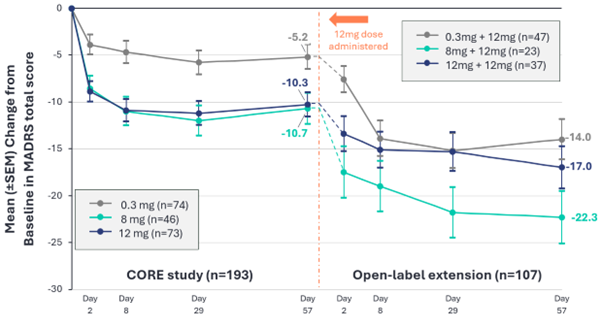
Core Insights - Atai Beckley N.V. announced positive topline results from the open-label extension study of its Phase 2b clinical trial of BPL-003 for treatment-resistant depression, showing that a 12 mg dose provided additional rapid and sustained antidepressant effects for up to eight weeks [1][4][7] Company Overview - Atai Beckley is a clinical-stage biopharmaceutical company focused on developing effective mental health treatments, formed through the merger of atai Life Sciences and Beckley Psytech Limited in November 2025 [13] - The company is advancing BPL-003, a proprietary intranasal formulation of mebufotenin benzoate, which has received Breakthrough Therapy designation from the FDA for treatment-resistant depression [12][13] Clinical Trial Details - The Phase 2b clinical trial consisted of a core study and an open-label extension study, with 126 patients completing the core study and 107 continuing into the extension study [2][4] - The core study evaluated the efficacy and safety of single doses of BPL-003 (0.3 mg, 8 mg, or 12 mg), while the extension study assessed the effects of a second 12 mg dose administered eight weeks later [2][4] Efficacy Findings - A 12 mg dose of BPL-003 administered eight weeks after an initial dose resulted in a 63% response rate and a 48% remission rate at Week 8 of the open-label extension study [4][8] - Patients who received an 8 mg dose in the core study showed a mean reduction in MADRS score of 22.3 points at Day 57 in the extension study, with an 81% responder rate and a 67% remission rate [8] Safety Profile - The safety and tolerability profile of BPL-003 was consistent with prior studies, with most adverse events being mild or moderate and transient [8] - Common side effects included nausea, headache, and anxiety, with one serious drug-related adverse event reported but resolved with monitoring [8] Next Steps - The company plans to meet with the FDA for an End-of-Phase 2 meeting to discuss the Phase 3 clinical development program, with guidance expected in Q1 2026 and trial initiation anticipated in Q2 2026 [9][10]
Johnson & Johnson to highlight breadth of its major depressive disorder portfolio at 2025 ECNP Congress
Prnewswire· 2025-10-10 11:30
Core Insights - Johnson & Johnson presented 17 abstracts at the European College of Neuropsychopharmacology (ECNP) Congress, showcasing new clinical and real-world data on major depressive disorder (MDD) and treatment-resistant depression (TRD) [1][2]. Group 1: Major Depressive Disorder (MDD) - MDD affects approximately 332 million people globally, representing about 4% of the population, with around 22 million adults in the U.S. experiencing at least one major depressive episode in 2023 [8]. - The disorder is complex and heterogeneous, with up to 256 unique symptom combinations, leading to varied treatment responses [8]. - Current standard-of-care oral antidepressants leave 2 in 3 patients with residual symptoms, highlighting the need for innovative treatment approaches [8]. Group 2: Treatment-Resistant Depression (TRD) - About one-third of adults with MDD do not respond to oral antidepressants and are classified as having TRD, which significantly impacts their quality of life and has a high economic burden [11]. - The STAR*D study indicates that approximately 86% of patients do not achieve remission after trying their third oral antidepressant [11]. Group 3: New Treatment Data - New analyses from Phase 3 data evaluate the impact of CAPLYTA (lumateperone) on sexual function in MDD patients, suggesting a potential to reset treatment expectations [6]. - A sub-group analysis of Phase 3 data compares the efficacy of adjunctive seltorexant with quetiapine XR in MDD patients with insomnia symptoms [6]. - Findings from the ESCAPE-TRD study explore the association between patient characteristics and remission with SPRAVATO (esketamine) versus quetiapine XR in TRD patients [6]. Group 4: Company Commitment - Johnson & Johnson emphasizes a patient-first approach in developing innovative therapies for MDD and TRD, as stated by the Global Neuroscience Therapeutic Area Head [2].


atai Life Sciences Announces Positive Topline Data from Part 2 of Beckley Psytech's Phase 2a Study of BPL-003 in Combination with SSRIs for Treatment-Resistant Depression
GlobeNewswire News Room· 2025-05-20 11:00
Core Insights - Atai Life Sciences announced positive topline data from Beckley Psytech's Phase 2a study of BPL-003, indicating a rapid and durable antidepressant effect for treatment-resistant depression when administered with SSRIs [1][2][6] - BPL-003 was well-tolerated, with patients able to be discharged within an average of less than two hours after dosing [1][3] - The Phase 2b study results are expected in mid-2025, with 196 patients enrolled, marking it as the largest controlled clinical study for mebufotenin [7] Study Findings - A single dose of BPL-003 resulted in a mean MADRS reduction of 18 points from baseline the day after dosing, 19 points one month later, and 18 points three months post-dosing [4] - The open-label Phase 2a study involved 12 patients with moderate-to-severe depression who had not responded to at least two prior treatments [2][6] Treatment Context - BPL-003 is designed as a rapid and durable treatment for treatment-resistant depression and is administered via an intranasal spray [8] - The findings support the potential for BPL-003 to fit within the current interventional psychiatric care model, similar to Spravato® [5] Company Background - Atai Life Sciences is focused on developing effective mental health treatments, with a pipeline that includes other psychedelic-based therapies for various mental health conditions [12] - Beckley Psytech, in which Atai holds a significant stake, is dedicated to developing rapid-acting psychedelic medicines for neuropsychiatric disorders [11]