Truck Capacity

Search documents
J.B. Hunt ‘a little bit more positive’
Yahoo Finance· 2026-02-18 15:44
Core Viewpoint - J.B. Hunt Transport Services has observed a tightening in truck capacity and a more positive demand trend than previously expected, as indicated by management's commentary at an investor conference [1]. Group 1: Market Conditions - Truck capacity has notably tightened, with demand trending ahead of prior expectations, as stated by the CFO of J.B. Hunt [1]. - Tender rejections and spot rates have increased since the week before Thanksgiving, without the typical seasonal retreat, indicating a tighter market [2]. - The National Truckload Index (NTIL) shows elevated spot rates due to new constraints on the driver pool and severe winter weather [4]. Group 2: Regulatory Impact - Increased regulation on the driver pool has led to a modest peak season, with a competitive hiring environment for drivers despite limited demand [3][5]. - Regulatory enforcement is contributing to the capacity squeeze, affecting the company's brokerage and transportation segments [5]. Group 3: Company Performance - J.B. Hunt's dedicated segment signed a record number of new customers last year, with a goal of net fleet growth of 800 to 1,000 trucks annually [6]. - The company experienced a net contraction of approximately 100 units in its fleet due to planned customer attrition, despite selling dedicated service on 1,200 tractors [6]. - Customer retention rates have historically been above 98%, indicating strong customer loyalty [6]. Group 4: Future Outlook - The company believes it is too early to set expectations for the upcoming bid season, but both main segments are positioned to perform well in 2026 following a downturn [5]. - New accounts typically operate at a loss for the first three months but are expected to break even by the sixth month, suggesting a cautious approach to onboarding new customers [8].

Schneider National’s shares sink on weak Q4, 2026 outlook
Yahoo Finance· 2026-01-29 23:11
Core Insights - Schneider National's fourth-quarter results and full-year 2026 guidance fell short of expectations, leading to a 16% drop in shares during after-hours trading [1] - The company reported adjusted earnings per share of 13 cents, which was 7 cents below consensus estimates and the previous year's results [1] - Consolidated revenue reached $1.4 billion, marking a 5% year-over-year increase but was $50 million below consensus [1] Financial Performance - The Truckload (TL) unit generated $610 million in revenue, a 9% year-over-year increase, driven by a 12% rise in truck count, although revenue per truck per week declined by 2% [3] - Dedicated revenue increased by 13% year-over-year, attributed to the acquisition of Cowan Systems, with dedicated truck count up 18% but revenue per truck per week down 4% [4] - Intermodal revenue decreased by 3% year-over-year to $268 million, as a 3% increase in loads was offset by a 5% decline in revenue per load [9] Operational Challenges - Management cited "softer than expected market conditions" in November and "material tightening in December" due to severe weather, which impacted overall performance [2] - The earnings shortfall was driven by increased purchased transportation costs, weather-related expenses, and heightened healthcare costs [3] - The TL unit reported a 96.2% adjusted operating ratio, which is 30 basis points better year-over-year and 60 basis points better than the third quarter [5] Market Dynamics - Heightened regulatory enforcement on the driver pool is affecting capacity, with some shippers inquiring about mini bids due to shrinking capacity risks [6] - The Outbound Tender Rejection Index indicates a tightening truckload market, reflecting the number of loads being rejected by carriers [7] - The National Truckload Index shows elevated spot rates due to new constraints on the driver pool and severe winter weather [8]

Freight Recession Nearing an End? Truck Capacity Signals Tighten
CNBC Television· 2025-12-22 12:25
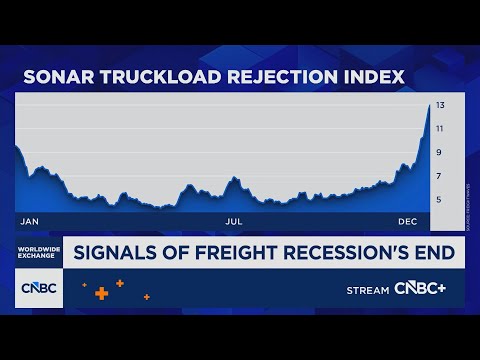
All right, turn it now [music] to the transports. Dow transports coming off a four-week win streak. And take a look at this chart.It could be a sign the freight recession is possibly coming to an end, or at least the demand environment is becoming more favorable for carriers. This is the sonar truckload rejection index. It's at a year high and its highest level since May of 2022.That was just before what is now considered by many the longest freight recession ever. I spoke with Craig Fuller from Freight Wav ...