
US-India trade deal

Search documents
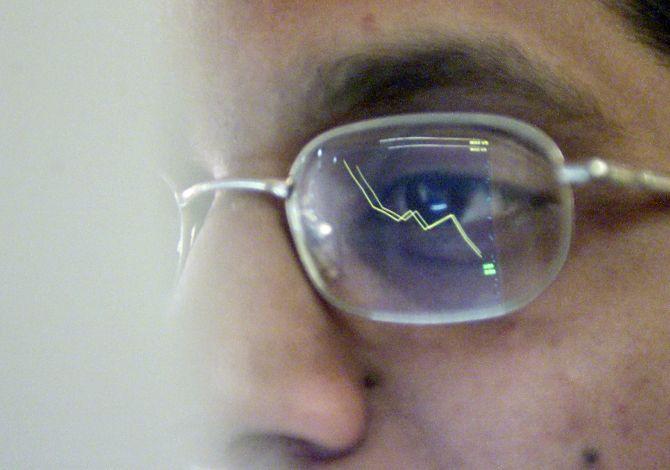
Sensex crashes over 1K points on selling in metal, IT stocks
Rediff· 2026-02-13 12:12
Market Overview - Benchmark equity indices Sensex and Nifty experienced a decline of more than 1 percent due to a broad selloff, particularly in metal, IT, and commodity stocks, reflecting sluggish global market conditions [3][4][9] - The 30-share BSE Sensex fell by 1,048.16 points, or 1.25 percent, closing at 82,626.76, with an intraday low of 82,534.55 [3] - The 50-share NSE Nifty dropped by 336.10 points, or 1.30 percent, settling at 25,471.10, hitting an intraday low of 25,444.30 [4] Sector Performance - Major laggards among Sensex constituents included Hindustan Unilever, Tata Steel, Tata Consultancy Services, and HCL Technologies, while Bajaj Finance and State Bank of India were the only gainers [5][6] - Profit-booking was observed in metal stocks amid a stronger dollar index, influenced by geopolitical developments regarding Russia's return to the US-dollar settlement system [10] Analyst Insights - Analysts noted that domestic equities ended lower due to weak global cues and concerns over upcoming US inflation data [7] - Sentiment from the US-India trade deal has diminished, with renewed fears of AI-driven disruption affecting risk appetite, particularly for Indian IT firms reliant on the labor arbitrage model [7][9] - The cautious market tone led to negative performance across all major indices, with most sectors closing in the red [9] Asian Market Performance - Asian markets, including Hong Kong's Hang Seng, Shanghai's SSE Composite, Japan's Nikkei 225, and South Korea's Kospi, also ended in negative territory [11] - Foreign institutional investors purchased equities worth Rs 108.42 crore, while domestic institutional investors were net buyers of stocks worth Rs 276.85 crore [11]

Trump Slashes India Tariffs After Modi Agrees To Drop Russian Oil, Go Full 'BUY AMERICAN'
ZeroHedge· 2026-02-02 17:50
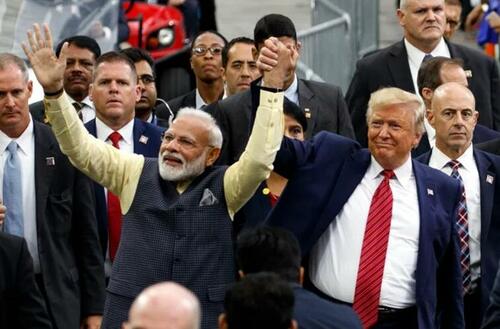
Core Viewpoint - The United States will reduce its punitive tariff on Indian imports from 25% to 18% as part of a new trade deal with India, which involves India ceasing its purchases of Russian crude oil and increasing imports from the U.S. [1][2][4] Trade Agreement Details - The agreement is framed as a significant geopolitical win, with India agreeing to stop buying Russian oil and to increase purchases from the U.S. and potentially Venezuela, contributing to efforts to end the war in Ukraine [2][4] - The deal is characterized by a deepening of U.S.-India trade and energy ties, marking a shift from previous tariff escalations [4][6] - The U.S. will cut its "reciprocal tariff" on Indian goods to 18%, while India will eliminate tariffs and non-tariff barriers on American products [8][10] Economic Impact - Following the announcement, India's Nifty 50 index futures surged by 3.8%, and the U.S.-listed iShares MSCI India ETF rose by 2.4%, indicating positive market sentiment [5] - The Indian rupee gained 1% against the dollar in offshore trading, reflecting investor confidence in the new trade dynamics [5] Energy Sourcing Challenges - India has been importing approximately 1.5 million barrels per day of Russian crude, and transitioning away from this sourcing will be complex and time-consuming [7] - Indian officials have previously defended these imports as essential for energy security, highlighting the challenges in shifting energy sourcing [7] Future Commitments - Modi has committed to a substantial "BUY AMERICAN" initiative, which includes over $500 billion in U.S. energy, technology, agriculture, coal, and other exports [8]
Sensex, Nifty flat at open after 2-day slide amid mixed global cues
The Economic Times· 2025-12-17 04:00
Market Overview - Indian equities opened largely unchanged, with the Sensex rising 51 points (0.06%) to 84,731 and the Nifty 50 slipping 14 points (0.05%) to 25,874, as investors weighed mixed signals from global markets and inconclusive U.S. jobs data [15] - The broader market showed little conviction, with mid-cap and small-cap indices trading largely flat [15] Stock Performance - Among Sensex constituents, shares of State Bank of India, Bajaj Finance, and Tata Consultancy Services led the advance, rising between 1% and 1.5% [15] - Akzo Nobel India slid about 15% after reports indicated that Imperial Chemical Industries sold roughly 48.8 lakh shares in the company through a block deal [15] - RailTel Corporation of India climbed 2% on reports of potential partnership talks with Elon Musk-owned Starlink in India [15] Foreign Institutional Investment - Foreign Institutional Investors (FIIs) sold equities worth nearly Rs 2,382 crore on December 16, while Domestic Institutional Investors (DIIs) were net buyers to the tune of Rs 1,077 crore [10] Currency and Commodities - The Indian rupee weakened in early trade, falling 12 paise to 91.05 against the U.S. dollar, a day after hitting a record low of 91.0750 [13] - U.S. crude futures rose 1.3% to $55.97 a barrel, while Brent crude gained 1.15% to $59.60, recovering some losses amid geopolitical risks and concerns over global demand [12][11] Economic Insights - The recent sharp fall in the rupee and crude oil prices has attracted investor attention, with a decline in crude due to poor demand from China and the U.S. being viewed positively for India's macroeconomic conditions [5] - Dr. VK Vijayakumar, Chief Investment Strategist at Geojit Investments, noted that sustained rupee depreciation is accelerating FII outflows, negatively impacting the market [6] - There is a potential for FIIs to become buyers in India by 2026, especially if a U.S.-India trade deal occurs, which could lead to rupee strengthening in H1 2026 [7]
