Uranium exploration

Search documents
Global Uranium Corp. Plans Ambient Noise Tomography Survey at Astro Project
Globenewswire· 2026-03-26 12:00
Core Viewpoint - Global Uranium Corp. is advancing its Astro Project in Saskatchewan by initiating an Ambient Noise Tomography survey to refine high-priority structural targets and prepare for future drilling [1][4][6]. Group 1: Project Overview - The Astro Project is located in the eastern Athabasca Basin, and the company holds an option to acquire an 80% interest in it from Cosa Resources Corp., contingent on meeting certain earn-in requirements [1]. - The planned ANT program builds on a previous 2025 helicopter-borne ZTEM survey that identified a 25-kilometre conductive corridor and seven target zones, including three high-priority areas [2][6]. Group 2: Survey Details - The ANT survey will focus on the most prospective areas identified, particularly the AS-1 target, to refine targets by identifying key geological features at depth [3]. - The survey is expected to begin in early June and be completed by July, with final results anticipated in August, which will inform subsequent ground work and drill targeting [5]. Group 3: Strategic Importance - The ANT survey is a critical step in advancing the Astro Project towards planning for future drilling, aiming to define high-confidence drill targets and support follow-up geophysical programs [4][6]. - The CEO of Global Uranium Corp. emphasized the significance of the ANT survey in refining targets and assessing the potential of the Astro Project within the Athabasca Basin [6].


Geiger Mobilizes for 10,000-Metre Drill Program at Aberdeen Project in the Thelon Basin
TMX Newsfile· 2026-03-23 10:00
Core Insights - Geiger Energy Corp. is preparing for a 10,000 metre summer drill program starting in June 2026 at the Aberdeen Project in the Thelon Basin, Nunavut, focusing on high-grade uranium targets [2][9] Exploration Program - The 2026 drilling program will primarily target the Loki and Tatiggaq areas, where previous exploration has indicated strong uranium potential and mineralization [3][4] - At Loki, the company has identified uranium mineralization at shallow depths within Thelon Formation sandstone, alongside significant alteration systems similar to those found in major Athabasca Basin deposits [3][6] - The Tatiggaq area is recognized for its high-grade basement-hosted uranium discovery, which remains open for further expansion [4][7] Strategic Objectives - The program aims to discover high-grade uranium mineralization, positioning the Thelon Basin as a significant undeveloped uranium play globally [5][9] - The company plans to identify structural traps that have led to uranium enrichment, with the goal of uncovering high-grade intersections in the region [4][5] Project Overview - The Aberdeen Project encompasses over 50 high-priority targets, many of which show strong alteration and anomalous uranium from limited historical drilling [13] - The Tatiggaq prospect consists of two high-grade pods over a 300-metre area, with ongoing testing planned to assess the extent of mineralization [7][12] Logistics and Operations - Preparations for the drilling program include winter overland hauling to transport supplies to the camp site, utilizing snow-tracked vehicles for cost-effective logistics [10]


Nexus Uranium Enters One of America's Highest-grade Historic Uranium Districts, Acquiring Seven Drill-Ready Breccia Pipe Targets on the Arizona Strip
TMX Newsfile· 2026-03-19 09:00
Core Viewpoint - Nexus Uranium Corp. has entered into a definitive agreement to acquire a 100% interest in the Arizona Strip Project, which includes 38 federal Bureau of Land Management lode mining claims in Mohave County, Arizona, known for its high-grade uranium deposits [1][2][5]. Acquisition Details - The acquisition involves a share purchase agreement with an arm's length company, where Nexus will issue 2,700,000 common shares to acquire all common shares of the Vendor, which holds the mining claims [5][6]. - The transaction is subject to acceptance by the Canadian Securities Exchange and other customary closing conditions, with closing expected to occur shortly [6]. Project Significance - The Arizona Strip is recognized as one of the most prolific uranium districts in the U.S., with historic mines producing uranium at grades ranging from 0.42% to 1.08% U₃O₈, among the highest in North America [2][3]. - Previous exploration activities have included ground geophysical surveys, surface geochemical sampling, and drilling, which have identified uranium and multi-element pathfinder anomalies across the seven targets [4]. Strategic Intent - The acquisition aligns with the company's strategy to build a diversified portfolio of uranium assets across established U.S. districts, complementing its existing Chord Project in South Dakota [3]. - The prior operator's groundwork provides a strong foundation for Nexus to compile historic data and plan follow-up exploration programs [3][4]. Technical Overview - The seven targets within the Arizona Strip Project have been previously explored, with significant findings including high uranium values and multi-element anomalies [12]. - Specific targets such as SGB, RN, and EM have shown promising indicators of mineralization, including elevated copper and confirmed collapse pipe structures [12]. Company Background - Nexus Uranium is a Canadian exploration company focused on uranium projects in North America, holding multiple projects in South Dakota and Wyoming, as well as the Mann Lake project in Saskatchewan [9].

Video - CEO Clips: Cosa Resources Advances Uranium Exploration in the Athabasca Basin
TMX Newsfile· 2026-03-19 06:00
Group 1 - Cosa Resources is advancing uranium exploration in Saskatchewan's Athabasca Basin, focusing on drill campaigns over the next 12 to 24 months near the Cigar Lake mine and Hurricane deposit [1] - The company has a strong treasury and strategic partnerships, emphasizing high-potential targets in a leading uranium district [1]

Denison Mines begins Wheeler North 2026 exploration programme
Yahoo Finance· 2026-03-10 11:02
Core Viewpoint - Denison Mines has initiated the 2026 winter exploration program at the Wheeler North joint venture, which includes a comprehensive 7,500m diamond drilling campaign targeting high-priority areas in Saskatchewan's Athabasca Basin [1][2]. Group 1: Exploration Program Details - The winter exploration program consists of approximately 2,500m of diamond drilling at the Fox Lake Trail target, marking the beginning of a larger drilling campaign [1]. - The Wheeler North property covers 16,409 hectares across eight claims and features multiple high-priority drill targets [2]. - Denison Mines is fully funding and managing the exploration effort as part of a strategic joint venture agreement with Skyharbour Resources [2]. Group 2: Ownership and Investment Structure - Skyharbour Resources holds a 51% ownership stake in the Wheeler North property, while Denison Mines holds 49% and operates the project [2]. - Denison has the option to increase its stake to 70% through a phased earn-in agreement, requiring an investment of C$10 million ($7.36 million) in exploration within 48 months [3]. - To achieve 60% ownership, Denison must invest C$10 million, including C$2.5 million within the first two years, and pay Skyharbour $1.5 million [3]. Group 3: Target Areas and Geological Insights - The Fox Lake Trail target features several parallel electromagnetic conductors, enhanced by recent ground geophysical surveys [4]. - The Fork Zone has been identified as a key focus due to its high-grade uranium mineralization potential, with a previously reported discovery hole encountering 3% triuranium octoxide over 0.5m [4]. - The Sphinx target also presents promising opportunities near Denison's Phoenix uranium deposit, contributing to the overall strategic value of the joint venture [5]. Group 4: Future Plans and Infrastructure - The joint ventures, including Wheeler North, are set to undergo more than 15,000m of diamond drilling throughout 2026, indicating a robust exploration strategy [5]. - The location of these ventures is strategically advantageous, being centrally located in the eastern Athabasca Basin and adjacent to significant infrastructure such as highways and power grids [5].

Atomic Initiates Lisbon Valley East Drill Permitting
TMX Newsfile· 2026-03-03 13:00
Core Viewpoint - Atomic Minerals Corporation has submitted drill permits for its South Lisbon Valley East property, indicating a strong belief in the potential for significant uranium mineralization in the area, which is analogous to previously productive uranium belts in the region [1][4]. Company Overview - Atomic Minerals Corporation is a publicly listed exploration company on the TSXV under the symbol ATOM, with a management team experienced in the junior mining sector [11]. - The company aims to identify exploration opportunities in underexplored regions that are geologically similar to areas with past uranium discoveries [11]. Property Details - The South Lisbon Valley East property spans 1,516.5 acres (614 hectares) and is located approximately 35 kilometers northeast of Monticello, Utah [1]. - The property is situated in the Colorado Plateau, which is known for hosting the largest uranium province in the USA, having produced 597 million pounds of uranium to date [7][12]. Exploration Plans - The company plans to drill an initial 18-20 holes across the property to test for uranium mineralization and establish the full width of the suspected arcuate belt [4]. - Drilling will utilize existing road and trail structures from historic oil and gas drilling, focusing on areas with significant gamma ray spikes [5]. Historical Context - The Lisbon Valley has a history of uranium production, yielding approximately 78 million pounds of U3O8 from 1952 to 1982 from a belt measuring 16 miles long by 1 mile wide [8]. - Historical oil and gas drilling in the area has indicated anomalous gamma ray readings, suggesting the presence of uranium mineralization in the Chinle Formation [9].


Collective Metals Announces Plans for Inaugural Drill Program at the Rocas Uranium Project
Globenewswire· 2026-03-02 13:00
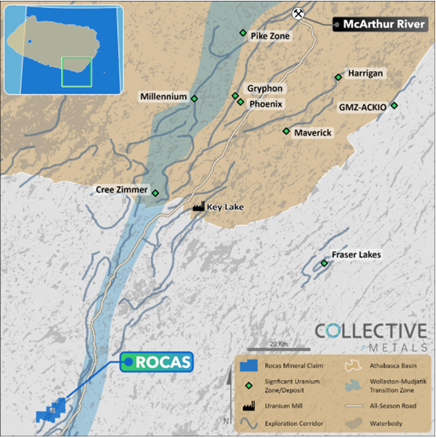
Core Viewpoint - Collective Metals Inc. has finalized plans for its inaugural drill campaign at the Rocas Uranium Project, targeting high-priority uranium areas identified through previous prospecting and geophysical surveys [2][3]. Drill Program Details - The Phase I drilling program will consist of approximately 1,200 to 1,500 meters across six to eight drill holes, focusing on shallow, high-grade basement-hosted uranium mineralization [3]. - The drilling will test target zones defined by anomalous uranium occurrences identified during the 2025 prospecting program and geophysical work completed in 2024 [3][4]. Prospecting and Mapping Results - Preliminary results from the 2025 prospecting and mapping program revealed anomalous radioactivity readings of up to 33,000 counts-per-second (cps), with ten separate occurrences exceeding 10,000 cps [3][6]. - Historical mineralized outcrop grab samples along approximately 900 meters of strike length returned values ranging from 587 ppm U to 0.498 wt.% U3O8, none of which have been drill-tested [6][20]. Funding and Logistics - The Company will fully fund the drilling program to meet the year-one expenditure requirements under the definitive property option agreement with Standard Uranium [3]. - Key contracts for the program have been secured, and diamond drilling crews are expected to mobilize to the project as early as mid-March [3]. Exploration Potential - The Rocas Project is considered highly prospective for the discovery of shallow, high-grade basement-hosted uranium mineralization, located near the Athabasca Basin margin [9][20]. - The project area hosts several uranium occurrences and has remained untested by drilling to date, with a focus on a 7.5-kilometer magnetic low/EM conductive corridor [4][20].
Myriad Uranium's Preliminary Interpretation of High-Resolution Geophysics at Copper Mountain Provides Strong Additional Validation for District-Scale Uranium Endowment. Ground-Truthing Program Underway.
TMX Newsfile· 2026-03-02 10:30
Core Viewpoint - Myriad Uranium Corp. has completed preliminary interpretation of data from a high-resolution airborne magnetic and radiometric survey at the Copper Mountain Uranium Project, leading to the identification of new anomalies and the initiation of ground-truthing to validate these findings [1][2]. Survey Results - The airborne survey covered approximately 191.8 km², with 2,114 line-kilometers completed at 100 m line spacing, revealing over 100 prioritized anomaly points, predominantly located east of the north-south structural corridor [9][3]. - The combined magnetic and radiometric dataset suggests a large hydrothermal system that may host additional uranium mineralization beyond historically drilled areas [3][7]. Ground-Truthing Program - Myriad has commenced field work to validate selected radiometric anomaly points, with initial results aligning with airborne data, indicating elevated radiometric counts [4][8]. - The ground-truthing aims to confirm the presence and intensity of uranium mineralization, characterize geological settings, and refine priority drill targets [8][4]. Company Background - Myriad Uranium Corp. holds a 75% interest in the Copper Mountain Uranium Project, which has multiple historic uranium deposits and past-producing mines, with a definitive agreement to acquire the remaining 25% interest [13]. - The project has a history of extensive exploration, with Union Pacific investing approximately C$117 million (2024 dollars) in the late 1970s, resulting in significant historical resource estimates [13].


Drilling Underway at Geiger's Hook Project in the Athabasca
TMX Newsfile· 2026-02-24 11:00
Core Viewpoint - Geiger Energy Corp. has commenced drilling at its 100% owned Hook Project in Saskatchewan, with a focus on expanding the ACKIO discovery and exploring additional targets in the area [1][2]. Project Overview - The drilling program will involve approximately 3,000 metres across 8-15 drill holes, depending on results, targeting areas ACKIO and TT [4][12]. - The 2026 program aims to identify additional discoveries to enhance the mineralization potential of the Hook Project [4]. Target Areas - The ACKIO area will be tested to expand known high-grade lenses and explore approximately 500 metres along the trend for potential new deposit zones [13]. - The TT area, located about 5.5 km southwest of ACKIO, will be tested below historical clay alteration zones, with three to five drill holes planned [13]. - Other prospective areas for testing include NES, Westside, and TAB, based on favorable magnetic and gravity anomalies [13]. Company Background - Geiger Energy controls approximately 390,000 hectares in Saskatchewan's Athabasca Basin and 95,519 hectares in Nunavut's Thelon Basin, focusing on high-grade uranium deposits [5]. - The company's flagship asset, the Aberdeen Project, features high-grade discoveries and numerous high-priority targets, many of which remain untested [6][7]. ACKIO Discovery Details - The ACKIO prospect extends over 375 metres along strike and 150 metres in width, with at least nine distinct uranium pods starting at 28 metres depth and continuing to approximately 300 metres [8]. - The Hook Project also contains large clay-alteration systems with elevated radioactivity, indicating further discovery potential beyond the ACKIO area [8].

Myriad Uranium Corp. Announces Participation in Red Cloud's Pre-PDAC Mining Showcase
TMX Newsfile· 2026-02-24 10:00
Core Viewpoint - Myriad Uranium Corp. will present at Red Cloud's Pre-PDAC Mining Showcase, highlighting its strategy and recent developments in uranium exploration [1][2]. Company Overview - Myriad Uranium Corp. is a uranium exploration company with a 75% interest in the Copper Mountain Uranium Project in Wyoming, USA, which has known uranium deposits and historic mines, including the Arrowhead Mine that produced 500,000 lbs U3O8 [4]. - The Copper Mountain project has seen extensive drilling, with approximately 2,000 boreholes drilled, and has significant exploration potential, supported by an estimated C$117 million (2024 dollars) spent by Union Pacific on exploration and development [4]. - The company also holds a 100% interest in the Red Basin Uranium Project in New Mexico, which features near-surface mineralization and significant upside potential [4].