Viksit Bharat 2047

Search documents
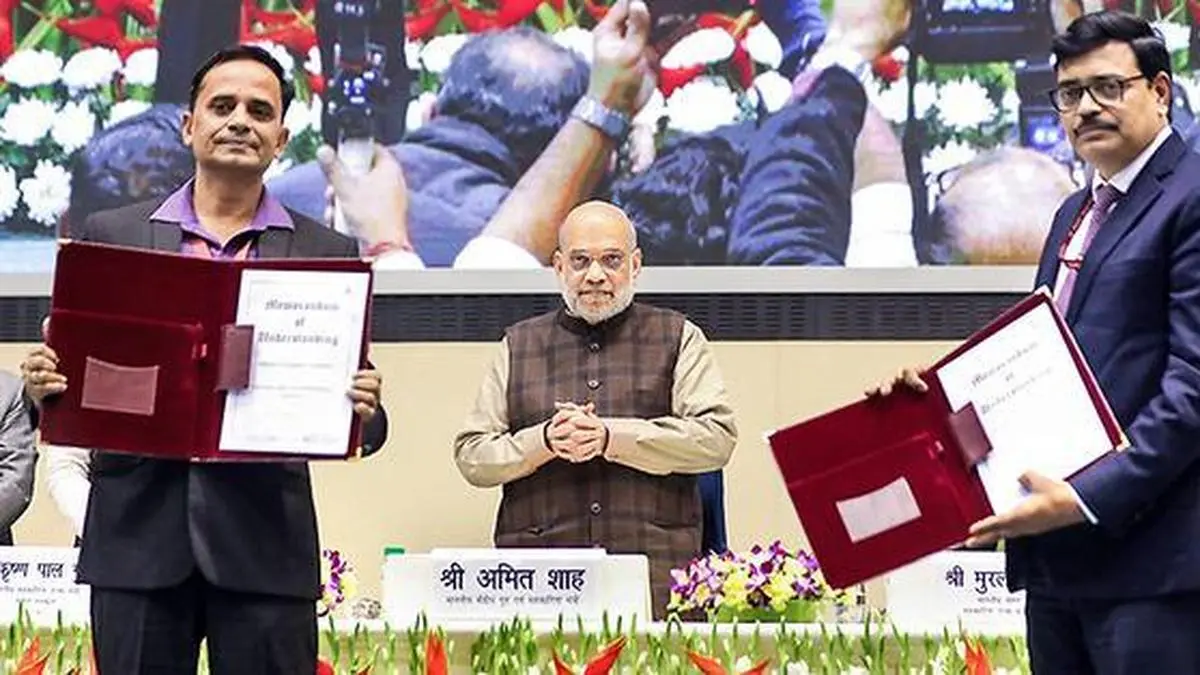
Airport Authority of India signs MoU with Bharat taxi for enhanced last-mile connectivity at select airports
BusinessLine· 2026-02-08 04:13
Core Insights - The Airports Authority of India (AAI) has signed a Memorandum of Understanding (MoU) with Bharat Taxi to enhance cab services at various airports, focusing on passenger-friendly and regulated transportation options [1][2] - This partnership aims to improve last-mile connectivity for air travelers, ensuring transparent and fair pricing without surge charges, while also prioritizing driver welfare [2][3] Company Overview - Bharat Taxi operates as a driver-owned cooperative taxi service, supported by the National Cooperative Development Corporation and other cooperative institutions, distinguishing itself from traditional ride-hailing platforms [2][3] - The service is part of Bharat Taxi's expansion strategy, following its recent launch as India's first cooperative-based taxi service [4] Service Implementation - The collaboration will initially roll out services at airports in Rajkot, Vadodara, Surat, Bhuj, Pune, Aurangabad, Varanasi, Kanpur, Prayagraj, and Agra [4] - The initiative is expected to enhance passenger experiences by providing reliable, surge-free transportation while empowering local drivers through a cooperative framework [5] Strategic Partnerships - Bharat Taxi has established partnerships with various institutions, including the Delhi Traffic Police and State Bank of India, to facilitate regulated operations and integrated last-mile solutions [5]

India's big bank moment has arrived. Why it matters
The Economic Times· 2025-11-07 10:03
Core Perspective - India's ambition to create at least two globally competitive banks among the world's top 20 aligns with its broader developmental goals, particularly the "Viksit Bharat 2047" roadmap, which envisions an economy capable of financing its own transformation [1][12] Group 1: Banking Landscape and Consolidation - India's banking landscape has been characterized by fragmentation, with numerous public sector banks (PSBs) operating with overlapping mandates [2][13] - The government's consolidation drive in 2020 reduced the number of state-owned banks from 27 to 12, aiming to create institutions with stronger balance sheets and broader reach [2][13] - The current consolidation effort may merge stronger, mid-sized PSBs into larger entities to build globally resilient institutions [13] Group 2: Importance of Scale - The scale of financial institutions is crucial for funding large-scale projects, managing risks, and influencing markets [5][12] - India's largest lender, the State Bank of India (SBI), has assets of around USD 846 billion, ranking 43rd globally, and would need to triple its balance sheet to break into the top 10 [13] - Large banks are better positioned to support multi-billion-dollar infrastructure projects and raise capital on favorable terms in international markets [13] Group 3: Reform and Modernization - Experts emphasize that mergers alone cannot create world-class banks; reforms in governance, human resources, and technology are essential [5][12] - Successful mega-banks must modernize through digital transformation, data-driven lending, and advanced risk management systems [6][12] - The government's proposal to raise the foreign investment limit in PSBs from 20% to 49% aims to improve access to international capital and attract long-term strategic investors [7][8] Group 4: Challenges and Considerations - The ambition to create large banks raises questions about enhancing profitability, governance, and service quality, as larger balance sheets do not guarantee better banking [9][10] - Merging large institutions involves complex integration challenges, including technology systems and corporate cultures [11][12] - There is a risk of creating "too big to fail" institutions, which could heighten systemic vulnerability if not managed prudently [11][12] Group 5: Potential Rewards - A handful of globally strong Indian banks could champion the country's international trade, infrastructure finance, and digital banking leadership [12] - With a stronger capital base and better access to foreign markets, these banks could help Indian firms expand globally while providing the domestic economy with the necessary credit depth [12]

Global ambition: India aims to place two PSBs among top 20 banks; ‘Viksit Bharat 2047’ drives long-term vision
The Times Of India· 2025-09-13 10:18
Group 1 - The Indian government aims to develop at least two public sector banks (PSBs) that rank among the top 20 global lenders by assets as part of its 'Viksit Bharat 2047' vision [4] - Currently, only State Bank of India (SBI) and HDFC Bank are in the top 100 global banks, ranked 43rd and 73rd respectively [4] - The financial performance of the 12 PSBs has improved significantly, with a cumulative net profit of Rs 1.78 lakh crore in FY25, a 26% increase from the previous year, and SBI contributing over 40% of this profit [4] Group 2 - Key discussions at the PSB conclave included strengthening corporate governance, enhancing customer experience, improving risk management, and utilizing artificial intelligence for modernization [4] - Gross non-performing assets (NPAs) have decreased to 2.58% as of March 2025, down from 9.11% in 2021 [4] - The conclave also focused on priority sector lending, particularly to agriculture and MSMEs, with non-food credit growth easing to 9.9% year-on-year in July 2025 [4] Group 3 - Discussions emphasized improving the CASA ratio, diversifying operations, and strengthening risk management to better absorb economic shocks [3] - Participants included key figures from the Department of Financial Services, SBI, Punjab National Bank, and the Reserve Bank of India [3] - The government underscored the importance of organic growth and operational autonomy for banks to achieve global scale, aiming for a significant international role by 2047 [3]
FinMin for creation of two globally competitive banks as part of Viksit Bharat vision
The Economic Times· 2025-09-12 15:43
Core Insights - India aims to establish two globally competitive banks that rank among the top 20 lenders in the world as part of its 'Viksit Bharat 2047' vision [11] - The discussions during the PSB Manthan 2025 focused on enhancing the scale and size of public sector banks (PSBs) to achieve this goal [11] Financial Performance - The cumulative profit of public sector banks reached a record level of Rs 1.78 lakh crore in FY25, marking a 26% increase from the previous year [5][11] - In FY24, all 12 public sector banks collectively earned a profit of Rs 1.41 lakh crore, with an increase of approximately Rs 37,100 crore in FY25 [5][11] - State Bank of India (SBI) contributed over 40% of the total earnings in FY25, with a net profit of Rs 70,901 crore, a 16% increase from Rs 61,077 crore in the previous fiscal [6][11] - Punjab National Bank reported the highest net profit growth of 102% to Rs 16,630 crore, followed by Punjab & Sind Bank with a 71% rise to Rs 1,016 crore [6][11] Strategic Discussions - The meeting emphasized improving the autonomy of banks' boards to enhance efficiency in commercial decision-making [7][11] - Diversifying operations to gain expertise in other banking segments was discussed as a means for PSU banks to become globally relevant [8][11] - Challenges related to information technology, cyber-security, customer service, and grievance handling were also addressed [8][11] Historical Context - The PSB Manthan event is a continuation of previous initiatives, with the last one held in April 2022 focusing on Enhanced Access & Service Excellence (EASE) reforms [9][11]
Unlocking the True Potential of Academia for Viksit Bharat | Umesh Rathod | TEDxSAKEC
TEDx Talks· 2025-06-24 16:16
Let's not begin with what we are but what we could have been. Imagine India of 1947 we have just got independence. What could have happened if we could have adopted not the clerical you know job creation uh education system for the British Empire but rather an opportunity for education uh you know ecosystem where we cultivated creators risktakers and nation builders.What if our classrooms were not about silence and obedience but about dialogue, discovery and dissent. Right. What if we instead of rewarding m ...