Vision-Language-Action

Search documents
走向融合统一的VLA和世界模型......
自动驾驶之心· 2025-12-23 09:29
Core Viewpoint - The article discusses the integration of two advanced directions in autonomous driving: Vision-Language-Action (VLA) and World Model, highlighting their complementary nature and the trend towards their fusion for enhanced decision-making capabilities in autonomous systems [2][51]. Summary by Sections Introduction to VLA and World Model - VLA, or Vision-Language-Action, is a multimodal model that interprets visual inputs and human language to make driving decisions, aiming for natural human-vehicle interaction [8][10]. - World Model is a generative spatiotemporal neural network that simulates future scenarios based on high-dimensional sensor data, enabling vehicles to predict outcomes and make safer decisions [12][14]. Comparison of VLA and World Model - VLA focuses on human interaction and interpretable end-to-end autonomous driving, while World Model emphasizes future state prediction and simulation for planning [15]. - The input for VLA includes sensor data and explicit language commands, whereas World Model relies on sequential sensor data and vehicle state [13][15]. - VLA outputs direct action control signals, while World Model provides future scene states without direct driving actions [15]. Integration and Future Directions - Both technologies share a common background in addressing the limitations of traditional modular systems and aim to enhance autonomous systems' cognitive and decision-making abilities [16][17]. - The ultimate goal for both is to enable machines to understand environments and make robust plans, with a focus on addressing corner cases in driving scenarios [18][19]. - The article suggests that the future of autonomous driving may lie in the deep integration of VLA and World Model, creating a comprehensive system that combines perception, reasoning, simulation, decision-making, and explanation [51]. Examples of Integration - The article mentions several research papers that explore the fusion of VLA and World Model, such as 3D-VLA, which aims to enhance 3D perception and planning capabilities [24][26]. - Another example is WorldVLA, which combines action generation with environmental understanding, addressing the semantic and functional gaps between the two models [28][31]. - The IRL-VLA framework proposes a closed-loop reinforcement learning approach for training VLA models without heavy reliance on simulation, enhancing their practical application [34][35]. Conclusion - The article concludes that the integration of VLA and World Model is a promising direction for the next generation of autonomous driving technologies, with ongoing developments from various industry players [51].

让机器人「不仅会想,还能准确去做」,VLA-R1把「推理+行动」带进真实世界
机器之心· 2025-10-25 05:14
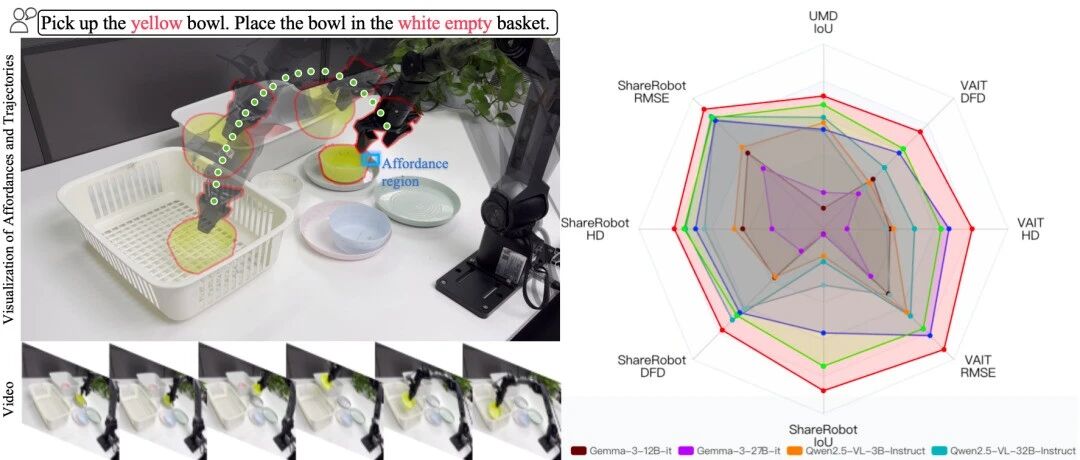
Core Insights - The article discusses the VLA-R1 model, which enhances reasoning in Vision-Language-Action (VLA) models by integrating chain-of-thought (CoT) supervision with reinforcement learning (RL) to improve both reasoning quality and execution accuracy [4][5]. Group 1: VLA-R1 Overview - VLA-R1 is a foundational model that emphasizes "reasoning first, then executing" [4]. - It combines CoT supervision with verifiable rewards from RL to optimize the reasoning and execution processes [4][5]. Group 2: Key Innovations - Two-stage training approach: The model first undergoes supervised fine-tuning (SFT) with explicit CoT supervision, followed by reinforcement learning based on GRPO to stabilize the transition from reasoning to action [6][8]. - Three types of verifiable rewards (RLVR) are introduced to ensure accurate perception, trajectory execution, and structured output [9][11]. - The VLA-CoT data engine generates a structured dataset of 13,000 visual-language-action samples to provide high-quality supervision signals for SFT [12][19]. Group 3: Experimental Results - VLA-R1 was evaluated across four levels: in-domain testing, out-of-domain testing, simulation platforms, and real robot experiments [16][17]. - In the in-domain benchmark, VLA-R1 achieved a perception IoU of 36.51, improving by 17.78% over the baseline [22]. - In real robot experiments, VLA-R1 demonstrated a success rate of 62.5% for affordance perception and 75% for trajectory execution under various environmental complexities [26]. Group 4: Applications - VLA-R1 is applicable in home automation tasks, such as object retrieval and organization in cluttered environments, by effectively reasoning through similar targets and multiple container options [34]. - It can also be utilized in warehouse picking and light industrial assembly processes, where it clarifies the relationships between parts, tools, and containers [34]. - The model's structured output format is suitable for educational demonstrations and automated assessments, allowing for easy evaluation of reasoning and execution steps [34].