Welfare Reform

Search documents
Why Reeves’s claims on the economy don’t stack up
Yahoo Finance· 2025-11-04 15:14
Economic Context - The UK is facing the highest inflation in the G7, with current inflation at 3.8%, nearly double the Bank of England's target of 2% [1][2] - The national debt has reached £2.9 trillion, over 95% of GDP, and is expected to continue rising [3] Government Spending and Taxation - The Chancellor's recent budget is noted as one of the largest increases in spending, tax, and borrowing in history, with an additional £70 billion allocated annually for the rest of the parliament [4][5] - The government is expected to issue £300 billion in debt this year to cover expenses and existing commitments, leading to higher interest rates in the market [2] Welfare System Reforms - The government is committed to reforming the welfare system, which currently leaves a significant number of young people out of education or employment [10] - Spending on sickness and disability benefits is projected to exceed £100 billion annually by the end of the decade, with recent plans to reverse the two-child benefit cap potentially increasing spending by up to £3 billion [11][12] Public Services and Productivity - Public services productivity has fallen at the fastest rate in three years, driven by declines in the NHS and health services [16] - The Chancellor emphasizes the need for increased spending on public services while facing criticism for not linking efficiency to pay rises [15] Business Environment - Businesses are expressing concerns over rising costs, with a fifth expecting lower turnover and a quarter scaling back investment plans [17] - The Chancellor's plans to raise taxes are seen as inevitable, which may impact business confidence and investment [18] Economic Outlook - The Office for Budget Responsibility (OBR) is expected to downgrade Britain's growth potential, which could significantly affect the economic and fiscal outlook [14] - There is a risk that higher taxes could lead to weaker growth, creating a cycle of increased taxation and reduced economic performance [20]
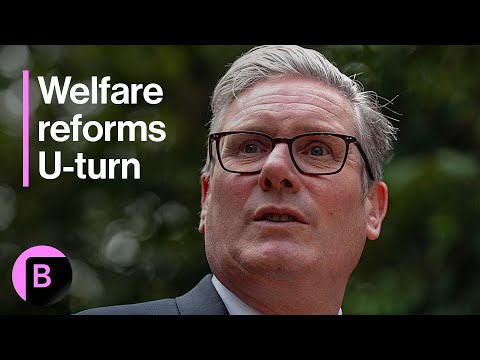
Starmer Drops Flagship Welfare Reforms to Avoid Defeat
Bloomberg Television· 2025-07-02 06:22
UK Political Landscape - Keir Starmer faced a difficult choice regarding a welfare reform bill, potentially losing a key vote or making a U-turn [1][2] - Labour MPs criticized the bill's restrictions on benefit payments to some disabled people as "Dickensian" [3] - Starmer's U-turn on the welfare reform bill has political and economic costs, potentially negating the reform's savings [3] - The government is billions of pounds in the red, increasing pressure on the Chancellor [4] UK Economic Outlook - The Office for Budget Responsibility (OBR) admitted to being too optimistic in its medium-term growth outlook [5] - Downgraded growth forecasts in the autumn budget could leave Rachel Reeves with even less headroom against fiscal rules [6] - Raising taxes could further hinder UK economic growth, creating a difficult situation for the Chancellor [7] Fiscal Policy Implications - Chancellor Rachel Reeves may need to raise taxes or bend fiscal rules due to the U-turn on welfare reform and revised growth forecasts [4] - Raising taxes could lead to less growth, creating a "doom loop" for the UK economy [7] - The situation leaves significant pressure on trade deals to boost growth, as Starmer has limited options [7]