
Wellness Economy

Search documents
Best Health & Fitness Stocks for Investors Betting on Wellness
ZACKS· 2025-11-24 15:15
Industry Overview - The health and fitness landscape has evolved into a powerful global force, driven by a shift towards healthier lifestyles, with consumers seeking nutritious eating habits and organized workout plans [2] - Major technology companies like Apple and Amazon are accelerating this transformation by integrating fitness and healthcare solutions, creating a seamless blend of wellness in daily routines [3] - The global health and wellness market is projected to reach $11 trillion by 2034, growing at a 5.4% CAGR from 2025, supported by preventive health efforts and employer wellness initiatives [4] Company Insights - United Natural Foods focuses on distributing natural and organic food products, catering to consumers prioritizing wellness, with a diverse catalog that includes grocery, supplements, and personal care items [7] - The Beachbody Company offers a comprehensive digital fitness platform with a vast library of workout videos and nutrition solutions, positioning itself as a holistic health provider [11] - Life Time Group Holdings has transformed into a wellness-driven brand, offering high-end fitness amenities and expanding its services to include nutrition-focused offerings and recovery spaces [14][15] - Peloton Interactive has shifted from a hardware-first strategy to a balanced mix of connected devices and subscription services, enhancing its digital fitness ecosystem [19][20]






New Global Wellness Institute Report Shows UAE Wellness Economy Now Worth $40.8 Billion
Prnewswire· 2025-11-20 04:30
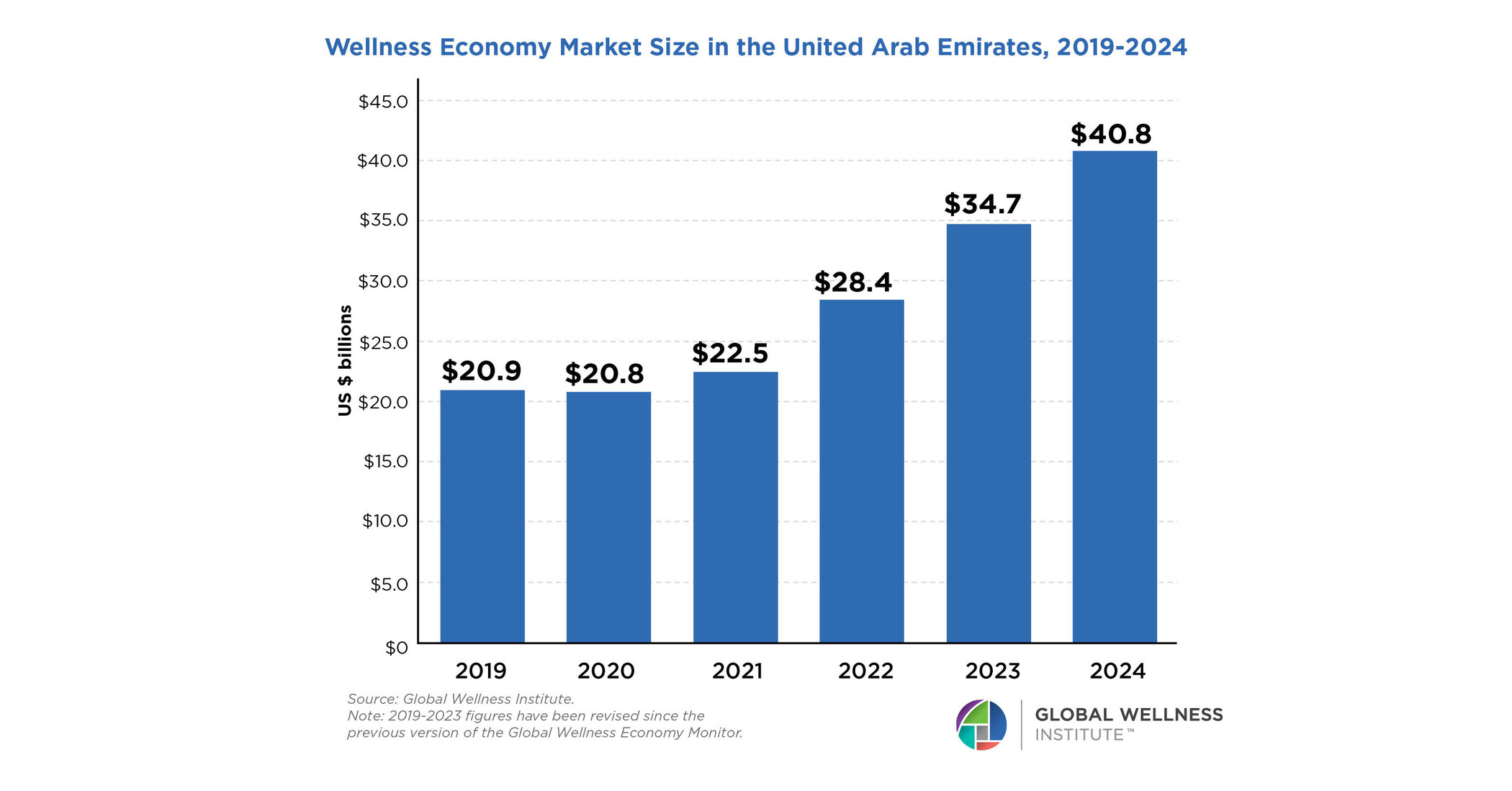
Core Insights - The UAE's wellness economy is experiencing rapid growth, with a 14.3% increase projected from 2019 to 2024, reaching a total value of $40.8 billion, making it the fastest-growing in the MENA region [1][2][3] Wellness Economy Overview - The UAE ranks first in several wellness sectors, including Wellness Real Estate valued at $1.4 billion, Personal Care & Beauty at $14.8 billion, and Spa Revenue at $2.9 billion for 2024 [2] - The wellness real estate sector has surged by 22.8% from 2019 to 2024, driven by innovative projects like SHA Emirates and Aldar's Fahid Island [3] - The wellness tourism sector has grown at a compound annual growth rate (CAGR) of 23.5%, now valued at $11.3 billion, supported by the UAE Tourism Strategy 2031 [4] Strategic Initiatives - The UAE's National Strategy for Wellbeing 2031 aims to enhance quality of life and position the country as a global leader in wellness [3][9] - Aldar Development emphasizes the integration of wellness in community design, promoting healthier lifestyles through intentional planning [5] Cultural and Technological Integration - The UAE combines traditional wellness practices with modern technology, offering personalized wellness experiences through advanced diagnostics and treatments [6][7][11] - Investments in AI-driven healthcare aim to improve efficiency and accessibility while reducing the ecological footprint through sustainable practices [8] Unique Wellness Experiences - The diverse geography of the UAE provides a backdrop for various wellness activities, including outdoor adventures and cultural immersion [10] - Eco-friendly wellness facilities are adopting sustainable practices, enhancing the overall wellness experience for visitors and residents [11]
Running Boom 2.0: how everyone’s chase to the finish line is changing bottom lines
Medium· 2025-11-16 00:11
Core Insights - The Global Wellness Economy is projected to grow from $6.3 trillion to $9 trillion by 2028, indicating a significant trend towards health and wellness as a status symbol [1][10] - The running movement has evolved from solitary jogging in the 1970s to a social, digital, and data-driven activity, attracting diverse participants and leading to commercialization [2][3] Industry Trends - Technology is a key driver in the running boom, with brands like Garmin and Whoop gaining popularity for their advanced features such as AI coaching and recovery scores [2] - The use of activity-tracking apps has surged, with Strava reporting 135 million users in 2024, up from 120 million the previous year, and expanding through acquisitions to create a comprehensive training ecosystem [3] Social Dynamics - The modern running culture is increasingly social, with a 59% rise in running club participation and a notable number of Gen Z users meeting potential partners through fitness activities [6] - Creative initiatives like the "Friday Night Lights Run Club" are redefining social running experiences, blending fitness with entertainment [7] Market Competition - Traditional sportswear brands like Nike are losing market share due to a lack of innovation, with their global sports footwear market share declining from 28.8% in 2021 to 26.3% in 2024 [9] - Despite challenges, Nike's Q1 2026 earnings per share reached $0.49, exceeding forecasts by 81.48%, highlighting potential for recovery through strategic partnerships and athlete endorsements [9]


Peloton(PTON) - 2026 Q1 - Earnings Call Transcript
2025-11-06 23:00
Financial Data and Key Metrics Changes - Total revenue for Q1 was $551 million, comprising $152 million from connected fitness products and $398 million from subscription revenue, outperforming guidance by $6 million [19] - Paid connected fitness subscriptions decreased by 6% year-over-year to 2.732 million, with average net monthly churn improving to 1.6%, a 20 basis point improvement year-over-year [18][19] - Total gross profit was $284 million, a decrease of 7% year-over-year, with total gross margin at 51.5%, down 30 basis points year-over-year [20][21] - Adjusted EBITDA was $118 million, a 2% improvement year-over-year, and free cash flow increased to $67 million, significantly outperforming prior expectations [24][25] Business Line Data and Key Metrics Changes - Connected fitness products revenue decreased by $7 million, or 5% year-over-year, while subscription revenue decreased by $28 million, or 7% year-over-year [19] - Connected fitness products gross margin was 6.9%, negatively impacted by a $13.5 million inventory accrual, but would have been 15.8% excluding this charge [21][57] - Subscription gross margin increased to 68.6%, an 80 basis point improvement year-over-year [21] Market Data and Key Metrics Changes - The connected fitness market in the U.S. is still declining year-over-year, but the rate of decline has decelerated to low single digits [50] - The overall wellness economy in the U.S. is estimated to exceed $2 trillion, indicating a significant market opportunity beyond connected fitness [52] Company Strategy and Development Direction - The company is focusing on product innovation, wellness expansion, and new distribution channels, including a new retail partnership with Johnson Fitness and Wellness [12][13] - The launch of the Peloton Cross Training Series and Peloton IQ aims to enhance member engagement and outcomes, with a shift towards premium products [9][10] - The company is committed to operational discipline and business excellence, targeting at least $100 million in run rate cost savings by the end of fiscal 2026 [16] Management's Comments on Operating Environment and Future Outlook - Management expressed confidence in achieving positive operating income on a full-year basis in fiscal 2026, despite external challenges [32] - The anticipated financial impact of the recent recall is reflected in the guidance, with expectations for a small drag on subscriptions but overall revenue impact expected to be immaterial [4][40] - The company remains focused on execution and believes it offers an unmatched ecosystem of products and experiences to help members invest in their health and well-being [16] Other Important Information - The company has expanded its retail presence significantly, now having 10 micro stores in the U.S. and a retail presence in 46 states [12] - The acquisition of Breathwork aims to enhance mental fitness offerings, which are now included in all-access subscriptions [10][11] Q&A Session Summary Question: What is the market opportunity for the new commercial business unit? - Management highlighted a large market opportunity with low share and emphasized the strategic combination of Precor's commercial-grade equipment and Peloton's software and community [32][33] Question: Are there any plans in the next five years to provide for dividends? - Management indicated it is early to discuss dividends but emphasized the importance of deleveraging and maximizing capital allocation options in the future [35][36] Question: Can you compare the recent recall to the previous one? - Management explained that the recent recall was based on different models and incidents, with a small anticipated headwind to paid connected fitness net churn due to elevated subscription pauses [38][40] Question: How do you see churn normalizing post-price increase? - Management noted that while there was an initial spike in cancellations, churn has moderated back to normal levels, with expectations for flat churn over the year despite a temporary increase in Q2 [41][44] Question: What is the overall demand environment? - Management acknowledged continued softness in connected fitness equipment demand but remains optimistic about long-term growth potential in the wellness economy [50][52]