Housing

Search documents
First-Time Homebuyers Face an Affordability Crisis But Some Are Finding a Way In
Yahoo Finance· 2025-12-17 19:53
Antonio_Diaz / Getty Images The housing market is challenging in 2025, but some first-time homebuyers are finding a path into homeownership. Key Takeaways The median age for first-time buyers is 40, an all-time high. This signals how challenging the housing market is for those who want to enter for the first time. Family help and choosing lower-cost regions are giving some first-time homebuyers a path into homeownership. While first-time homebuyers have largely been priced out of the housing market ...
Home prices just turned negative for first time in 2 years, stirring fears of 2008-style crash. Shockproof your wealth
Yahoo Finance· 2025-12-17 13:11
Core Insights - The U.S. housing market is showing signs of a downturn, with analysts predicting significant price corrections that could exceed 50% in certain areas, potentially worse than the 2008 crisis [1][2][3] - Recent data indicates that 53% of U.S. homes have lost value over the past year, with an average decline of 9.7%, marking the highest share of depreciating homes since 2012 [2][5] - The combination of rising mortgage rates, affordability issues, and increased inventory is contributing to a national decline in home prices [3][4] Housing Market Analysis - Melody Wright warns that the current conditions, while different from 2008, could still lead to a severe downturn in the housing market [2] - Parcl Labs reports that U.S. home prices have slipped below year-ago levels, with the last negative trend occurring in mid-2023 due to rapid Federal Reserve rate hikes [5] - The average home price has decreased by 1.4% over the past three months, reflecting a broader trend of declining values [4] Economic Factors - The sharp increase in mortgage rates in 2022 and 2023 has created an affordability shock, leading to decreased buyer demand and lower sales volumes [3] - Analysts suggest that inflated home prices from the pandemic era, combined with higher mortgage rates, are softening demand and pushing prices downward [4] Gold Market Insights - Gold has seen a significant price increase of over 60% in the past 12 months, reaffirming its status as a safe haven during economic uncertainty [6] - Ray Dalio emphasizes the importance of including gold in investment portfolios as a diversifier during challenging economic times [7][8]
Here’s the Minimum Income Needed To Buy a $500K Home in 2026
Yahoo Finance· 2025-12-16 15:09
Core Insights - The housing market is expected to shift as mortgage interest rates decrease and home prices stabilize, impacting new homebuyers' opportunities in 2026 [1][3] Group 1: Mortgage Rates and Market Trends - Mortgage rates are projected to drop from approximately 6.24% in November 2025 to around 6% in 2026, which may influence buyer behavior [3] - The National Association of Realtors (NAR) indicates that while the housing market may recover in 2026, it may not favor first-time homebuyers, particularly those looking for homes priced at $500,000 or higher [4] Group 2: Financial Requirements for Homebuyers - For a $500,000 home with a 20% down payment at a 6.24% mortgage rate, the estimated monthly payment would be between $3,000 and $3,200, including property taxes and insurance [5] - To qualify for a $500,000 home, lenders suggest that the monthly housing expense should not exceed 28% of income, requiring an annual income of approximately $137,000 based on a $3,200 monthly payment [6] - Considering total debt, the required annual income for homebuyers could range from $110,000 to $140,000, depending on individual financial circumstances [7]
Powell: ‘Housing market faces some really significant challenges’ that a 25-basis-point rate cut won’t resolve
Yahoo Finance· 2025-12-15 19:00
Core Insights - The U.S. housing market is facing significant challenges, and recent Federal Reserve rate cuts are unlikely to improve affordability [2] - A structural housing shortage is identified as a key issue in the U.S. housing market, with a need for more housing units [3] - The Federal Reserve's previous purchases of mortgage-backed securities during the pandemic may have contributed to overheating the housing market, though the extent is uncertain [3] Economic Context - The U.S. labor market has softened, with the latest unemployment rate at 4.4%, which is above the cycle low of 3.4% recorded in April 2023 [4] - The Federal Reserve is transitioning from a restrictive to a neutral policy stance, indicated by several cuts to short-term rates [4] - Long-term yields and mortgage rates have decreased from their cycle highs over the past year [4]
If You Rent, Brace Yourself — Homeowners Have 43x's More Wealth And It's Mostly From One Thing You're Paying For But Never Get: Equity
Yahoo Finance· 2025-12-15 09:03
Core Insights - The wealth gap between homeowners and renters has significantly widened, with the typical homeowner's net worth at approximately $430,000 compared to around $10,000 for renters, resulting in a 43-to-1 difference [1] - The last official dataset from the Federal Reserve's Survey of Consumer Finances (SCF) in 2022 indicated a median homeowner's net worth of $396,200 versus $10,400 for renters, reflecting a 38-to-1 difference at that time [2] Wealth Dynamics - Home equity serves as a wealth multiplier, with homeowners building equity over time, which can constitute 50% or more of a household's total net worth, thus driving household wealth [4] - Renters do not build equity through rent payments, which means they miss out on ownership, price appreciation, and leveraging assets for future investments [5] Historical Context - The homeowner-renter wealth gap has been significant for years, but the increase from 2019 to 2022 marked the largest three-year jump in median net worth differences recorded by the SCF, indicating accelerated homeowner wealth growth despite broader economic challenges [6]
加拿大一些城市房价涨幅超越纽约洛杉矶等城市
Sou Hu Cai Jing· 2025-12-15 06:11
Core Insights - Despite rising home prices in most major North American cities, Canadian cities are experiencing the highest price increases, significantly outpacing cities like New York and Los Angeles [1] Group 1: Price Trends - Over the past 20 years, home prices in Canada have consistently risen, with an average increase of 92% from 2005 to 2025 across North America's top 25 cities [1] - The fastest-growing cities in terms of home price increases are all located in Canada, with Vancouver leading at a 175% increase since 2005, followed by Montreal at 167% and Toronto at 165% [1][4] Group 2: Comparative Analysis - In the United States, cities with the fastest home price increases include Dallas, Charlotte, Denver, Seattle, Houston, and Atlanta, but none match the growth rates seen in Canadian cities [3] - The top five housing markets in North America based on price increase percentages are: 1. Vancouver: 175% 2. Montreal: 167% 3. Toronto: 165% 4. Dallas: 139% 5. Charlotte: 134% [4]


Experts Predict Where the Housing Market Is Headed in 2026
Yahoo Finance· 2025-12-13 10:55
Core Insights - The real estate market is facing challenges for both buyers and sellers, with national average prices remaining flat in 2025 according to Zillow Research [1] - Buyers are struggling due to high prices and uncertainty around mortgage rates, leading to market stagnation [2] - Experts are beginning to analyze and forecast the housing market for 2026 as the fourth quarter of 2025 progresses [3] Home Prices - Zillow Research anticipates home values to remain unchanged through January 2026, with a peak growth of nearly 1.9% expected in August [4] - Economists from the Mortgage Bankers Association predict several quarters of declining prices, with no national price increases expected until 2028 [4] Mortgage Rates - Fannie Mae projects mortgage rates to decrease to 6.4% by the end of 2025 and further to 5.9% by the end of 2026, although this may be an optimistic estimate [5] - The Mortgage Bankers Association forecasts a slight drop in rates to 6.3% by 2027, with no significant changes expected in 2025 and 2026 [5] Home Sales - Sales are expected to remain stagnant until the end of 2025, but Zillow Research indicates that inventory may surpass sales, providing buyers with more options in 2026 [6] - Fannie Mae has a positive outlook for 2026 home sales, predicting an 8.9% year-over-year increase by the end of the year [6] - The National Association of Realtors forecasts home sales based on mortgage rates dropping to 6%, which would make home buying affordable for an additional 5.5 million households [7] - The Mortgage Bankers Association also anticipates an increase in sales for 2026, projecting 5 million new and existing home sales compared to 4.8 million in 2025 [8]
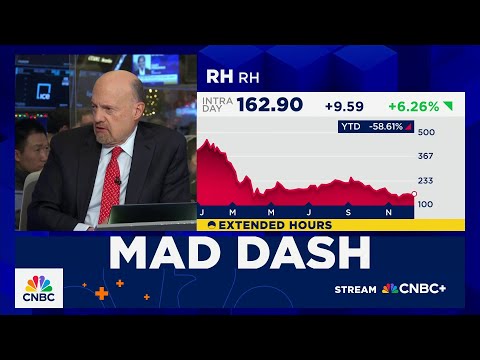
Cramer’s Mad Dash: RH
CNBC Television· 2025-12-12 14:48
Gary Friedman last night uh guiding lower on margins takes us to a mad dash. >> No, it was not a call that if you're looking for upside. I think that in some ways and I went over this with Ben Stos, my research director, that RH is to housing as strategy is to Bitcoin.I mean, you just they're linked. >> You mean like a leverage play. >> Yeah.And and I feel like that if you're really sure that housing's going to come back, really really sure because if you're just kind of sure that's Home Depot, if you're re ...
Hidden housing MELTDOWN freezing millions out of the market
Youtube· 2025-12-12 14:30
Welcome back. The housing market expected to shift in 2026 as President Trump works to encourage the younger generation of American home buyers. The 30-year fixed mortgage rate now sits at 6.2%.That's about uh just over 5 a.5% for a 15-year fixed, higher than most people want. Mortgage rates expected to drop however slightly at least heading into the next year as the Federal Reserve is cutting interest rates and did so this week by quarter point a third straight cut. Joining me now is the founder of Sirant ...

Powell says rate cuts won't make 'much of a difference' for struggling housing sector
Fox Business· 2025-12-12 13:52
Core Insights - The housing sector is facing ongoing challenges, with Federal Reserve Chair Jerome Powell indicating that interest rate cuts are unlikely to significantly improve inventory and affordability issues [1][2][5] - Powell emphasized that the primary issues affecting the housing market are low supply and high mortgage rates, which are not directly influenced by the Fed's monetary policy [5][9][13] Interest Rate Cuts - The Federal Reserve has cut the benchmark federal funds rate by 25 basis points for the third consecutive meeting, but Powell expressed skepticism about the effectiveness of these cuts in addressing housing market weaknesses [1][3][9] - The Fed's "dot plot" projections suggest only one additional rate cut in 2026, indicating a cautious approach moving forward [10] Housing Supply and Demand - Powell noted a long-standing shortage of housing supply in the U.S., stating that more diverse housing options are needed to meet demand [6][9] - Many homeowners are reluctant to sell due to having low-rate mortgages from the pandemic, which contributes to the ongoing supply constraints [5][13] Market Dynamics - The housing market has seen a significant increase in delistings, with a 38% rise in October compared to the previous year and a 45% increase in delistings for 2025 to date compared to 2024 [14][15] - Approximately 6% of listings have been removed from the market each month since June, marking 2025 as the year with the highest delisting rate since tracking began in 2022 [16]