进出口贸易

Search documents
可考虑将以旧换新品类从耐用消费品扩大到必需品|宏观晚6点
Sou Hu Cai Jing· 2025-08-07 10:14
Macro News - In July, China's export value increased by 7.2% year-on-year, with a growth rate rebounding by 1.4 percentage points compared to June [1] - Imports rose by 4.1% year-on-year, with an increase of 3.0 percentage points from the previous month [1] - The trade surplus for the month reached $98.24 billion [1] Education Funding - The Ministry of Finance has arranged for the annual childcare education subsidy funds, which will be distributed soon [2] - Local governments are being guided to develop detailed measures and standards for the subsidy based on local conditions [2] - Some regions that previously implemented preschool education funding are advised to ensure policy continuity [2] Warehousing Industry - The China Warehousing Index has maintained expansion for nine consecutive months [3] - In July, the index stood at 50.1%, a decrease of 0.9 percentage points from the previous month, indicating continued expansion but at a slower pace [5] - The warehousing sector is experiencing a generally good operational state despite weak demand due to extreme weather conditions [5]


7月进出口数据解读:出口延续强韧性,进口增长超预期
Yin He Zheng Quan· 2025-08-07 09:14
出口延续强韧性,进口增长超预期 -7 月进出口数据解读 2025 年 8 月 7 日 分析师 张迪 ☎:010-8092-7737 ☑: zhangdi_yj@chinastock.com.cn 分析师登记编码:S0130524060001 目雷 8 月 7 日海关总署公布 7 月进出口数据: 7 月我国出口商品 3217.8 亿美元, 0 同比增速为 7.2%(前值 5.9%),过去十年出口增速同期均值为 3.6%。进口 2235.4 亿美元,增速 4.1%(前值 1.1%),过去十年进口增速同期均值为 0.6%。 贸易顺差 982 亿美元(前值 1148 亿美元)。 7 月出口增速延续小幅回升,其一全球经济景气度仍具韧性,其二抢出口 0 和转口贸易仍有所支撑:一是全球制造业 PMI 仍具韧性。7月 IMF 发布最 新全球经济展望,预计 2025 年和 2026 年的全球经济增速将分别为 3.0%和 3.1%,较今年 4 月预测值分别上调 0.2 和 0.1 个百分点。7 月全球制造业 PMI 为 49.7%(前值 50.4%),欧英越印墨等均有不同幅度上行,其中越南 PMI 上行 3.5 个百分点,墨西哥 ...
宏观数据观察:东海观察7月进出口超预期回升,贸易顺差有所下降
Dong Hai Qi Huo· 2025-08-07 08:37
1. Report Industry Investment Rating No relevant information provided. 2. Core Viewpoints of the Report - In July 2025, China's import and export exceeded expectations, with export growth mainly due to increased exports to Europe and South Korea, and import growth mainly driven by price increases of commodities such as integrated circuits and agricultural products. The trade surplus was lower than expected due to a significant increase in imports. In the future, exports are expected to be supported by improved Sino - US trade and short - term US rush to import, while import growth is expected to remain low [1][3][4][5]. 3. Summary by Related Catalogs 3.1 Import and Export Totals - In July 2025, the total import and export volume (in US dollars) was 545.323 billion, a year - on - year increase of 5.9%, up 2.0 percentage points from the previous value. The top trading partners in terms of trade volume were ASEAN (trade volume of 86 billion, a year - on - year increase of 7.3%, trade share of 15.78%), the EU (74.5 billion, a year - on - year increase of 5.42%, trade share of 13.67%), the US (47.9 billion, a year - on - year decrease of 21%, trade share of 8.79%), South Korea (28.1 billion, a year - on - year increase of 2.28%, trade share of 5.14%), and Japan (27.4 billion, a year - on - year increase of 9.95%, trade share of 5.02%) [1][3]. 3.2 Exports - In July 2025, exports were 321.784 billion US dollars, a year - on - year increase of 7.2%, better than the expected 5.4% and up 1.3 percentage points from the previous value. The top export destinations were ASEAN (export volume of 54.6 billion, a year - on - year increase of 16.59%, export share of 16.98%), the EU (50 billion, a year - on - year increase of 9.24%, export share of 15.54%), the US (35.8 billion, a year - on - year decrease of 21.67%, with the decline widening by 5.54 percentage points, export share of 11.13%), Japan (12.5 billion, a year - on - year increase of 2.45%, export share of 3.88%), and South Korea (12.4 billion, a year - on - year increase of 4.63%, export share of 3.84%). The top export products were mechanical and electrical products (accounting for 60.2%, a year - on - year increase of 8.0%), of which high - tech products accounted for 24.3%, a year - on - year increase of 4.2%. The top five mechanical and electrical products were electronic components (14.23%), automobile and auto parts (10.37%), electrical equipment (9.67%), automatic data processing equipment and parts (8.69%), and household appliances (4.29%) [3][4]. 3.3 Imports - In July 2025, imports were 223.539 billion US dollars, a year - on - year increase of 4.1%, better than the expected - 1% and up 3 percentage points from the previous value. The top import sources were ASEAN (import volume of 31.4 billion, a year - on - year decrease of 5.76%, import share of 14.05%), the EU (24.5 billion, a year - on - year decrease of 1.58%, import share of 11.07%), Chinese Taipei (19.4 billion, a year - on - year increase of 0.45%, import share of 8.67%), South Korea (15.7 billion, a year - on - year increase of 0.51%, import share of 7.02%), and Japan (14.9 billion, a year - on - year increase of 17.13%, import share of 6.68%). The top import products were mechanical and electrical products (accounting for 40.68%, a year - on - year increase of 2.74%), of which electronic components such as integrated circuits accounted for 41.02% with a year - on - year increase of 13%. Other major import products included crude oil (10.68%), metal ores and concentrates (10.15%), and agricultural products (8.36%). In agricultural product imports, soybeans accounted for 27.44%, meat 10.99%, and dried and fresh fruits and nuts 9.33% [4]. 3.4 Trade Balance - In July 2025, the trade surplus was 98.24 billion US dollars, a year - on - year increase of 14.93%, lower than the expected 105 billion. The largest trade surplus was in automobiles (8.3 billion, an increase of 0.826 billion), followed by auto parts (6.3 billion, a decrease of 0.036 billion). The largest trade deficits were in crude oil (23.8 billion, a decrease of 0.34 billion), integrated circuits (19.4 billion, an increase of 2.049 billion), and agricultural products (10.293 billion, a decrease of 0.112 billion) [4][5].
上半年珠三角9市进出口总值占全国五分之一 7市增速跑赢全省
Nan Fang Ri Bao Wang Luo Ban· 2025-08-07 08:28
Core Insights - The total import and export value of the Pearl River Delta (PRD) region reached 4.38 trillion yuan in the first half of the year, marking a year-on-year growth of 4.3% and accounting for 96.3% of Guangdong's total foreign trade [1] - The PRD continues to play a crucial role as a "stabilizer" and "ballast" for national foreign trade, showcasing resilience despite external pressures [1][4] - The construction of the Guangdong-Hong Kong-Macao Greater Bay Area is enhancing resource optimization and competitive advantages among cities, thereby strengthening the industrial chain [1][3] Guangdong Foreign Trade Performance - Guangdong's foreign trade grew by 4% year-on-year, surpassing the national growth rate of 2.9% [1] - Key cities such as Zhaoqing (16.7%), Dongguan (16.5%), and Guangzhou (15.5%) outperformed both provincial and national levels in foreign trade growth [1][2] City-Specific Highlights - Guangzhou's foreign trade reached 605.05 billion yuan, a 15.5% increase, contributing over 800 billion yuan to national and provincial growth [2] - Dongguan's foreign trade totaled 749.28 billion yuan, with a growth rate of 16.5%, significantly boosting Guangdong's overall trade performance [2] - Zhaoqing led the PRD with a remarkable growth rate of 16.7%, driven by a surge in both exports and imports [2][3] Export Structure and Market Diversification - Zhaoqing's export structure is shifting positively, with significant growth in machinery and high-end equipment exports [3] - Guangdong's trade with emerging markets, including ASEAN and countries along the Belt and Road Initiative, is expanding, effectively countering weakened demand from traditional markets [6][7] Cross-Border Trade Efficiency - The collaboration with Hong Kong and Macau is enhancing customs efficiency, with significant improvements in logistics costs and transit times [7][8] - The introduction of innovative customs clearance models, such as the "one-stop" inspection mode, is streamlining cross-border operations [8] Strategic Outlook - The PRD is positioned as a strategic hub for China's new development pattern, contributing to the transformation and upgrading of national foreign trade [8]
7月中国进出口总值同比增6.7%
Zhong Guo Xin Wen Wang· 2025-08-07 06:50
分区域看,前7个月,东盟为中国第一大贸易伙伴,中国与东盟贸易总值为4.29万亿元,同比增长 9.4%。欧盟为中国第二大贸易伙伴,中国与欧盟贸易总值为3.35万亿元,同比增长3.9%。美国为中国第 三大贸易伙伴,中国与美国贸易总值为2.42万亿元,同比下降11.1%。 同期,中国对共建"一带一路"国家合计进出口13.29万亿元,同比增长5.5%。 进口方面,前7个月,中国进口原油3.27亿吨,同比增长2.8%,铁矿砂、煤和天然气进口量减少。 同期,进口机电产品4.09万亿元,同比增长5.8%。 中新社北京8月7日电 (记者 尹倩芸)中国海关总署7日公布数据显示,7月中国货物贸易进出口总值 3.91万亿元(人民币,下同),同比增长6.7%。其中,出口同比增长8%;进口同比增长4.8%,连续两个月 增长。 今年前7个月,中国货物贸易进出口总值25.7万亿元,同比增长3.5%。其中,出口15.31万亿元,增 长7.3%;进口10.39万亿元,下降1.6%,降幅较上半年收窄1.1个百分点。 分产品看,前7个月,中国出口集成电路7784.5亿元,同比增长21.8%;出口汽车5134.6亿元,同比 增长10.9%;出口农产 ...
7月数据出炉!出口同比增长8%
Zhong Guo Zheng Quan Bao· 2025-08-07 05:27
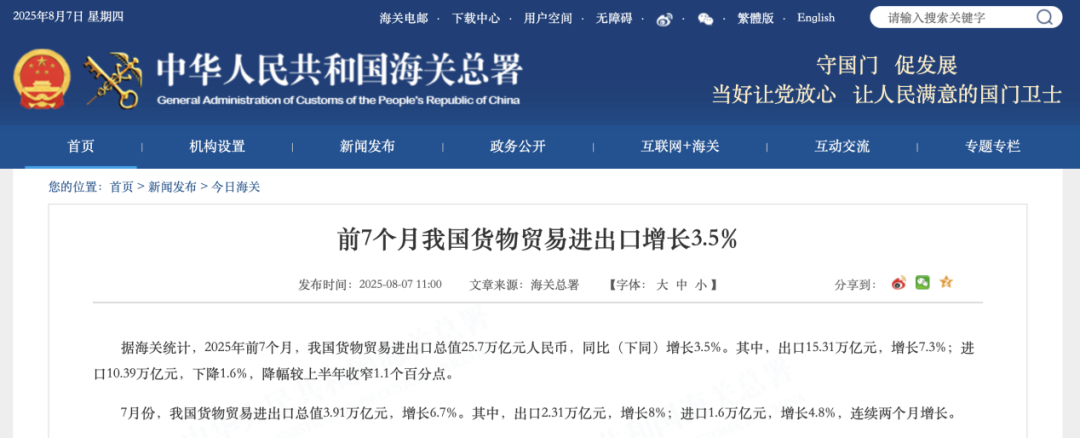
Trade Overview - In the first seven months, China's total goods trade value reached 25.7 trillion yuan, a year-on-year increase of 3.5% [1] - Exports amounted to 15.31 trillion yuan, growing by 7.3%, while imports were 10.39 trillion yuan, showing a decline of 1.6%, with the decline narrowing by 1.1 percentage points compared to the first half of the year [1] Monthly Trade Performance - In July, the total goods trade value was 3.91 trillion yuan, reflecting a year-on-year growth of 6.7% [1] - Exports in July were 2.31 trillion yuan, up by 8%, and imports were 1.6 trillion yuan, increasing by 4.8%, marking two consecutive months of growth [1] Export Composition - In the first seven months, exports of electromechanical products reached 9.18 trillion yuan, a 9.3% increase, accounting for 60% of total exports [2] - Key components included automatic data processing equipment and parts at 823.62 billion yuan (up 1.1%), integrated circuits at 778.45 billion yuan (up 21.8%), and automobiles at 513.46 billion yuan (up 10.9%) [2] - Labor-intensive product exports totaled 2.41 trillion yuan, down by 0.8%, representing 15.7% of total exports [2] Trade Partners - ASEAN remained China's largest trading partner, with trade totaling 4.29 trillion yuan, a 9.4% increase, accounting for 16.7% of total foreign trade [3] - The EU was the second-largest trading partner, with trade valued at 3.35 trillion yuan, up by 3.9%, making up 13% of total foreign trade [3] - The US ranked third, with trade totaling 2.42 trillion yuan, down by 11.1%, representing 9.4% of total foreign trade [4] Enterprise Performance - Private enterprises' imports and exports reached 14.68 trillion yuan, a 7.4% increase, comprising 57.1% of total foreign trade, up by 2.1 percentage points year-on-year [5] - Exports from private enterprises were 10.04 trillion yuan, growing by 8.7%, while imports were 4.64 trillion yuan, up by 4.7% [5] - Foreign-invested enterprises had imports and exports of 7.46 trillion yuan, a 2.6% increase, accounting for 29% of total foreign trade [5] - State-owned enterprises saw a decline in imports and exports to 3.49 trillion yuan, down by 8.8%, representing 13.6% of total foreign trade [5]
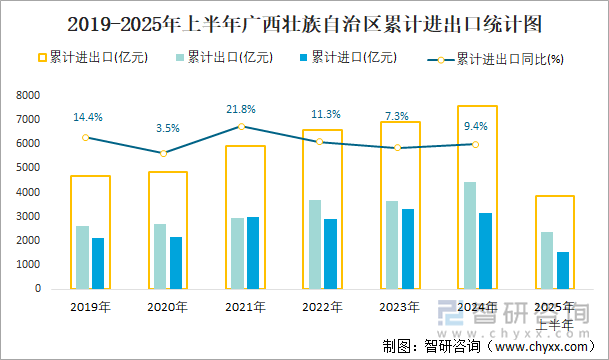
2025年上半年广西壮族自治区贸易统计分析:广西壮族自治区进出口总额为3871.5亿元,同比增长13%
Chan Ye Xin Xi Wang· 2025-08-07 03:42
数据来源:海关总署,智研咨询整理 2025年上半年,广西壮族自治区进出口总额(海关口径)为3871.5亿元,比上年同期增长13%,其中出 口额为2346.48亿元,同比增长24%,进口额为1525.02亿元,同比下滑0.5%,贸易顺差为821.46亿元。 知前沿,问智研。智研咨询是中国一流产业咨询机构,十数年持续深耕产业研究领域,提供深度产业研 究报告、商业计划书、可行性研究报告及定制服务等一站式产业咨询服务。专业的角度、品质化的服 务、敏锐的市场洞察力,专注于提供完善的产业解决方案,为您的投资决策赋能。 上市企业:中成股份(000151),远大控股(000626),厦门信达(000701),凯瑞德(002072),江 苏国泰(002091),怡亚通(002183),鹏都农牧(002505),五矿发展(600058),苏豪弘业 (600128),东方创业(600278),江苏舜天(600287),ST沪科(600608),苏美达(600710), 云维股份(600725),汇鸿集团(600981),中信金属(601061) 相关报告:智研咨询发布的《2025-2031年中国数字贸易行业竞争策略研究及未来前景展 ...
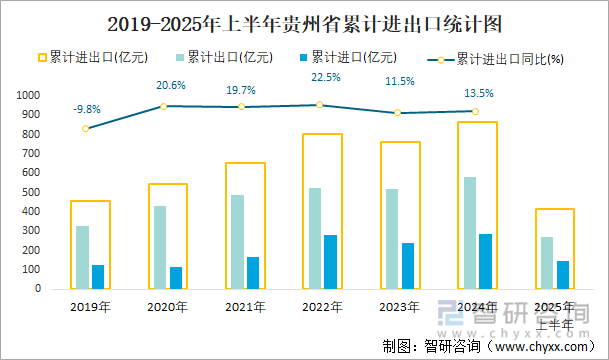
2025年上半年贵州省贸易统计分析:贵州省进出口总额为413.9亿元,同比增长12.8%
Chan Ye Xin Xi Wang· 2025-08-07 03:42
Group 1 - The core viewpoint of the news highlights the growth in import and export activities in Guizhou Province, with a total import and export value of 41.39 billion yuan in the first half of 2025, representing a year-on-year increase of 12.8% [1] - Exports amounted to 26.905 billion yuan, showing a year-on-year growth of 14% [1] - Imports reached 14.481 billion yuan, with a year-on-year increase of 10.6%, resulting in a trade surplus of 12.424 billion yuan [1] Group 2 - The listed companies mentioned include Zhongcheng Co., Ltd. (000151), Yuanda Holdings (000626), Xiamen Xinda (000701), and others, indicating a diverse range of companies involved in the trade sector [1] - The report referenced is the "2025-2031 China Digital Trade Industry Competition Strategy Research and Future Outlook Report" published by Zhiyan Consulting, suggesting a focus on the digital trade industry [1]
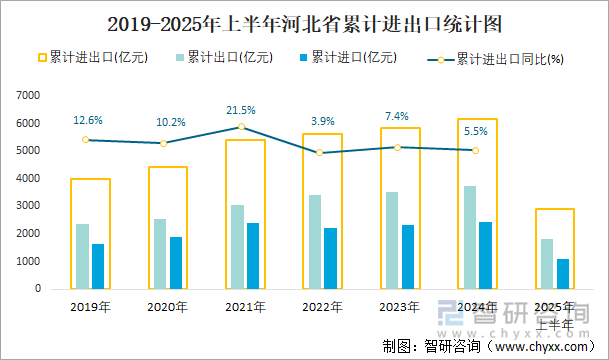
2025年上半年河北省贸易统计分析:河北省进出口总额为2902.9亿元,同比下滑6.1%
Chan Ye Xin Xi Wang· 2025-08-07 03:42
数据来源:海关总署,智研咨询整理 2025年上半年,河北省进出口总额(海关口径)为2902.9亿元,比上年同期下滑6.1%,其中出口额为 1812.8亿元,同比下滑1.6%,进口额为1090.14亿元,同比下滑12.7%,贸易顺差为722.66亿元。 知前沿,问智研。智研咨询是中国一流产业咨询机构,十数年持续深耕产业研究领域,提供深度产业研 究报告、商业计划书、可行性研究报告及定制服务等一站式产业咨询服务。专业的角度、品质化的服 务、敏锐的市场洞察力,专注于提供完善的产业解决方案,为您的投资决策赋能。 上市企业:中成股份(000151),远大控股(000626),厦门信达(000701),凯瑞德(002072),江 苏国泰(002091),怡亚通(002183),鹏都农牧(002505),五矿发展(600058),苏豪弘业 (600128),东方创业(600278),江苏舜天(600287),ST沪科(600608),苏美达(600710), 云维股份(600725),汇鸿集团(600981),中信金属(601061) 相关报告:智研咨询发布的《2025-2031年中国数字贸易行业竞争策略研究及未来前景展望报 ...
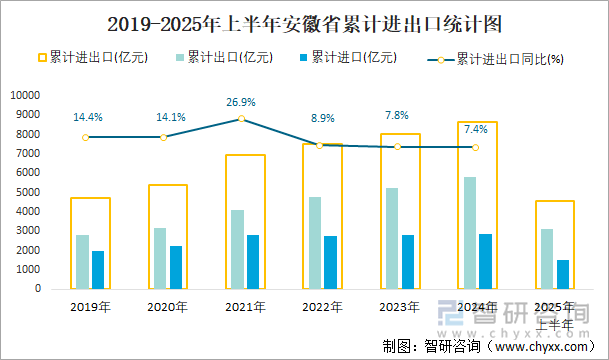
2025年上半年安徽省贸易统计分析:安徽省进出口总额为4585.4亿元,同比增长15.2%
Chan Ye Xin Xi Wang· 2025-08-07 03:34
上市企业:中成股份(000151),远大控股(000626),厦门信达(000701),凯瑞德(002072),江 苏国泰(002091),怡亚通(002183),鹏都农牧(002505),五矿发展(600058),苏豪弘业 (600128),东方创业(600278),江苏舜天(600287),ST沪科(600608),苏美达(600710), 云维股份(600725),汇鸿集团(600981),中信金属(601061) 2025年上半年,安徽省进出口总额(海关口径)为4585.4亿元,比上年同期增长15.2%,其中出口额为 3098.48亿元,同比增长15.4%,进口额为1486.87亿元,同比增长14.7%,贸易顺差为1611.61亿元。 知前沿,问智研。智研咨询是中国一流产业咨询机构,十数年持续深耕产业研究领域,提供深度产业研 究报告、商业计划书、可行性研究报告及定制服务等一站式产业咨询服务。专业的角度、品质化的服 务、敏锐的市场洞察力,专注于提供完善的产业解决方案,为您的投资决策赋能。 数据来源:海关总署,智研咨询整理 相关报告:智研咨询发布的《2025-2031年中国数字贸易行业竞争策略研究及未来前 ...