毛纺织

Search documents
南山智尚(300918) - 2025年4月28日投资者关系活动记录表
2025-04-29 00:54
Group 1: Financial Performance - The company achieved a revenue of 360 million CNY in Q1 2025, with a net profit attributable to shareholders of approximately 37.3 million CNY, reflecting a year-on-year growth of 12.84% [6] - The total equity attributable to shareholders reached approximately 2.797 billion CNY, marking a year-on-year increase of 27.39% [6] - The gross margin for ultra-high molecular weight polyethylene fiber business improved from 11% to 28% [6] Group 2: Export Business Impact - In 2024, the company's overall export business accounted for 25.49% of total revenue, with a minimal contribution from exports to the U.S. [7] - The company plans to enhance R&D investment in core products to improve market competitiveness and adapt to external policy changes [7] Group 3: New Materials Business Growth - The new materials segment is becoming a core growth driver, with significant production of ultra-high molecular weight polyethylene fibers and increased orders in deep-sea economic sectors [8] - The company is set to launch an 80,000-ton high-performance nylon filament project in November 2024, which is expected to boost production capacity [8] Group 4: Product Development and Applications - Ultra-high molecular weight polyethylene fibers are being developed for various applications, including robotics, marine ropes, and protective gear, with significant advancements in product performance [10] - The company has made breakthroughs in key technologies for nylon fibers, targeting applications in both civilian and industrial sectors [10] Group 5: Competitive Advantages - The ultra-high molecular weight polyethylene fibers are positioned as high-end products, competing with international leaders in terms of quality and specifications [12] - The company has patented methods to control creep in fiber usage, enhancing the performance of materials used in robotic tendons [12]
研判2025!中国毛纺织行业产业链、发展现状、竞争格局及发展趋势分析:产业结构持续优化,积极推动行业向低碳经济型、科技创新型、增长集约型转变[图]
Chan Ye Xin Xi Wang· 2025-04-28 01:27
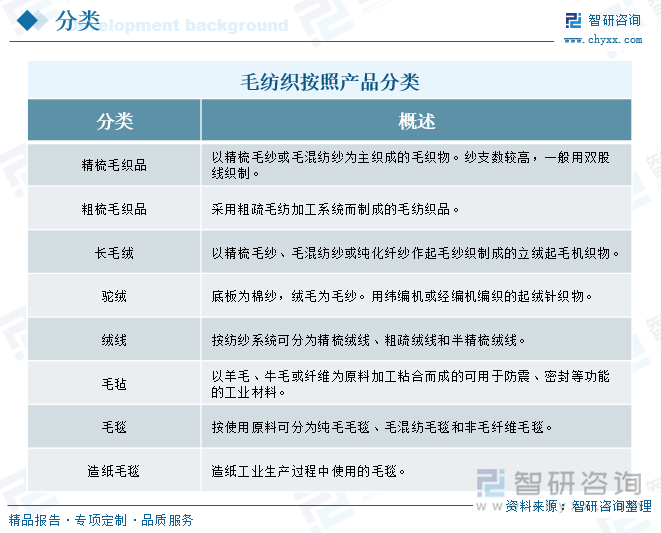
Core Viewpoint - The wool textile industry in China has a history of over a century and has developed a complete production and processing system, becoming a global leader in processing capacity and consumption. However, the industry faces challenges in 2024 due to economic cycles and geopolitical factors, leading to a need for technological innovation and collaborative efforts to achieve recovery growth. The market size is projected to increase by 6.25% to 8.5 billion yuan [1][12]. Industry Overview - The wool textile industry focuses on processing animal hair fibers and includes various manufacturing activities such as primary processing, yarn production, and final product processing. Wool products are essential in daily life due to their softness, warmth, and breathability [3][6]. - The industry can be categorized into eight product types and three processing categories, with fine wool products being high-end fabrics used for quality garments [3][5]. Industry Chain - The upstream of the wool textile industry involves the procurement of raw materials like wool and cashmere, which directly affect the cost and quality of products. The midstream includes various processing stages, while the downstream encompasses sales through multiple channels [6]. Production and Market Trends - China's wool and cashmere production has been on the rise, with wool production reaching 367,500 tons in 2023, a 3.2% increase, and cashmere production at 17,600 tons, a 20.1% increase [7]. - The online retail market in China is expected to grow significantly, with online retail sales projected to reach 15.23 trillion yuan by 2024, providing a vital channel for wool textile sales [9]. Competitive Landscape - The wool textile industry is maturing with increasing competition, leading to the elimination of weaker companies. Major players include Jiangsu Sunshine Co., Ltd., Shandong Nanshan Zhishang Technology Co., Ltd., and Shandong Ru Yi Woolen Garment Group Co., Ltd. [18][20]. Development Trends - The industry is focusing on fashion transformation and brand building, leveraging trend research and new media to enhance brand influence [24]. - Technological innovation is crucial for optimizing traditional processes and promoting green and smart manufacturing, which will drive high-quality development [25]. - Structural transformation is necessary for sustainable development, with an emphasis on optimizing capacity and promoting green practices [26].