Grocery

Search documents
Promising Grocery Stocks To Watch Today – February 6th
Defense World· 2026-02-08 08:02
Core Insights - Grocery stocks, including CAVA Group, Casey's General Stores, and Conagra Brands, are highlighted as key investments due to their stable demand and cash flows, making them attractive defensive investments [2]. Group 1: CAVA Group - CAVA Group is identified as one of the grocery stocks to monitor, indicating its potential for investment interest [2]. Group 2: Casey's General Stores - Casey's General Stores operates convenience stores and gasoline stations, offering a variety of grocery items and freshly prepared food [3][4]. - The company provides self-service gasoline, food, beverages, tobacco products, health and beauty aids, automotive products, and other non-food items [4]. Group 3: Conagra Brands - Conagra Brands operates as a consumer packaged goods food company primarily in the United States, with segments including Grocery & Snacks, Refrigerated & Frozen, International, and Foodservice [4]. - The Grocery & Snacks segment focuses on shelf-stable food products distributed through various retail channels [4].


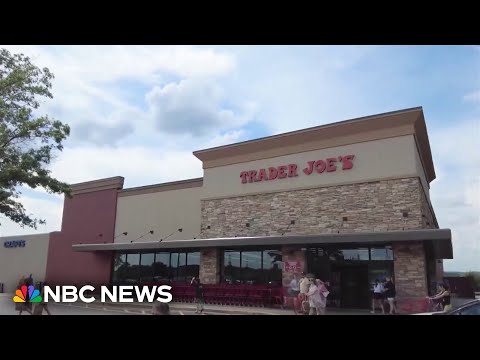
Budget conscious shoppers turn to stores like Trader Joe's to save on groceries
NBC News· 2026-02-06 17:42
The search for affordability. >> Come with me to Trader Joe's lowbudget edition. >> The love of a good snack.>> Some really bougie snacks at Trader Joe's. >> And viral totes propelling a new grocery chain to the top spot. >> Trader Joe's. Trader Joe's.The best. >> And many shoppers aren't surprised that Trader Joe's has been named the number one grocery store in the country according to a new national customer satisfaction survey, beating out competitors like Publix, Costco, and Whole Foods. I love everythi ...
Budget conscious shoppers turn to stores like Trader Joe's to save on groceries
NBC News· 2026-02-05 01:07
The search for affordability. Come >> with me to Trader Joe's lowbudget edition. >> The love of a good snack.>> Some really bougie snacks at Trader Joe's. >> And viral totes propelling a new grocery chain to the top spot. >> Trader Joe's. Trader Joe's.The best. >> And many shoppers aren't surprised that Trader Joe's has been named the number one grocery store in the country according to a new national customer satisfaction survey, beating out competitors like Publix, Costco, and Whole Foods. I love everythi ...
Amazon is closing about 70 Amazon Fresh and Amazon Go locations across the US #amazon #amazonfresh
CNET· 2026-02-03 08:39
Amazon is making a massive change to its grocery business. The company will shut down all Amazon Go stores. It is also closing every Amazon Fresh location soon.This marks a major retreat from the [music] physical retail market. Amazon spent years trying to reinvent how we shop. Their just walk out technology was the main feature.However, the high-tech stores struggled to turn a profit. High operating costs and low sales led to this decision. Many stores across the country will close their doors.This move re ...


X @Bloomberg
Bloomberg· 2026-02-03 08:08
UK grocery price inflation eased to its lowest level since April, as consumers opted for supermarkets’ own-brand products and promotional items https://t.co/RCZoq5kOaT ...
7 top grocery executive changes in January
Yahoo Finance· 2026-02-02 10:00
Executive Changes in the Grocery Industry - The grocery industry began 2026 with significant executive changes, including Lidl US's fifth CEO change since its U.S. entry over a decade ago and the promotion of Save Mart Companies' president to CEO [1][2] - Joel Rampoldt, the former CEO of Lidl US since 2023, has transitioned to an advisory role, with Marco Giudici stepping in as interim CEO [3] - Lidl US is facing challenges in the U.S. market, despite improvements made under Rampoldt, such as a focus on fresh foods and market density [4] Save Mart Companies Leadership Transition - Jim Perkins, previously president of The Save Mart Companies since 2024, has been appointed CEO following Shane Sampson's retirement [5] - The company plans to open new locations, undertake major remodels, and expand its merchandising assortment across all banners this year [5] Walmart's Leadership Overhaul - John Furner, Walmart's incoming CEO, announced a significant C-suite shakeup effective February, including David Guggina as his successor for Walmart U.S. [6] - Kathryn McLay, CEO of Walmart International, will exit the company, with Chris Nicholas from Sam's Club U.S. stepping into her role [6] - Seth Dallaire will take on the chief growth officer role for Walmart Inc., while Latriece Watkins will become CEO of Sam's Club U.S. [7] Kroger's Executive Promotion - Kroger has promoted Victor Smith, president of the Atlanta Division, to senior vice president of retail divisions as part of its executive changes [8]

CORRECTING and REPLACING ReposiTrak and National Grocers Association Deepen Partnership to Strengthen Independent Grocers' Profitability and Compliance Readiness
Businesswire· 2026-01-28 15:42
Core Insights - ReposiTrak and the National Grocers Association are enhancing their partnership to improve the profitability and compliance readiness of independent grocers [1] Group 1 - The collaboration aims to provide exclusive education and tools for independent grocers [1] - The initiative focuses on helping independent grocers unlock cash, reduce risk, and stay ahead of regulatory changes [1]


AI agents among key grocery trend highlighted at FMI Midwinter
Supermarket News· 2026-01-22 20:17
Core Insights - The grocery industry is experiencing structural shifts that could redefine its future, with trends that may seem weak now but are expected to gain prominence in the next three to five years [1][2] Group 1: Structural Shifts - Major retailers are transitioning from traditional loyalty programs to closed ecosystems, enhancing customer retention [2][4] - Transparency is becoming essential in a low-trust environment, serving as a defensive measure against consumer skepticism [2][6] - AI agents are emerging as decision-makers, influencing purchasing decisions for both consumers and retailers [2][8] Group 2: Metabolic Health and Nutrition - Metabolic health, including the GLP-1 movement, is influencing consumer choices and could develop into a distinct grocery category [3][5] - Future nutrition labels may shift from traditional facts to supplemented metabolic data, reflecting a growing focus on health [3] Group 3: Retail Strategies - Retailers are increasingly creating "walled-in gardens" to keep customers within their ecosystems, as seen with Costco and Amazon [3][4] - Last-mile delivery is evolving through "dark store networks," which enhance pickup and delivery options for consumers [5] Group 4: Technology and Consumer Interaction - Third-party apps are enabling consumers to assess brand trustworthiness and product risks, exemplified by the Yuka app in Europe [7] - QR codes on product labels are providing transparency regarding product origins and recall alerts [7] Group 5: AI's Role in Decision-Making - AI is becoming a pivotal decision-maker in the grocery sector, with agents potentially making purchasing decisions on behalf of consumers [8][9] - Retailers may shift from direct sales to selling through consumers' AI gatekeepers, changing the dynamics of retail interactions [9]
Associated British Foods PLC (OTC:ASBFY) Faces Challenges Amidst Declining Primark Performance
Financial Modeling Prep· 2026-01-13 00:00
Core Viewpoint - Associated British Foods PLC (AB Foods) is facing challenges due to weak demand for its Primark retail chain in continental Europe and subdued demand in the United States for its food business, leading to a potential decline in annual profit [4][6]. Group 1: Company Overview - AB Foods is a diversified international group involved in food, ingredients, and retail, owning Primark, a major affordable fashion retail chain [1]. - The company operates across various sectors, including grocery, sugar, agriculture, and ingredients, with Primark being a significant part of its retail operations [1]. Group 2: Market Performance and Ratings - Citigroup has maintained a "Sell" rating for AB Foods, lowering its price target from 1,830 GBp to 1,710 GBp, reflecting concerns over the company's performance [2]. - The current stock price of ASBFY is $25.20, with a minimal change of approximately 0.0003%, and it has experienced a yearly high of $31.96 and a low of $22.69 [5]. Group 3: Performance Concerns - Panmure Liberum downgraded AB Foods from 'buy' to 'hold' due to a surprise profit warning, highlighting concerns over Primark's declining performance in continental Europe [3][6]. - Weak like-for-like sales in Europe raise questions about Primark's value amidst increasing competition and cautious consumer behavior, contrasting with its recovery in the UK driven by strategic investments [3][6].