
Central Banking

Search documents
Analysis: Investors anxious over make-or-break fight for the Fed
Yahoo Finance· 2026-01-12 11:25
By Scott Murdoch, Saqib Iqbal Ahmed and Rae Wee SINGAPORE/LONDON, Jan 12 (Reuters) - A U.S. Justice Department investigation at the Federal Reserve and a combative response by chair Jerome Powell have sharply raised the stakes in a long-running dispute that has put the independence of the world's most powerful central bank openly on the line, investors said. In a strongly worded statement on Sunday, Powell disclosed a probe that threatened him with criminal indictment over a building renovation project ...
Fed Keeps Close Eye on Labor Market as It Assess Further Cuts
Nytimes· 2026-01-09 12:39
Core Viewpoint - The central bank is unlikely to lower interest rates again without significant evidence of rising unemployment [1] Group 1 - A notable increase in unemployment is a key factor for the central bank to consider lowering interest rates [1]


Fed Governor Stephen Miran says more than 100 basis points in rate cuts justified this year
Fox Business· 2026-01-06 19:36
Federal Reserve Governor Stephen Miran said the central bank should move more aggressively on interest rates this year, arguing that rate reductions totaling more than 100 basis points are justified as underlying inflation pressures continue to fade. In an interview with Maria Bartiromo on FOX Business’ "Mornings with Maria," Miran said inflation is already running close to the Federal Reserve’s 2% target once temporary measurement distortions are stripped out. He said current policy remains clearly restric ...

After a bruising 2025, the Fed faces another slew of challenges in the year ahead
CNBC· 2026-01-03 14:37
Core Insights - The Federal Reserve is entering 2026 facing significant political and policy challenges, including a new chair and a mixed economic environment that will complicate decision-making for policymakers [1][2] Economic Outlook - Following three consecutive interest rate cuts, the Federal Reserve is expected to adopt a cautious approach in 2026, with additional cuts likely being limited due to expectations of solid economic growth and persistent inflation pressures [2] - The year 2026 is anticipated to continue the extraordinary upheaval experienced in the previous year regarding the Federal Reserve [2] Political Context - President Donald Trump has previously threatened to remove Fed Chair Jerome Powell for not implementing interest rate cuts quickly enough, and there have been controversies surrounding the Fed, including cost overruns on a renovation project [4][5] - The potential removal of Governor Lisa Cook has also been a point of contention, with unproven allegations of mortgage fraud complicating the political landscape [5] Upcoming Events - A Supreme Court hearing is scheduled for January 21, 2026, to determine Trump's authority to remove Cook, followed by an interest rate vote by the Federal Open Market Committee [6] - Trump is expected to announce his choice for Fed chair in January, while Powell must decide whether to continue serving on the Board of Governors until January 2028 [6] Internal Dynamics - Recent rate votes have seen multiple dissents, and new regional presidents joining the Federal Open Market Committee are expected to have a hawkish stance, likely resisting further rate cuts [7]

Year-End Liquidity Turmoil on the Fed’s Balance Sheet. Plus $38 Billion in T-bills Replace $15 Billion in MBS and Add $23 Billion in RMPs
Wolfstreet· 2026-01-03 02:46
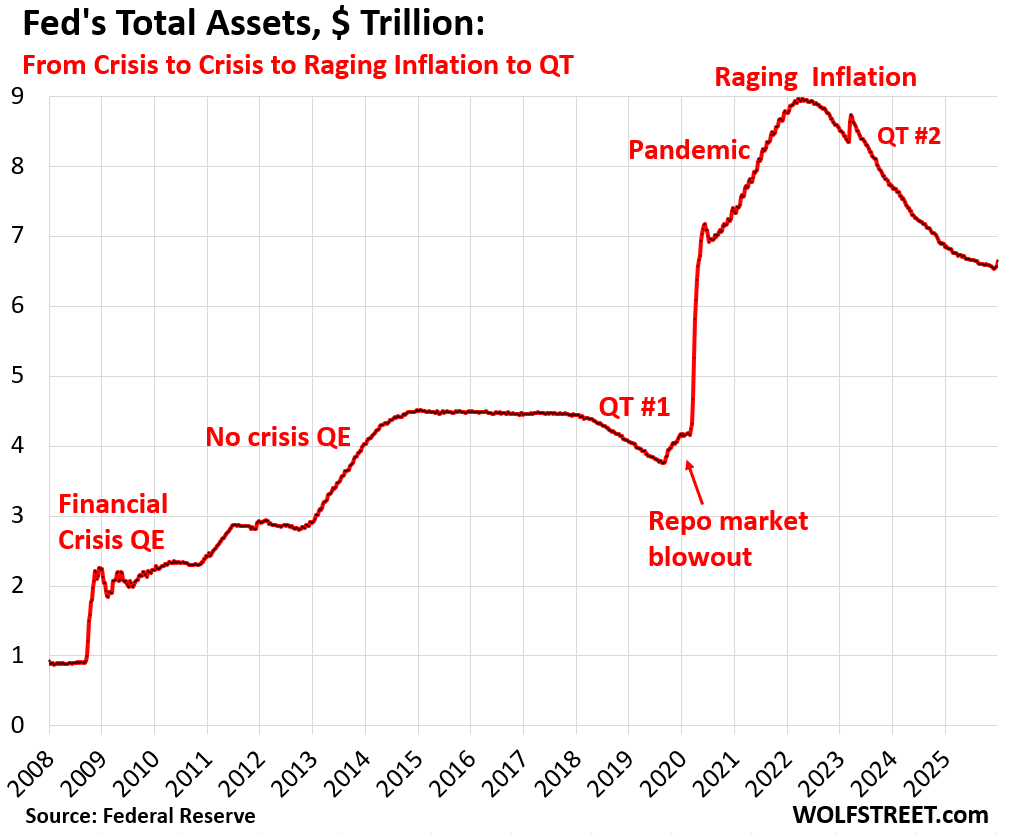
Core Insights - The Federal Reserve's balance sheet experienced significant year-end liquidity shifts, with the Standing Repo Facility (SRF) spiking to $75 billion before falling back, and Overnight Reverse Repos (ON RRPs) reaching $106 billion before also declining [1][14][15] Group 1: Standing Repo Facility (SRF) - The SRF saw a one-day uptake of $75 billion on December 31, which increased the Fed's total assets temporarily [6][7] - By January 2, the SRF balance fell back to $23 billion, with expectations that it will approach zero in the following week [6][7] - The SRF allows approved counterparties, primarily large broker-dealers and banks, to borrow overnight at a rate of 3.75%, enabling them to profit from lending in the repo market [11][12] Group 2: Overnight Reverse Repos (ON RRPs) - ON RRP balances spiked to $106 billion on December 31, reflecting a significant influx of funds from money markets depositing at the Fed [14] - By January 2, ON RRP balances dropped to just $6 billion, indicating a rapid unwinding of year-end liquidity [14] Group 3: Treasury Bills and Balance Sheet Management - The Fed added $38 billion in short-term Treasury bills in December, with $15 billion replacing mortgage-backed securities (MBS) that came off the balance sheet [2][19] - The Fed's strategy aims to shift its balance sheet composition towards shorter-term securities, with T-bills expected to grow while MBS are phased out [18][23] - The Fed's total assets rose by $104 billion to $6.64 trillion, largely due to the SRF spike and Reserve Management Purchases (RMPs) [27] Group 4: Mortgage-Backed Securities (MBS) - MBS holdings fell by $15 billion in December to $2.04 trillion, with the Fed's plan to continue reducing MBS until they are eliminated [23][24] - The decline in MBS is primarily due to reduced pass-through principal payments as mortgage refinancing and sales have decreased significantly [24][25]
Will he stay or will he go? Powell is not saying whether he'll stay on Fed board when chair term ends
CNBC· 2026-01-02 12:35
Core Viewpoint - The future of Federal Reserve Chair Jerome Powell after his term ends in May 2026 is uncertain, with speculation surrounding whether he will remain on the board as a governor or leave the Fed entirely [1][5][12]. Group 1: Powell's Decision and Its Implications - Powell's potential departure could shift the balance of power on the Fed's Board of Governors, currently with three Trump appointees out of seven, potentially allowing the president to exert more influence over monetary policy [6][10]. - The Federal Reserve Act may allow the board's majority to dismiss individual bank presidents opposing rate cuts, raising concerns about the independence of the Fed if Powell were to leave [7][10]. - Powell's decision is complicated by the ongoing legal case involving Fed Governor Lisa Cook, which could affect the board's composition and Trump's ability to appoint new members [8][9]. Group 2: Political Context and Speculation - The current political climate is unprecedented, with President Trump openly seeking control over Fed policy, contrasting with past chairs who transitioned quietly to other roles [3][5]. - Powell's reluctance to disclose his future plans may serve as a strategic move to maintain leverage over the administration, signaling his willingness to stay or leave based on the president's nominee choices [11][13]. - Observers believe that Powell is likely to leave when his chairmanship ends, as staying could invite greater political scrutiny and undermine the Fed's independence [12].

What Will Prompt the Fed to Cut Interest Rates Again? FOMC Minutes Offer Key Insights.
Investopedia· 2025-12-31 01:03
Core Viewpoint - The Federal Reserve is considering further interest rate cuts if inflation continues to decline, although there is division among officials regarding recent economic data [2][9]. Group 1: Interest Rate Decisions - The Federal Reserve cut interest rates for the third consecutive time during its December meeting due to concerns about a weakening labor market, despite inflation remaining above the 2% target [5]. - The minutes indicate that most Federal Open Market Committee (FOMC) members would support further rate cuts if inflation decreases as expected [3][9]. - Some FOMC members suggested maintaining the target range for interest rates unchanged for a period after the recent cut, emphasizing the need to address emerging labor market weaknesses [8]. Group 2: Economic Indicators - The latest Consumer Price Index (CPI) report indicated that inflation was at 2.7% in November, down from a previous 3% annual increase [6]. - The jobs report following the FOMC meeting revealed that unemployment rose to 4.6%, the highest level since 2021, highlighting concerns about labor market conditions [8]. - Many FOMC members noted reduced risks of tariffs driving inflation higher, while expressing concerns about potential deterioration in the labor market if interest rates remain elevated [9].
美联储会议纪要凸显央行分歧,大多数官员认为适宜进一步降息
Sou Hu Cai Jing· 2025-12-30 23:43
Core Viewpoint - The Federal Reserve's December meeting minutes indicate that a majority of officials believe further rate cuts would be appropriate if inflation declines as expected over time [1] Group 1 - Some officials explicitly stated that they believe rates should remain unchanged for "some time" after the December meeting [1] - The minutes reflect internal divisions within the central bank and the difficulty of the recent decision-making process [1] - Officials voted 9 to 3 to lower the benchmark interest rate by 25 basis points to a range of 3.5%-3.75% [1] Group 2 - Some officials supporting the rate cut noted that the decision was made after considerable deliberation, and they could have supported maintaining the target range [1] - A subtle adjustment in the post-meeting statement suggests uncertainty among officials regarding when the FOMC might cut rates again [1]
Federal Reserve: Inflation risk tilted to upside, labor market tilted to downside
Youtube· 2025-12-30 19:27
分组1 - The Federal Reserve's recent rate cut of 25 basis points was a closer call than it appeared, with some members expressing a preference for no change or a larger cut [1] - There is a debate within the Fed regarding the balance between inflation concerns and labor market conditions, with some members advocating for future cuts if inflation declines as expected [1] - The Fed acknowledges a K-shaped economy, where higher-income households are spending strongly while lower-income households are adjusting to inflation [1] 分组2 - Concerns about persistent inflation are present, with some members worried that the Fed's commitment to the 2% inflation target could be undermined [1] - The labor market is expected to continue softening but may stabilize next year with appropriate policy measures [1] - The impact of tariffs on inflation is seen as diminishing, but there are still concerns about entrenched inflation and its effects on the economy [1][2]
中国人民银行在四季度货币政策委员会会议上采取适度宽松立场_ PBOC strikes a measured easing stance at Q4 MPC meeting
2025-12-25 02:41
25 December 2025 | 12:33AM HKT Economics Research China: PBOC strikes a measured easing stance at Q4 MPC meeting Bottom line: The PBOC held its Q4 MPC meeting on December 18th and the statement was released on December 24th. The PBOC struck a measured easing stance, signaling the possibility of easing in the coming months but also a preference for a reactive approach to preserve policy room. The renewed emphasis on intensifying policy adjustments is in line with the tone set at the Central Economic Work Con ...