光子集成技术

Search documents
一场科技与产业的“联想”实验
Xin Hua Wang· 2026-01-28 03:11
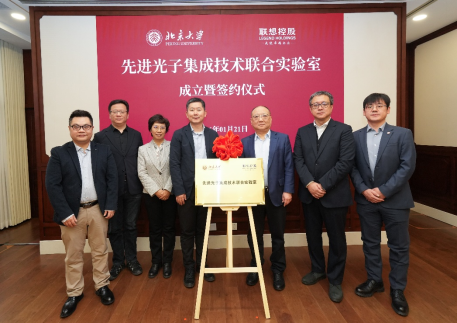
Core Viewpoint - The establishment of the "Peking University - Legend Holdings Advanced Photonic Integration Technology Joint Laboratory" aims to merge cutting-edge academic wisdom with real industrial needs to foster breakthrough results in photonic integration technology, which is crucial for overcoming energy consumption bottlenecks and enhancing computational efficiency [1][3]. Group 1: Laboratory Establishment and Goals - The joint laboratory is a collaboration between Peking University and Legend Holdings, focusing on the integration of advanced photonic technologies to address significant technical challenges in the industry [1][3]. - Legend Holdings aims to become a participant and enabler in China's technology industry ecosystem, with a three-tiered innovation system that includes increased R&D investment, investment in cutting-edge technologies, and commercialization of early-stage technologies [3][4]. Group 2: Research and Development Focus - The laboratory will leverage Peking University's research capabilities and Legend Holdings' financial support to tackle core issues such as the "power wall" and "capacity crisis" that hinder the development of next-generation communication and intelligent computing systems [10][12]. - The collaboration is expected to yield significant results by 2025, with the potential for joint patents and innovations that can transform the industry [12][13]. Group 3: Collaborative Model - Legend Holdings proposes a "co-creation partner" model that differs from traditional venture capital approaches, aiming for deep involvement in the entire lifecycle of research projects from early planning to industrialization [8][9]. - This model allows researchers to remain engaged in their scientific pursuits while ensuring that their innovations are applied in practical, societal contexts [9][10]. Group 4: Long-term Vision and Impact - The partnership is seen as a starting point for further collaborations that can lead to a broader integration of cutting-edge scientific achievements with industry applications, fostering a sustainable innovation ecosystem [13]. - The success of this model could lead to the emergence of new companies similar to Ayar Labs, which has recently gained significant investment and valuation, indicating a shift towards optical interconnect technologies as a solution for future computing demands [12][13].