Automotive Seating Components

Search documents
2025全球汽车座椅腰部调节系统行业Top5 生产商排名及市场占比
QYResearch· 2026-01-22 05:57
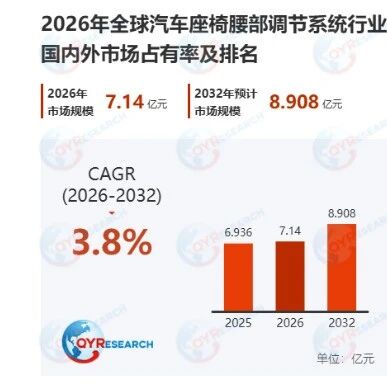
Core Viewpoint - The automotive seat lumbar adjustment system is evolving from a high-end feature to an essential comfort module in vehicles, driven by increasing consumer demand for comfort during long drives and the rise of smart cabins in electric vehicles [2][10]. Market Overview - The global market for automotive seat lumbar adjustment systems is projected to reach $131 million by 2032, with a compound annual growth rate (CAGR) of 3.8% from 2026 to 2032 [2][17]. - The top three manufacturers are expected to hold approximately 38.0% of the market share by 2025 [6]. Industry Chain Analysis - The system consists of core components such as actuators and control units, utilizing pneumatic or electromechanical solutions for lumbar support [7]. - Key upstream suppliers include Parker Hannifin, Bosch, and TE Connectivity, which provide essential components that influence the system's performance and cost structure [7]. - The midstream phase focuses on system integration and functionality, requiring a balance between support effectiveness and long-term stability [8]. Application and Customer Base - The lumbar adjustment system is increasingly used in both passenger and commercial vehicles, becoming a vital feature in mid to high-end models and long-distance driving scenarios [9]. - Major customers include Toyota, Volkswagen, Ford, General Motors, BMW, Mercedes-Benz, and several Chinese automakers [9]. Industry Development Opportunities - The main drivers for the industry include the upgrade of automotive consumption and the growing demand for driving comfort, with the lumbar support feature expanding from high-end to more mainstream vehicles [10]. - Technological advancements in pneumatic control precision and sensor technology are creating favorable conditions for performance optimization and cost control [10]. Industry Challenges - The industry faces challenges related to increased system complexity and cost pressures, requiring high levels of system integration and quality control [11]. - The long verification cycles for stability and durability pose challenges for smaller suppliers in terms of financial investment and engineering capabilities [11]. Future Trends - The lumbar adjustment system is expected to evolve towards higher precision, greater intelligence, and deeper integration with other cabin features, enhancing personalized comfort experiences [12]. - Modular design and automated assembly are anticipated to improve consistency and production efficiency, leading to broader application across various vehicle models [12].