Laser Ranging Instrument

Search documents
【行业深度】洞察2025:中国激光测距仪行业竞争格局及市场份额(附市场集中度、企业竞争力评价等)
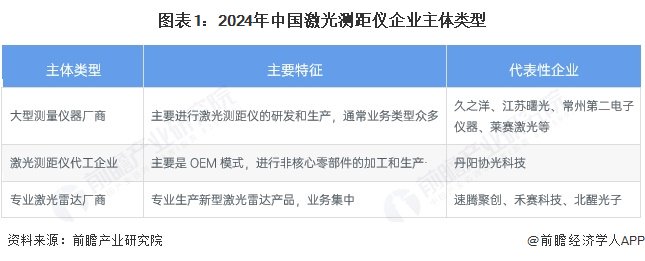
Qian Zhan Wang· 2025-04-30 05:11
Core Viewpoint - The Chinese laser rangefinder industry is characterized by a diverse competitive landscape, with major players including large measurement instrument manufacturers, OEM companies, and specialized lidar manufacturers, driven by the growing demand for lidar in smart vehicles [1][6][12]. Group 1: Types of Competitors - The Chinese laser rangefinder industry consists of three main types of companies: large measurement instrument manufacturers, OEM companies, and specialized lidar manufacturers [1][3]. - Large measurement instrument manufacturers, such as JiuZhiYang and LaiSai Laser, focus on R&D and production of laser rangefinders and have a diverse business portfolio [3]. - OEM companies primarily engage in the processing and production of non-core components, exemplified by DanYang XieGuang Technology [3]. - Specialized lidar manufacturers, like SuTeng JuChuang and HeSai Technology, concentrate on producing new lidar products [3]. Group 2: Leading Companies - The Chinese laser rangefinder industry can be categorized into three tiers: - The first tier includes listed companies like JiuZhiYang, JuXing Technology, LaiSai Laser, and YouLiDe, which have rich industry experience and strong brand advantages [6]. - The second tier consists of competitive enterprises, including specialized small giants and pre-listed companies, such as MaiCe Technology and LeiShen Intelligent, which possess significant technical accumulation [6]. - The third tier comprises small and medium-sized enterprises and new entrants [6]. Group 3: Market Concentration - As of January 2025, there are over 300 major laser rangefinder-related companies in China, with Guangdong province having the highest number, exceeding 90 [8]. - The market concentration in the laser rangefinder industry is moderate, with a CR3 of 53% and a CR5 of 63% [8]. Group 4: Market Share and Competition - In 2023, leading companies like JuXing Technology, JiuZhiYang, and YouLiDe collectively held a market share of no more than 25%, indicating a relatively fragmented market [10]. - The competitive landscape is intense, with numerous suppliers and established international brands like Bosch and Leica maintaining a leading position in the market [13]. Group 5: Business Strategies - Among listed companies, there is a noticeable divergence in market strategies: JiuZhiYang and LaiSai Laser focus on the domestic market, while JuXing Technology primarily targets international markets [12]. - LaiSai Laser leads in the business layout of laser rangefinders among listed companies, while other firms like JiuZhiYang and JuXing Technology treat laser rangefinder business as a supplementary segment [12].




预见2025:《2025年中国激光测距仪行业全景图谱》(附市场现状、竞争格局和发展趋势等)
Qian Zhan Wang· 2025-04-21 09:40
Industry Overview - The laser rangefinder is defined as an instrument that accurately measures the distance to a target using laser technology, characterized by remote measurement capabilities, portability, strong anti-interference, and data accuracy, widely used in military, industrial, and civilian applications [1][2] Industry Chain Analysis - The industry chain consists of upstream raw materials and components, midstream manufacturing, and downstream applications. Upstream includes laser-sensitive materials like silicon and gallium arsenide, while midstream involves the manufacturing of various types of laser rangefinders. Downstream applications span transportation, law enforcement, engineering measurement, and environmental monitoring [2][3] Market Growth - The market for laser rangefinders in China has grown from 1.2 billion yuan in 2016 to 3.3 billion yuan in 2023, with a compound annual growth rate (CAGR) of 14% from 2018 to 2023 [15][14] Competitive Landscape - The Chinese laser rangefinder market is fragmented, with leading companies like JiuZhiYang, JuXing Technology, and YouLiDe holding a combined market share of less than 25% in 2023. The industry features three tiers of companies: established public firms, competitive specialized firms, and smaller enterprises [20][16] Development Trends - The industry is expected to see a shift towards domestic substitution, market consolidation, and an increase in high-end demand. The market is projected to grow at a CAGR of 17.6%, reaching 8.9 billion yuan by 2029, driven by advancements in technology and expanding applications in smart vehicles and precision manufacturing [25][26]