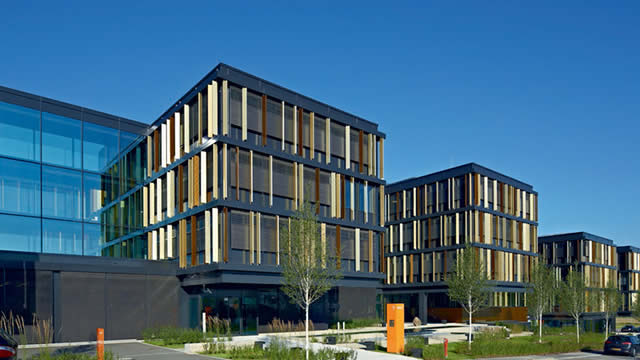
Life Sciences Real Estate

Search documents
Top Stock Movers Now: American Eagle Outfitters, Microchip Technology, Netflix, and More
Investopedia· 2025-12-03 17:46
Market Performance - Major U.S. equities indexes showed mixed results, with the Dow increasing by 0.4% and the S&P 500 rising by 0.1%, while the tech-heavy Nasdaq decreased by 0.2% [1] Company Highlights - Microchip Technology was the best-performing stock in the S&P 500, with shares climbing nearly 10% after the company raised its guidance due to strong bookings and an improved backlog [1] - American Eagle Outfitters saw a 15% increase in shares after reporting better-than-expected earnings, attributed to successful advertising campaigns featuring Sydney Sweeney and Travis Kelce [1] - Dollar Tree's shares rose approximately 3% as the discount retailer reported quarterly profits exceeding analysts' estimates and raised its outlook, benefiting from increased consumer demand for value [1] - Alexandria Real Estate Equities was the worst-performing stock in the S&P 500, with shares down 7% following weak guidance and a dividend cut [1] - Acadia Healthcare's shares fell 13% after the company warned of higher-than-expected liability costs [1] Industry Trends - Oil and gold futures advanced, indicating a positive trend in commodity markets [1] - The yield on the 10-year Treasury note decreased to 4.07%, reflecting changes in bond market dynamics [1] - The U.S. dollar weakened against the euro, pound, and yen, suggesting shifts in currency markets [1] - Prices for most major cryptocurrencies increased, indicating a positive trend in the digital asset space [1]




Lab spaces were the hottest commercial real estate bet. Now, landlords are facing headwinds from DC and Silicon Valley.
Business Insider· 2025-10-27 14:03
Core Insights - The life sciences real estate sector is experiencing significant challenges, including record vacancy rates and funding difficulties, leading to a retreat from previously high demand [2][5][6] Group 1: Market Trends - IQHQ, a developer, has put a recently acquired property in Redwood City, California, up for sale, indicating a shift in strategy as the life sciences real estate market faces downturns [2][3] - The average vacancy rate for life sciences spaces has surged from 6.6% in 2022 to 27% today, surpassing the national average vacancy rate for office spaces, which stands at 22.5% [6][12] - Newly constructed lab spaces completed between 2022 and 2024 have a staggering 48% vacancy rate, highlighting a mismatch between supply and demand [11] Group 2: Funding Challenges - Federal research funding, crucial for life sciences startups, is down by approximately $5 billion in grant awards compared to the previous year, impacting the sector's growth [4][19] - Venture capital investment in life sciences has decreased, with only $24.9 billion raised through September 2025, marking a potential low since before the pandemic [5][21] - The ecosystem of smaller life sciences firms, which traditionally drive demand for lab space, is under pressure as funding shifts towards larger, established companies [22] Group 3: Regional Insights - Major life sciences markets such as Boston, the Bay Area, and San Diego are experiencing unprecedented vacancy rates, with availability rates reaching 33% and 35% respectively [13][12] - Incubator spaces, typically resilient during downturns, are also feeling the strain, with some delaying expansion plans due to rising vacancies [14][16] Group 4: Future Outlook - There is a potential pivot in strategy for some real estate investors, considering alternative uses for vacant lab spaces, including applications in AI and drug manufacturing [23]


Life sciences markets hit vacancy rate highs, deflating rents
Yahoo Finance· 2025-09-12 10:53
Core Insights - The U.S. life sciences sector is experiencing a significant increase in vacancy rates, reaching 23.9% in the second quarter, which is a rise of 70 basis points quarter-over-quarter and 520 basis points year-over-year [2] - Asking rents are softening, with an average decline of 3.3% year-over-year, now at $67.88 per square foot, influenced by increased vacant sublease space [5][6] - The construction pipeline is contracting, with only 3% of inventory under construction, indicating a shift towards build-to-suit projects rather than speculative developments [3] Vacancy Rates and Market Dynamics - Vacancy rates in the life sciences sector have reached a new high, leading to increased concessions such as free rent and tenant improvements becoming standard [1] - The market is struggling with soft demand and a wave of new construction completions, contributing to the high vacancy rates [2] Rent Trends - Rent growth for lab and cGMP space is slowing, with an average increase of only 0.7% from the end of 2024 across 16 major markets, although rents are still 4.7% higher than at the end of 2023 [4] - Key markets like Boston, San Francisco Bay Area, Raleigh-Durham, and New Jersey have seen more pronounced rent declines, with New Jersey experiencing a drop of 5.3% [5] Sublease Space Impact - The increase in vacant sublease space, which is typically priced lower than direct available space, has contributed to the overall decline in average asking rents, with sublease space rising to 4.0% [6] - As the availability of sublease space decreases, its negative impact on rents is expected to lessen [6] Construction Activity and Future Outlook - Construction activity is at its lowest level since 2019, with just under 8 million square feet, allowing the market more time to absorb the vacant space delivered over the past two years [7] - This slowdown in construction is anticipated to help normalize high vacancy rates in some markets over the longer term [7]
Alexandria Posts Q2 Revenue Beat
The Motley Fool· 2025-07-23 16:01
Core Insights - Alexandria Real Estate Equities reported strong adjusted funds from operations of $2.33 per share, significantly exceeding analyst estimates of $0.59 per share, while revenue reached $762 million, also above expectations [1][2] - The company experienced a net loss per share of ($0.64), a reversal from last year's profit of $0.25, primarily due to $129.6 million in asset impairment charges [1][6] - Despite the loss, the company demonstrated strong cost controls and operational progress, although occupancy rates continued to decline [1][7] Financial Performance - Adjusted funds from operations per share were $2.33, down 1.3% year-over-year from $2.36 [2] - Revenue was $762 million, a slight decrease of 0.6% from $767 million in Q2 2024 [2] - The operating margin was 71%, down 1 percentage point from the previous year [2] - North American occupancy rates fell to 90.8%, down from 94.6% a year prior [2][7] Business Overview - Alexandria focuses on life sciences campuses, primarily in major innovation hubs like Boston, San Diego, and the San Francisco Bay Area [3] - The company’s business model emphasizes high-quality, adaptable buildings for a diverse tenant base, including large pharmaceutical companies and biotech start-ups [4] Operational Highlights - The company maintained a robust tenant rent collection rate of 99.9%, with 53% of annual rent coming from investment-grade or large-cap tenants [9] - Development activity included 217,774 square feet of new projects, with 90% leased upon completion [10] - Alexandria is pursuing a significant asset recycling program, expecting up to $1.95 billion in asset sales for the year to fund future expansions [10] Dividend and Guidance - The quarterly dividend was increased to $1.32 per share, up from $1.30, with a current payout ratio of 57% [12] - Updated financial guidance for 2025 projects adjusted funds from operations per share at $9.16 to $9.36, with GAAP net income expected between $0.40 and $0.60 per share [13] Market Outlook - The company anticipates a challenging operating environment, with no specific forecast for a rebound in tenant demand [14] - Key uncertainties include the pace of leasing decisions, funding levels for potential tenants, and market valuation pressures [14][15] - Management emphasizes the importance of monitoring asset sales, development execution, and occupancy stabilization within mega campuses [15]