Multifamily Rentals

Search documents
As Berkshire Hathaway hoards cash, Americans with stocks are ‘playing with fire’ based on 1 indicator. Here's why
Yahoo Finance· 2026-03-21 12:20
Core Insights - Berkshire Hathaway, led by Warren Buffett, has shifted its strategy, becoming a net seller of equities while holding $381.7 billion in cash as of September 2025, indicating a cautious approach towards U.S. equities due to high market valuations [1][6]. Group 1: Market Valuation Indicators - The Buffett Indicator, which measures U.S. stock market capitalization against GDP, currently stands at 230%, suggesting that the market is "Strongly Overvalued" compared to historical norms [3][4]. - Buffett has previously indicated that a ratio above 200% is risky, as seen during the dot-com bubble [2][4]. Group 2: Expert Opinions on Market Conditions - Federal Reserve Chair Jerome Powell and Leon Cooperman, CEO of Omega Family Office, have both expressed concerns about the overvaluation of U.S. stocks, with Cooperman warning of a potential market correction [7][8]. - Cooperman highlighted that the stock market is not adequately reflecting the uncertainties in the global environment, including geopolitical tensions [8]. Group 3: Investment Strategies Amidst Volatility - Investors are increasingly turning to gold as a hedge against inflation and market volatility, with Ray Dalio emphasizing the importance of including gold in investment portfolios [9][10]. - Real estate is also being highlighted as a productive asset class, with Buffett noting its income-generating potential [14]. Group 4: Alternative Investment Opportunities - Platforms like Arrived allow investors to enter the real estate market with minimal capital, providing opportunities for passive income without the responsibilities of property management [16]. - Masterworks offers fractional shares in high-value artworks, presenting an alternative investment avenue with historical returns [28][29].
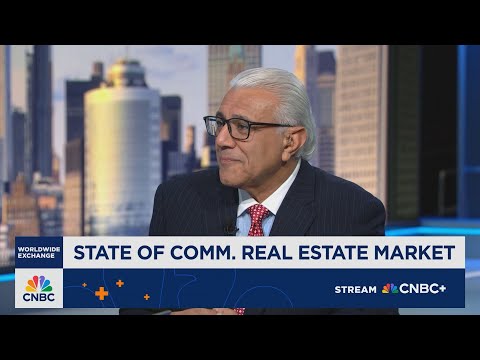
Nadji: Office space demand will never be the same after the pandemic
CNBC Television· 2025-09-19 11:47
Commercial Real Estate Market Trends - Commercial real estate construction is slowing down, which is seen as a positive development for the sector [1] - Equity for development has been cautious and pulled out of the market for the last 2 and a half years, awaiting price stabilization and sustained demand before re-entering [2] - Multifamily unit production has seen a significant pullback after record production [3] - Industrial properties are correcting overbuilding due to a pullback in new development [4] - Retail real estate is experiencing a comeback due to repositioning and the integration of online and physical presences, driven by experiential factors [14] - Multifamily rentals are projected to remain strong due to the high affordability gap between renting and owning homes [16] Office Space Dynamics - Office space demand is unique due to post-pandemic issues, with daily attendance reaching 80% of pre-pandemic levels, up from less than 70% a year ago and less than 60% two years ago [7] - While the labor market is slowing, existing workers are being asked to return to the office, influencing lease renewals [8][9] - Demand for office space will not return to pre-pandemic levels due to new cost-cutting strategies [9] - Older Class B and C office properties face higher vacancy rates (30-40%) compared to newer, modern, and suburban office properties (11-115%) [10] Investment Opportunities - Campus housing, particularly near large and high-profile public universities, continues to see strong demand and stable revenues [12] - Experiential retail, such as malls with aquariums and zoos, presents potential investment opportunities [13]