
New Energy Vehicle

Search documents
全球最大的液冷展会来了|2026深圳国际液冷产业展会及论坛
Sou Hu Cai Jing· 2026-01-13 01:51
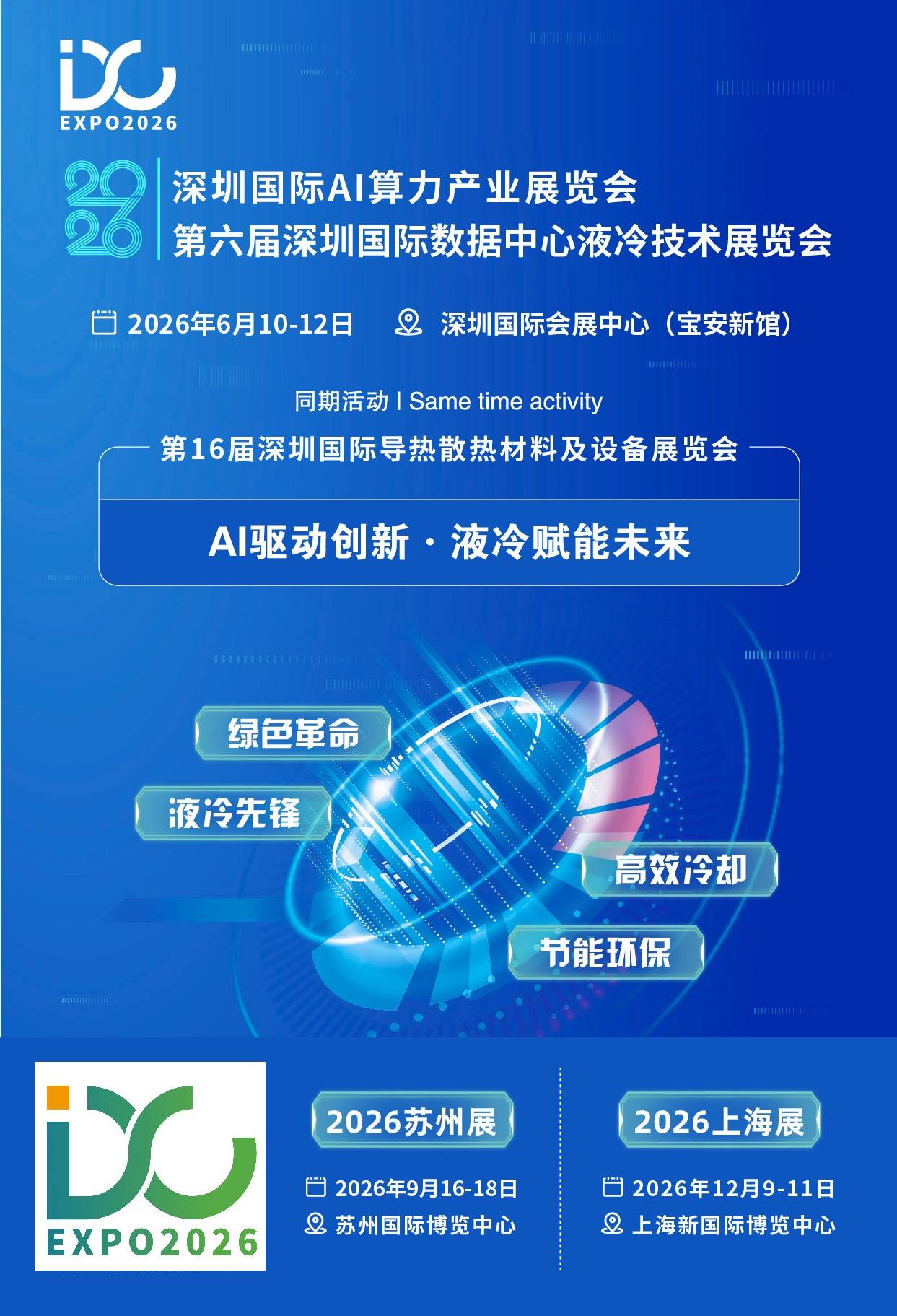
Group 1 - The 2026 Shanghai International Liquid Cooling Industry Exhibition will take place from December 9-11, 2026, at the Shanghai New International Expo Center [3] - The 2026 China (Shenzhen) International Liquid Cooling Industry Technology Exhibition is scheduled for June 10-12, 2026, at the Shenzhen International Convention and Exhibition Center [3] - The 2026 Suzhou Exhibition will occur from September 16-18, 2026, at the Suzhou International Expo Center [5] Group 2 - The rapid growth of big data has increased the demands on data center servers, necessitating higher power density in server cabinets [14] - Liquid cooling technology is becoming essential for data center efficiency, especially with the rise of 5G, edge computing, and AI applications [14][18] - The exhibitions aim to showcase the latest products and technologies in the liquid cooling industry, attracting professional audiences from data centers, power, electronics, edge computing, AI, and renewable energy sectors [14] Group 3 - The 2026 IDC exhibition is expected to cover an area of 15,000 square meters and will feature participation from major organizations such as the National Supercomputing Center in Shenzhen and Tencent [18] - Various technical exchange activities will be held during the IDC 2026 exhibition, focusing on industry hot topics and promoting diversified marketing strategies [19] - The exhibition will include a wide range of products covering cooling liquids, refrigerants, and various cooling devices, showcasing over a thousand new products across the entire industry chain [56] Group 4 - Shenzhen Angpai Technology Co., Ltd. is currently in the A-share IPO guidance stage, with plans to expand production capacity and R&D investment to capture market growth in liquid cooling [66] - The company has a registered capital of 90 million RMB and aims to leverage its professional R&D team and partnerships with universities to enhance its technological capabilities [66][68] - Angpai Technology's product offerings include liquid cooling module design, thermal management system integration, and innovative compressor technologies, with a focus on high reliability and efficiency [71][72]

破解“车主喊贵、险企喊亏”的困局
Xin Lang Cai Jing· 2026-01-03 23:22
Core Viewpoint - The rapid growth of new energy vehicle sales has led to significant challenges in the insurance sector, particularly regarding high premiums and underwriting losses, especially for high-usage commercial vehicles [1][2]. Group 1: Industry Challenges - New energy vehicles have become the preferred choice for commercial use due to lower operating costs, which inadvertently increases the probability of claims [1]. - The high claim rates, expensive repair costs, and insufficient data accumulation contribute to the industry's difficulties, leading to a situation where vehicle owners feel premiums are high while insurance companies report losses [1][2]. - The insurance sector faces additional pressure as some ride-hailing vehicles are insured as private cars, increasing the risk for insurers and prompting a more cautious underwriting approach [1]. Group 2: Solutions and Recommendations - Drivers are encouraged to comply with insurance regulations and acknowledge risks, while insurance companies should explore differentiated products based on actual operational characteristics and driving behavior [1][2]. - Automakers need to optimize product design to consider maintenance issues, enhance the commonality of parts, and improve supply levels to reduce repair costs and insurance payout pressures [2]. - Establishing a data-sharing mechanism among new energy vehicle manufacturers, ride-hailing platforms, and the insurance industry is essential for accurate risk assessment and pricing, which could lead to lower premiums for safe drivers [2]. Group 3: Collaborative Efforts - Addressing the challenges in new energy vehicle insurance requires collaboration among vehicle owners, manufacturers, and insurers to balance consumer rights and sustainable industry practices [3]. - Insurance companies should expand their coverage gradually, while automakers should promote a socialized maintenance system and reasonable data sharing [3]. - A collective effort is necessary to ensure the healthy development of the new energy vehicle insurance sector and protect user rights [3].
摩根士丹利:中国股票策略-反内卷信息提振 A 股市场情绪
摩根· 2025-07-11 02:22
Investment Rating - The report indicates a preference for A-shares over offshore markets due to their lagging performance year-to-date and more reasonable valuations compared to offshore markets [12]. Core Insights - Investor sentiment for A-shares has improved, with the weighted Morgan Stanley A-share Sentiment Indicator (MSASI) rising to 78% and the simple MSASI to 65% [2][6]. - The Chinese government has intensified its anti-involution message to address overcapacity issues in sectors like solar, lithium batteries, new energy vehicles, and e-commerce [4]. - Despite the positive sentiment, near-term volatility is expected to rise, and the report cautions against a beta-focused strategy in the offshore market [12]. Summary by Sections Investor Sentiment - A-share investor sentiment improved with the weighted MSASI increasing by 7 percentage points to 78% and the simple MSASI rising by 8 percentage points to 65% compared to the previous cutoff date [2]. - Average daily turnover for ChiNext and A-shares decreased by 11% and 7% respectively, while equity futures and Northbound turnover increased by 7% and 9% [2]. Market Inflows - Southbound markets experienced net inflows of US$2.7 billion from July 2 to July 9, with year-to-date and month-to-date net inflows reaching US$95.8 billion and US$0.5 billion respectively [3]. Economic Indicators - The Producer Price Index (PPI) showed a deflation of -0.4% month-over-month in June, driven by weak construction activities and tariff impacts, while the Consumer Price Index (CPI) rose to 0.1% year-over-year from -0.1% in May [5]. Policy Implications - The report emphasizes the need for a tailored approach to the anti-involution initiative, as different sectors have varying competitive landscapes, ESG considerations, and market sizes [4]. - The implementation of policies to rebalance and reflation the economy remains challenging due to institutional inertia [5].