OLED Materials

Search documents
瑞联新材拟斥资8000万加码OLED材料
WitsView睿智显示· 2026-03-30 05:47
Core Viewpoint - The company, Ruilian New Materials, plans to invest 80 million yuan in the construction of the Pucheng Haitai high-performance optoelectronic materials industrialization project, utilizing part of the remaining fundraising from its liquid crystal project [2][4][6]. Group 1: Project Overview - The project will be implemented by Ruilian New Materials' wholly-owned subsidiary, Pucheng Haitai, leveraging the existing 311 workshop, which has completed structural and decorative engineering [4]. - The total planned investment for the project is 80 million yuan, focusing on equipment procurement and installation, as well as necessary public utilities and auxiliary service facilities [6]. - Upon completion, the project will produce OLED sublimation precursor materials, addressing the growing market demand in the OLED display industry [6]. Group 2: Market Position and Strategy - Ruilian New Materials aims to capitalize on the continuous growth of the OLED display market, as the current production capacity is insufficient to meet business development needs [6]. - As a leading company in the domestic OLED sublimation precursor materials sector, it is essential for Ruilian to plan and layout production capacity in advance to better seize industry opportunities and meet core customer procurement needs [6]. - The successful implementation of this fundraising investment project will help Ruilian expand its market share, deepen its business layout in related sectors, and enhance its profitability and market presence [6].


韩国材料公司有望在今年量产蓝色磷光OLED材料
WitsView睿智显示· 2026-02-25 06:39
Core Viewpoint - Lordin, a South Korean OLED materials company, announced plans to mass-produce blue phosphorescent OLED materials in 2023, which could significantly enhance efficiency and reduce power consumption in OLED displays [1][4]. Group 1: OLED Technology Overview - OLEDs consist of self-emissive materials and can be categorized into phosphorescent and fluorescent types. Fluorescent OLEDs have an efficiency of 25%, while phosphorescent OLEDs can theoretically achieve 100% efficiency [1][4]. - The current commercialized phosphorescent OLEDs include red and green, but blue OLEDs, which consume the most energy, have shorter lifespans and face application challenges [1][4]. Group 2: Efficiency and Performance Improvements - Lordin's research indicates that if the efficiency of OLEDs can be improved from 25% to 100%, brightness could increase up to four times, and power consumption could decrease by 25-50% under the same current conditions [4][6]. - The company emphasizes the importance of thermal stability in blue phosphorescent materials, which must withstand continuous processing heat for over a week while maintaining performance [5][6]. Group 3: Material Development Strategies - Lordin is focusing on enhancing molecular stability through deuteration, which replaces carbon-hydrogen bonds with carbon-deuterium bonds to reduce molecular vibration energy and slow decomposition [5][6]. - The company is also pursuing a simplified process strategy with a new "ZETPLEX" structure that combines specific hosts with dopants to reduce the number of components, thereby improving process control and uniformity during mass production [5][6]. Group 4: Market Implications - The mass production of blue phosphorescent OLEDs is expected to alter the revenue structure of the OLED industry, as lower power consumption at the same brightness will impact panel cost structures and reduce heat generation, thereby extending panel lifespan and reliability [6]. - The application range for this technology is broad, including IT OLEDs, large televisions, and next-generation extended reality devices, indicating a potential generational shift in OLED technology [6].

韩企蓝色磷光OLED材料获新进展
WitsView睿智显示· 2025-12-17 04:47
Core Viewpoint - LORDIN has successfully developed the ZETPLEX technology, which addresses the lifespan issues of blue phosphorescent OLED materials and confirms the commercial viability of the product after six years of research [1]. Group 1: Technology Development - The emission layer (EML) in OLEDs is composed of organic materials that emit light when electrified, typically involving a combination of host materials and dopants to produce different colors [4]. - LORDIN's researchers aimed to overcome the limitations of multi-component EML systems, such as difficulty in controlling mixing ratios and high production costs, while addressing the complexities of OLED optical properties [4]. - The ZETPLEX technology features a two-component structure that achieves the efficiency of traditional four-component structures, with external quantum efficiency (EQE) exceeding 20% and device lifespan improved to about 60% of existing phosphorescent blue devices [5]. Group 2: Supply Chain and Production - LORDIN has made progress in establishing an "Indian supply chain" for material localization and stable mass production, ensuring a stable supply of heavy water, a core raw material for high-purity OLED processes [6]. - The company has completed its first supply agreement with an Indian partner and is negotiating a second contract, which would be the largest of its kind among South Korean private enterprises [6]. - This initiative aims to address the instability of raw material supply and ensure price competitiveness [7].
莱特光电9月25日获融资买入1273.09万元,融资余额1.23亿元
Xin Lang Cai Jing· 2025-09-26 01:36
Core Viewpoint - On September 25, 2023, Lite Optoelectronics experienced a decline of 1.37% in stock price, with a trading volume of 93.21 million yuan, indicating a moderate level of market activity [1] Financing Summary - On the same day, Lite Optoelectronics had a financing purchase amount of 12.73 million yuan and a financing repayment of 10.47 million yuan, resulting in a net financing purchase of 2.26 million yuan [1] - As of September 25, the total balance of margin trading for Lite Optoelectronics was 123 million yuan, which accounts for 1.20% of its circulating market value, indicating a relatively high level compared to the past year [1] - The company had a margin balance of 720,000 yuan with a short selling volume of 28,500 shares, which is below the 40th percentile of the past year, suggesting a low level of short selling activity [1] Business Performance - As of June 30, 2023, Lite Optoelectronics reported a total of 7,540 shareholders, a decrease of 11.99% from the previous period, while the average circulating shares per person increased by 13.62% to 23,785 shares [2] - For the first half of 2023, the company achieved an operating income of 292 million yuan, representing a year-on-year growth of 18.84%, and a net profit attributable to shareholders of 126 million yuan, which is a 36.74% increase year-on-year [2] Dividend Information - Since its A-share listing, Lite Optoelectronics has distributed a total of 205 million yuan in dividends, with 165 million yuan distributed over the past three years [3] Shareholding Structure - As of June 30, 2023, among the top ten circulating shareholders, several new entrants were noted, including Guotai Junan Advantage Flexible Allocation Mixed A (holding 3.35 million shares) and Hong Kong Central Clearing Limited (holding 2.55 million shares) [3] - The previous top ten shareholder, Taikang Innovation Growth Mixed A, has exited the list [3]

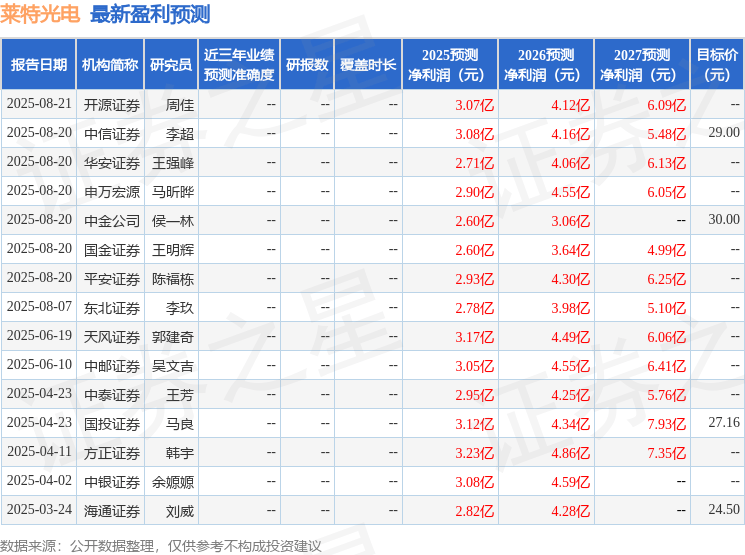
莱特光电:8月20日接受机构调研,国泰基金、工银瑞幸基金等多家机构参与
Sou Hu Cai Jing· 2025-08-22 10:06
Core Viewpoint - The company, Lite Optoelectronics, reported significant growth in its financial performance for the first half of 2025, driven by increasing demand in the OLED market and effective cost management strategies [2][13]. Financial Performance - In the first half of 2025, the company achieved revenue of 292 million yuan, a year-on-year increase of 18.84% - The net profit attributable to shareholders reached 126 million yuan, up 36.74% year-on-year - The sales revenue from OLED terminal materials was 262 million yuan, reflecting a growth of 31.63% [2][13]. Product Development and R&D - The company has expanded its product matrix to include red, green, and blue emitting layer materials, as well as core functional layer materials [3]. - R&D expenses for the first half of 2025 amounted to 32.07 million yuan, a 6.91% increase year-on-year, with a focus on developing new materials and enhancing existing product performance [3]. - The company has made significant progress in its new product lines, with Red Host materials moving towards mass production and Green Prime materials expected to achieve batch supply within the year [3]. Market Trends and Opportunities - The OLED technology is increasingly penetrating the mid-size display market, with projected growth in applications for laptops and automotive displays [7][8]. - The construction of new 8.6-generation AMOLED production lines by major manufacturers is expected to create new growth opportunities for the OLED industry [8]. - The demand for OLED organic light-emitting materials is anticipated to rise significantly due to the larger substrate area and increased material usage in the new production lines [8]. Shareholder Returns - The company has implemented a proactive dividend policy, with cash dividends totaling 165 million yuan from 2022 to 2024, representing 38.15% to 59.97% of annual net profits [11]. - A new share repurchase plan has been initiated, with 50 million to 100 million yuan allocated for repurchasing shares [11]. Future Outlook - The company expects a continued increase in OLED material demand in the second half of 2025, driven by new product launches from downstream brand manufacturers [12]. - Plans to enhance R&D investment and explore new business opportunities are in place, aiming to build a diversified business model and strengthen market competitiveness [12].
UDC公布2025年第一季度财务业绩
WitsView睿智显示· 2025-05-06 07:12
Core Viewpoint - UDC reported a total revenue of $166.3 million for Q1 2025, with a focus on OLED materials and technology licensing, despite a challenging macroeconomic environment [1]. Group 1: Financial Performance - In Q1 2025, UDC achieved total revenue of $166.3 million (approximately RMB 1.201 billion) and an operating profit of $69.7 million [1]. - Material sales revenue was $86.2 million, down from $93.3 million in the same period last year [1]. - Royalty and licensing fee income reached $73.6 million, an increase from $68.3 million year-over-year [1]. - The overall gross margin was 77%, slightly down from 78% in the previous year [1]. Group 2: Business Focus and Outlook - UDC specializes in the research and development of OLED materials, patent licensing, and technical support, with its phosphorescent OLED technology enhancing display efficiency and lifespan [1]. - Looking ahead to 2025, UDC maintains its revenue guidance, projecting revenues between $640 million and $700 million despite increased uncertainty in the macroeconomic environment [1].