Procurement and Supply Chain

Search documents
NORTH AMERICAN MANUFACTURERS CUT ORDERS AS GLOBAL SUPPLY CHAINS REMAIN UNDERUTILIZED IN OCTOBER: GEP GLOBAL SUPPLY CHAIN VOLATILITY INDEX
Prnewswire· 2025-11-12 13:14
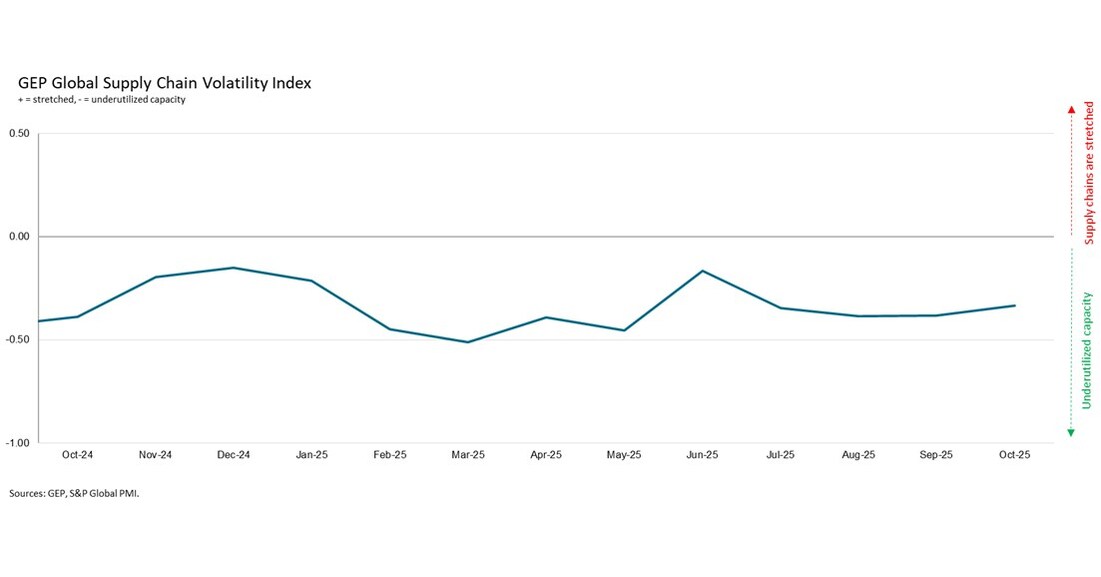
Core Insights - North American manufacturers have significantly reduced their purchases of raw materials and intermediate goods in October, indicating a potential slowdown in production in the coming months [1][9][18] Supply Chain Volatility Index - The GEP Global Supply Chain Volatility Index registered -0.33 in October, suggesting that global supply chain capacity remains underutilized, with manufacturers keeping inventories lean and curbing new purchases [4][9] - In North America, the index fell to -0.45, the lowest level since March, indicating that suppliers' capacity is underutilized to the greatest extent since prior to April's tariff announcements [10] - Asia's index dropped to -0.30, primarily due to a slowdown in purchasing by Chinese manufacturers, while Europe saw a slight improvement with the index rising to -0.25 [10] Regional Analysis - North America is experiencing a clear manufacturing pullback, with firms reporting lower material purchasing and reduced inventory building, which points to weaker production through the winter [5][7] - In Asia, the momentum has faded, with a pullback in factory buying across China offsetting continued strength in India, leading to a broader softening across the region [5] - Europe's manufacturing sector is showing only marginal increases in activity, with firms in major economies like Germany, France, Italy, and the U.K. continuing to restrict raw material purchasing, indicating a sluggish industrial recovery [6][9] Inventory and Purchasing Trends - Reports indicate that global procurement managers are experiencing historically low levels of stockpiling due to limited concerns about purchasing price inflation or shortages, reflecting a preference for lean inventories among manufacturers [15] - The global item shortages tracker remains well below its long-term trend level, signaling healthy supply levels for manufacturers, with minimal challenges in sourcing commodities and components [15] Labor and Transportation Insights - There was a modest rise in labor-related capacity constraints in October, with backlogs due to inadequate staff supply reaching a four-month high, although the labor shortages tracker remains only marginally above its long-term trend [15] - Global transportation costs slightly decreased in October, falling just below historically average levels [15]


TARIFF FEARS DRIVE U.S. STOCKPILING IN AUGUST, WHILE MANUFACTURING WEAKENS IN EUROPE AND ASIA: GEP SUPPLY CHAIN VOLATILITY INDEX
Prnewswire· 2025-09-11 12:23
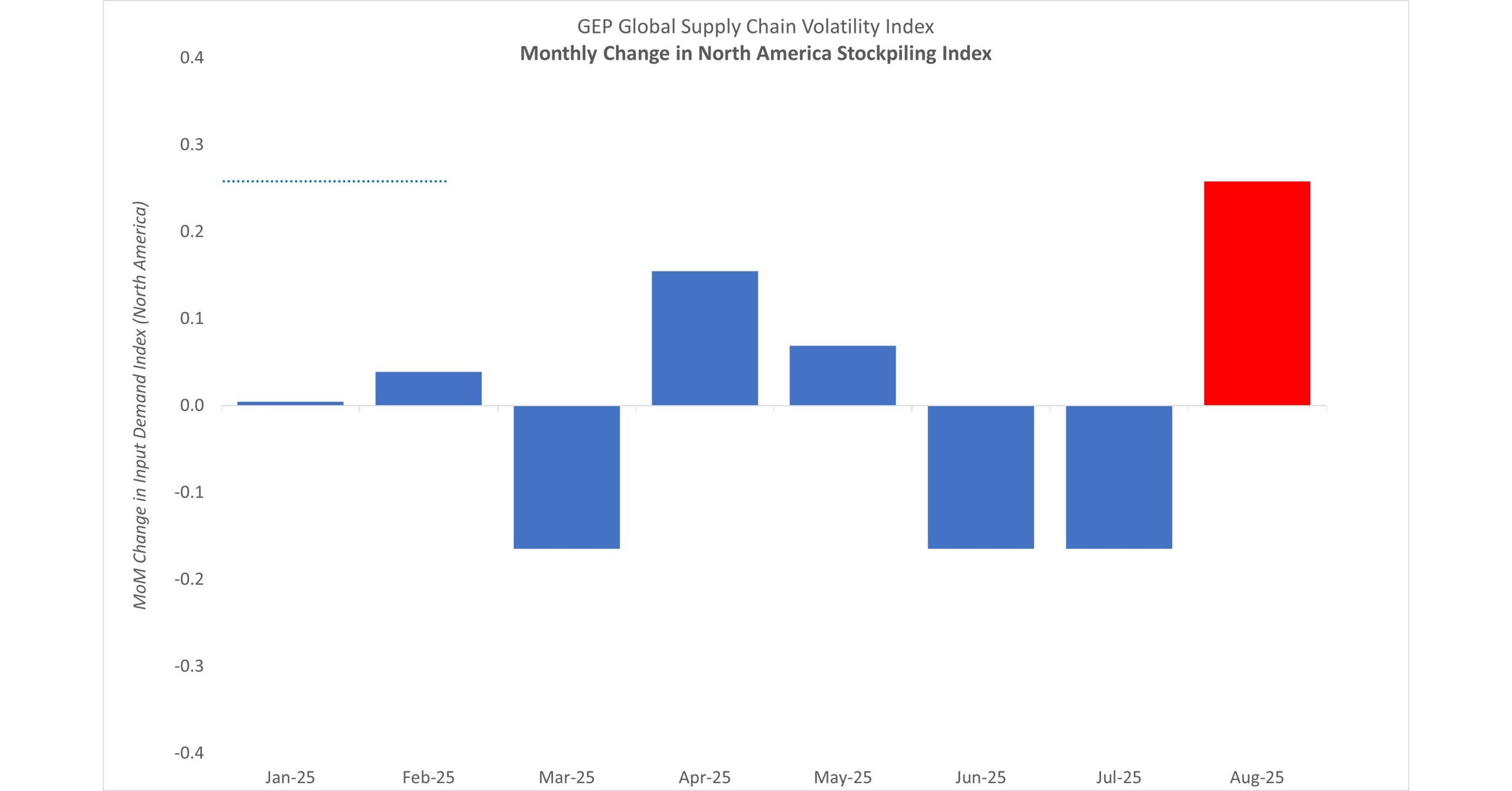
Core Insights - The GEP Global Supply Chain Volatility Index decreased to -0.39 in August from -0.35 in July, indicating rising spare capacity as global supply chain activity cooled [1][14] - North America showed strong supply chain activity, with companies stockpiling raw materials to mitigate tariff-related shortages, particularly in the US consumer goods sector [1][6] - In contrast, Asia's index fell to a three-month low, primarily due to weakened purchasing activity in China's consumer non-cyclicals sector, with Japan and Taiwan also experiencing declines [2][7] - Europe faced further deterioration, with Germany's basic materials sector struggling and UK manufacturing deepening its contraction, resulting in an index of -0.90, one of the steepest declines since 2024 [2][6] Regional Highlights - **North America**: Supply chains were nearly at full capacity as companies increased stock levels in response to recent orders and tariff concerns [6][7] - **Asia**: The index indicated rising spare capacity, with flat purchasing volumes in China, while South Korea, Indonesia, and India saw increased procurement activity [7] - **Europe**: The index continued to decline as factories reduced purchases of intermediate goods and destocked, highlighting the fragile nature of the region's industrial recovery [6][7] Expert Commentary - Michael DuVall, GEP's global head of supply chain strategy, noted that tariff uncertainty has become a structural reality, urging companies to invest in resilience, diversify suppliers, and enhance capabilities like demand sensing for better decision-making [3][6]