Shale Oil and Gas

Search documents
History Has Already Shown Us How Private Credit Challenges Played Out the Last Time.
Investment Moats· 2026-03-26 00:16
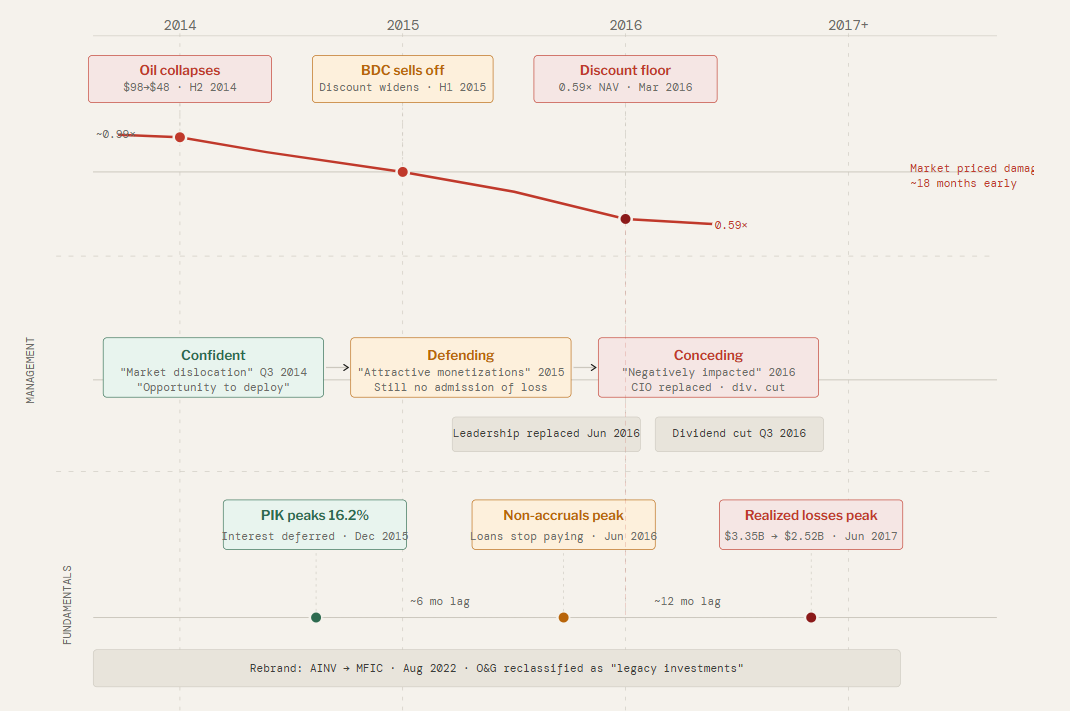
Core Insights - The article discusses the historical relationship between private credit and the energy sector, particularly shale oil and gas, before the current focus on software companies [1][2] - It highlights the significant borrowing by U.S. energy companies during the shale boom, with high yield energy issuance reaching approximately $290 billion from 2008 to 2014 [2] - The article draws parallels between the challenges faced by energy companies during the oil price collapse and the current situation of software companies in private credit [3] Group 1: Historical Context - During the shale boom, energy companies were major users of leveraged finance, with their weight in the high-yield index increasing from 10% to nearly 15% by 2014 [2] - The collapse of oil prices from $98 per barrel to $48 per barrel severely impacted shale producers, leading to increased risk for lenders [3] Group 2: Apollo's Role - Apollo, a significant alternative asset manager, had substantial exposure during the energy price trauma through its private credit lending corporation, Apollo Investment Corporation (AINV), which was later renamed MidCap Financial Investment Corporation (MFIC) [4][5] - The price of AINV declined by 48% from 2014 to 2016, reflecting the volatility and challenges faced by investors in the sector [6] Group 3: Investment Dynamics - MFIC had 17% of its portfolio exposed to the oil and gas sector at its peak, providing insights into potential future scenarios for private credit investors [7] - The article discusses the progression of interest payments and the eventual realization of losses when borrowers cannot meet their obligations [8] Group 4: Investor Experience - Investors who remained invested in AINV since 2013 experienced a 9% distribution yield initially, but faced capital losses, resulting in an overall return of approximately 2% per annum after 12 years [11][12] - The article emphasizes the psychological aspects of investing, noting that discomfort is a common experience and that investors often misinterpret their returns [10][15] Group 5: Broader Implications - The article suggests that discomfort in investing is inevitable, and investors should be aware of the historical patterns and management responses during challenging times [14] - It highlights the importance of understanding the range of potential returns and the psychological factors influencing investor behavior [15]


Devon–Coterra Deal Signals Investors Still Rule the Shale Patch
Yahoo Finance· 2026-03-02 21:00
Core Viewpoint - The merger between Devon Energy and Coterra Energy, creating a $58 billion entity, reflects a trend of consolidation among smaller public companies in the U.S. shale industry, aiming for multi-basin and multi-year drilling opportunities [1]. Company Overview - The merged entity will retain the name Devon Energy and will be headquartered in Houston, with a significant presence in Oklahoma City [3]. Production Capacity - The combined company is projected to produce over 1.6 million barrels of oil equivalent per day (boepd) by the third quarter of 2025, which includes more than 550,000 barrels of oil per day and 4.3 billion cubic feet of gas per day [2]. Synergies and Cost Efficiency - Devon and Coterra anticipate realizing $1 billion in annual pre-tax synergies from the merger, which is expected to enhance free cash flows significantly [4]. - The combined company will have the largest inventory in the Delaware Basin, with a breakeven cost below $40 per barrel, indicating strong capital efficiency across various basins [5]. Market Context - The transaction, which has been unanimously approved by both companies' boards, is expected to close in the second quarter of 2026, pending regulatory approvals and shareholder consent [6]. - This merger is part of a broader trend in the U.S. upstream sector, which is moving into a multi-year consolidation phase as opportunities to strategically enhance core play exposure become limited [7].


Devon Energy and Coterra merge in $58B deal to create US shale powerhouse
Invezz· 2026-02-02 14:32
Core Viewpoint - Devon Energy and Coterra Energy are merging in a $58 billion all-stock transaction, creating a significant player in the US shale industry [1] Group 1: Merger Details - The merger involves Coterra shareholders receiving 0.70 Devon shares for each Coterra share, implying an enterprise value of approximately $58 billion based on Devon's closing price [1] - The combined entity will retain the Devon Energy name and is projected to have a market capitalization exceeding $47 billion [1] - Devon shareholders will own about 54% of the new company, while Coterra shareholders will hold 46% [1] - The deal is anticipated to close in the second quarter, pending regulatory approvals and shareholder votes [1] Group 2: Production and Operational Synergies - The merger will create one of the largest shale producers globally, with expected production of around 1.6 million barrels of oil equivalent per day by the third quarter of this year [1] - The combined company will have a diverse asset base across major US shale basins, including the Permian and Anadarko [1] - The merger is expected to unlock approximately $1 billion in annual pretax synergies by the end of 2027, enhancing free cash flow and shareholder returns [1] Group 3: Leadership and Governance - Clay Gaspar will remain as president and chief executive of the combined company, while Tom Jorden will serve as nonexecutive chairman of the board [1] - The board will consist of six Devon-appointed directors and five Coterra-appointed directors, with shared leadership roles [1] - The company plans to maintain a shareholder-friendly capital return strategy, including a quarterly dividend of 31.5 cents per share and a stock-buyback program exceeding $5 billion [1] Group 4: Analyst Perspectives - Analysts view the merger as a positive move that strengthens the combined company's position in the Permian Basin, particularly in the Delaware sub-basin [1] - The merger is expected to attract greater investor interest by combining two high-quality companies into a larger entity [1] - The acquisition will expand Devon's footprint in the Delaware Basin and enhance its reach in the Anadarko Basin and Marcellus [1] Group 5: Industry Context - This merger is the largest US shale deal since Diamondback Energy's acquisition of Endeavor Energy Resources for about $26 billion in 2024 [1] - Despite a slowdown in merger activity in 2025, shale producers are pursuing scale to lower costs and improve resilience in mature basins [1] - The merger occurs amid improving energy markets, with Devon shares up nearly 18% over the past year and Coterra shares rising about 4% [1]