Sleep Monitoring

Search documents
行业聚焦:全球睡眠监测行业头部生产商市场份额及排名调查(附核心企业名单)
QYResearch· 2026-02-10 09:20
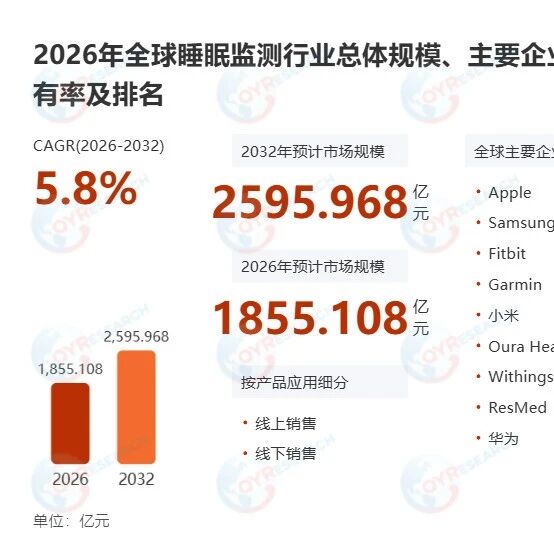
Core Viewpoint - Sleep monitoring is a comprehensive solution that utilizes various sensors and data analysis technologies to continuously collect, analyze, and identify events related to individual sleep processes, making it a crucial technology in health management, chronic disease management, and sleep disorder screening [2]. Group 1: Product Types and Applications - Sleep monitoring products can be categorized into three main types: wearable devices (such as bands, watches, and rings), non-contact bedside devices (like under-mattress sensors and bedside radar), and medical-grade sleep monitoring equipment (including polysomnography (PSG) and home sleep apnea testing (HSAT)), addressing a range of needs from daily health management to clinical diagnosis [2][4]. - Consumer-grade wearable devices focus on continuity, convenience, and user compliance, primarily for sleep behavior trend analysis and risk indication; non-contact bedside devices utilize radar and pressure sensors for unobtrusive monitoring, suitable for home, elderly, and long-term care scenarios; medical-grade devices like PSG and HSAT offer higher signal integrity and diagnostic accuracy, serving as standard assessment tools for sleep disorders [4]. Group 2: Industry Structure and Market Dynamics - The upstream supply chain includes key raw materials and components such as optical sensors, MEMS accelerometers, pressure sensors, and low-power microcontrollers, which directly impact the performance and cost structure of end products [4]. - The downstream customer base is diverse, including consumer electronics brands targeting individual users, medical institutions emphasizing diagnostic accuracy, and insurance and health management organizations increasingly using sleep monitoring for long-term risk management and chronic disease intervention [5]. Group 3: Market Size and Financials - By 2025, the nominal capacity for sleep monitoring products is estimated to be approximately 612 million units, with actual sales around 574 million units, and a global average factory price of about $44.8 per unit. Hardware manufacturers typically experience a gross margin ranging from 23% to 37% due to factors like product structure and cost fluctuations [5]. - The global sleep monitoring market is projected to reach $38.18 billion by 2032, with a compound annual growth rate (CAGR) of 5.76% over the coming years [6]. Group 4: Competitive Landscape - Major global sleep monitoring manufacturers include Apple, Samsung Electronics, Fitbit, Garmin, Xiaomi, Oura Health, Withings, ResMed, Huawei, and Philips, with the top five companies expected to hold approximately 59.4% of the market share by 2025 [8].