
《江南春》

Search documents
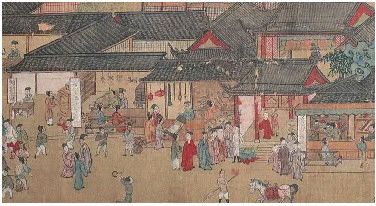
画出《江南春》的仇英,究竟是个什么人?
Qi Lu Wan Bao· 2025-12-26 16:30
Core Viewpoint - The focus of the news is on the painting "Jiangnan Spring" by Qiu Ying, which was donated to the Nanjing Museum in 1959, highlighting the artist's unique style and contributions to Chinese art [2][5]. Group 1: Qiu Ying's Artistic Style - Qiu Ying is renowned for his meticulous gongbi (fine brush) technique, which vividly captures the social life and scenery of Suzhou during the Ming Dynasty, as seen in his version of "Along the River During the Qingming Festival" [3][4]. - His works feature a large number of characters, with nearly 1,500 individuals depicted in intricate detail, showcasing various aspects of life in Ming Dynasty Suzhou [4][5]. - The color palette used by Qiu Ying is noted for its elegance and clarity, combining elements of nature and human activity to create a lively representation of Jiangnan's springtime [5][6]. Group 2: Qiu Ying's Background and Rise - Qiu Ying, born into a humble family, initially worked as a lacquer craftsman and had little formal education, which shaped his unique perspective as an artist [7][8]. - His breakthrough came when he was discovered by the renowned artist Wen Zhengming, who recognized his talent and encouraged him to refine his skills [9][10]. - After studying under Zhou Chen, Qiu Ying transformed from a mere copyist into a master artist, eventually becoming one of the "Four Masters of the Ming Dynasty" alongside Shen Zhou, Wen Zhengming, and Tang Yin [12][13]. Group 3: Market and Legacy - Qiu Ying's works gained immense popularity during the late Ming and early Qing dynasties, leading to a thriving market for his art, which appealed to both literati and wealthy merchants [13][14]. - His paintings are now highly valued, with original works fetching prices in the hundreds of millions, exemplified by the estimated value of "Jiangnan Spring" at 88 million yuan [16]. - Despite the scarcity of his surviving works, Qiu Ying's influence remains significant, with his pieces held in major museums worldwide, including the Palace Museum and the British Museum [16].

专场音乐会展现三弦魅力
Xin Lang Cai Jing· 2025-12-20 21:05
Core Viewpoint - The concert held by the Tianjin Music College's Sanxian Chamber Orchestra showcased the integration of traditional music with modern innovation, highlighting the unique charm of regional music culture [1] Group 1: Concert Highlights - The concert opened with "Welcoming the New Spring," featuring a lively melody that reflects regional music culture [1] - A performance of "Jiangnan Spring" with Sanxian and Pipa illustrated the beautiful scenery of the Jiangnan water town [1] - Several premieres were featured, including "Ancient Tunes and Modern Rhythms," which cleverly incorporated modern musical language with Sanxian and accordion [1] - The piece "Joyful Herdsmen," performed with Sanxian and long-tune singing, showcased the beauty of ethnic music fusion [1] - The piano concerto version of "Nuo" recreated the mysterious grandeur of the Zhou Dynasty's Nuo ritual [1] - The concert concluded with "Unforgettable Tianjin Sound," a Sanxian trio that evoked urban memories through dynamic melodies and rhythmic changes [1] Group 2: Cultural Significance - The entire performance demonstrated the diverse charm of Sanxian art and the deep integration of traditional culture with modern innovation [1]