中波制冷型红外热像仪

Search documents
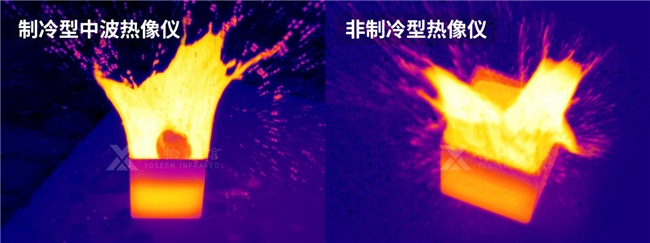
格物优信2000Hz超高帧频中波制冷型红外热像仪带来革命性性能提升
Sou Hu Wang· 2026-01-22 01:56
Core Viewpoint - The infrared thermal imaging technology is essential in scientific research, industrial production, and high-end manufacturing, with significant advancements made by the company in mid-wave cooled thermal imaging cameras, enhancing sensitivity, response speed, and temperature resolution [1][10]. Group 1: Technological Advancements - The company has developed a mid-wave cooled thermal imaging camera with an unprecedented frame rate of 2000Hz, allowing for the capture and processing of 2000 thermal images per second, which is crucial for high-temperature detection and precise temperature measurement [1][3]. - The thermal imaging camera features high sensitivity, high resolution, and high stability, with a noise equivalent temperature difference (NETD) of ≤20mK, enabling the detection of temperature differences as small as 0.02°C [3][4]. Group 2: Functional Features - The thermal imaging camera includes various functionalities such as adjustable temperature measurement ranges, region of interest (ROI) settings for enhanced frame rates, and filter wheel configurations for observing specific wavelengths or higher temperature targets [4][6]. - The device supports flexible adaptation to different monitoring needs, allowing users to switch resolutions to optimize frame rates for high-speed targets [3][4]. Group 3: Applications in Various Fields - In aerospace, the thermal imaging camera can monitor critical components like turbine blades and combustion chambers under extreme conditions, providing precise data for reliability testing and cooling technology optimization [6][8]. - In advanced scientific research, the camera records temperature changes in materials under thermal shock, aiding researchers in understanding thermal performance [8][10]. - In industrial measurement and precision manufacturing, the camera's capabilities are vital for monitoring high-temperature processes in metallurgy and electronic chip production, helping to identify temperature anomalies and improve product quality [8][10].