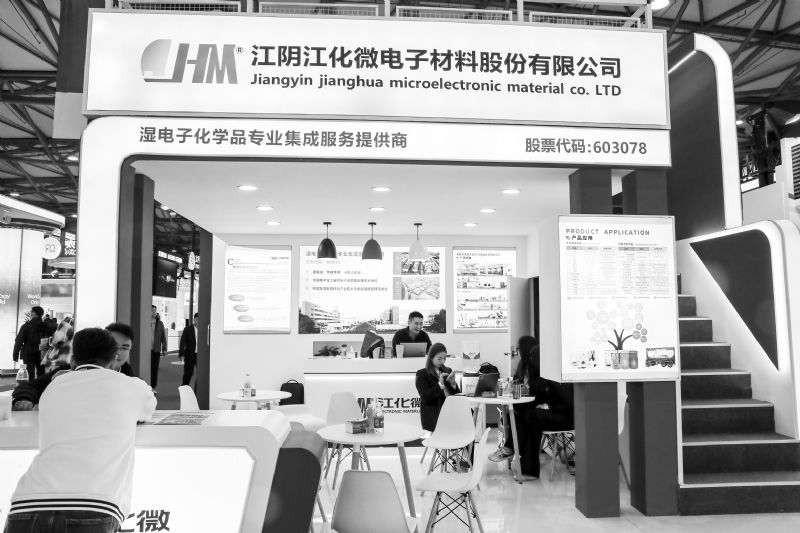
光刻胶配套湿电子化学品

Search documents
江化微拟18.48亿易主股价涨停 上海国资稳定控制权锁定期达五年
Chang Jiang Shang Bao· 2026-01-20 23:49
Core Viewpoint - Jianghua Micro, the first listed professional wet electronic chemical company in China, is set to be acquired by Shanghai State-owned Assets [2][3] Group 1: Share Transfer Details - The controlling shareholder, Zibo Xingheng Tusheng, plans to transfer 92.3823 million shares to Shanghai Fuxun Technology for 1.848 billion yuan, at a price of 20 yuan per share, representing 23.96% of the total share capital [2][3] - After the transfer, the actual controller will change from Zibo Municipal Finance Bureau to Shanghai State-owned Assets Supervision and Administration Commission [3][4] Group 2: Management and Control Stability - To maintain control and management stability, Shanghai State-owned Assets has set a 60-month lock-up period for the shares, and Jianghua Micro's chairman, Yin Fuhua, has committed not to leave the company voluntarily for five years [5][6] - Yin Fuhua will continue to serve in the core management team as the second-largest shareholder after the transfer [5][6] Group 3: Strategic Implications - The entry of Shanghai State-owned Assets is expected to inject new strategic resources and development momentum into Jianghua Micro, enhancing its industrial competitiveness and profitability [6][7] - Shanghai Fuxun Technology aims to leverage industrial synergy to empower Jianghua Micro's business development and increase its overall value [6][7] Group 4: Company Performance and Future Plans - Jianghua Micro specializes in high-end electronic chemical materials and has established three core production bases in Jiangyin, Zhenjiang, and Sichuan [7] - For the first three quarters of 2025, Jianghua Micro reported revenue of 910 million yuan, a year-on-year increase of 10.92%, while net profit decreased by 8.66% to 78.783 million yuan [7][8] - The company is advancing its capacity expansion projects, including a planned fundraising of 300 million yuan for a project to produce 37,000 tons of ultra-pure wet electronic chemicals [7][8]


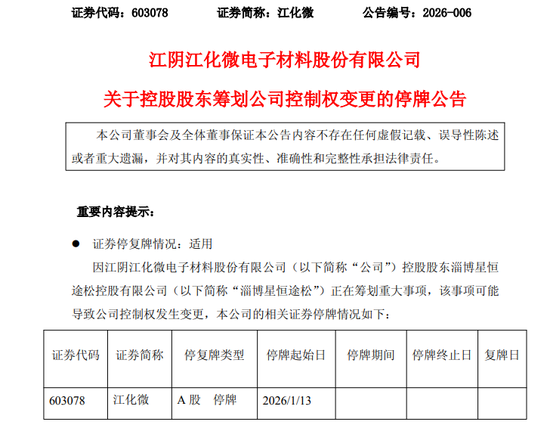
603078,筹划控制权变更!
Xin Lang Cai Jing· 2026-01-12 23:53
Core Viewpoint - Jianghuai Microelectronics (江化微) is facing a potential change in control as its major shareholder, Zibo Xingheng Tusheng, is planning a significant matter that may lead to a shift in the company's control structure [2][10]. Group 1: Company Overview - Jianghuai Microelectronics specializes in ultra-pure wet electronic chemicals and is a leading player in this sector, providing essential materials for the production of display panels, semiconductors, and solar cells [3][11]. - The company has three production bases with a total capacity of 405,000 tons per year, of which 235,000 tons are already built. The bases are located in Jiangyin (90,000 tons/year), Zhenjiang (228,000 tons/year), and Sichuan (87,000 tons/year) [3][11]. Group 2: Shareholder and Control Structure - The actual controller of Jianghuai Microelectronics is the Zibo Municipal Finance Bureau, which took over from the company's core founder, Yin Fuhua, through share transfers and private placements between 2021 and 2022. Zibo Xingheng Tusheng currently holds 23.96% of the company's shares, valued at approximately 2 billion yuan based on a market capitalization of around 8.3 billion yuan as of January 12 [4][12]. - Yin Fuhua retains the positions of Chairman and General Manager to ensure operational stability, and there has been a recent board restructuring [4][12]. Group 3: Performance Metrics - Since the Zibo Municipal Finance Bureau's takeover, Jianghuai Microelectronics has shown stable performance, with revenue and net profit projected to remain around 1 billion yuan and 100 million yuan, respectively, from 2022 to 2024. In the first three quarters of 2025, the company reported revenue of 910 million yuan, a year-on-year increase of 10.92%, while net profit was 78.78 million yuan, a decrease of 8.66% [5][13]. - The company's stock price has seen a cumulative decline of over 19% from 2022 until now, but it has rebounded with a rise of approximately 20% since the beginning of 2026, culminating in a trading halt on January 12 due to the control change announcement [7][16].