内生安全体系

Search documents
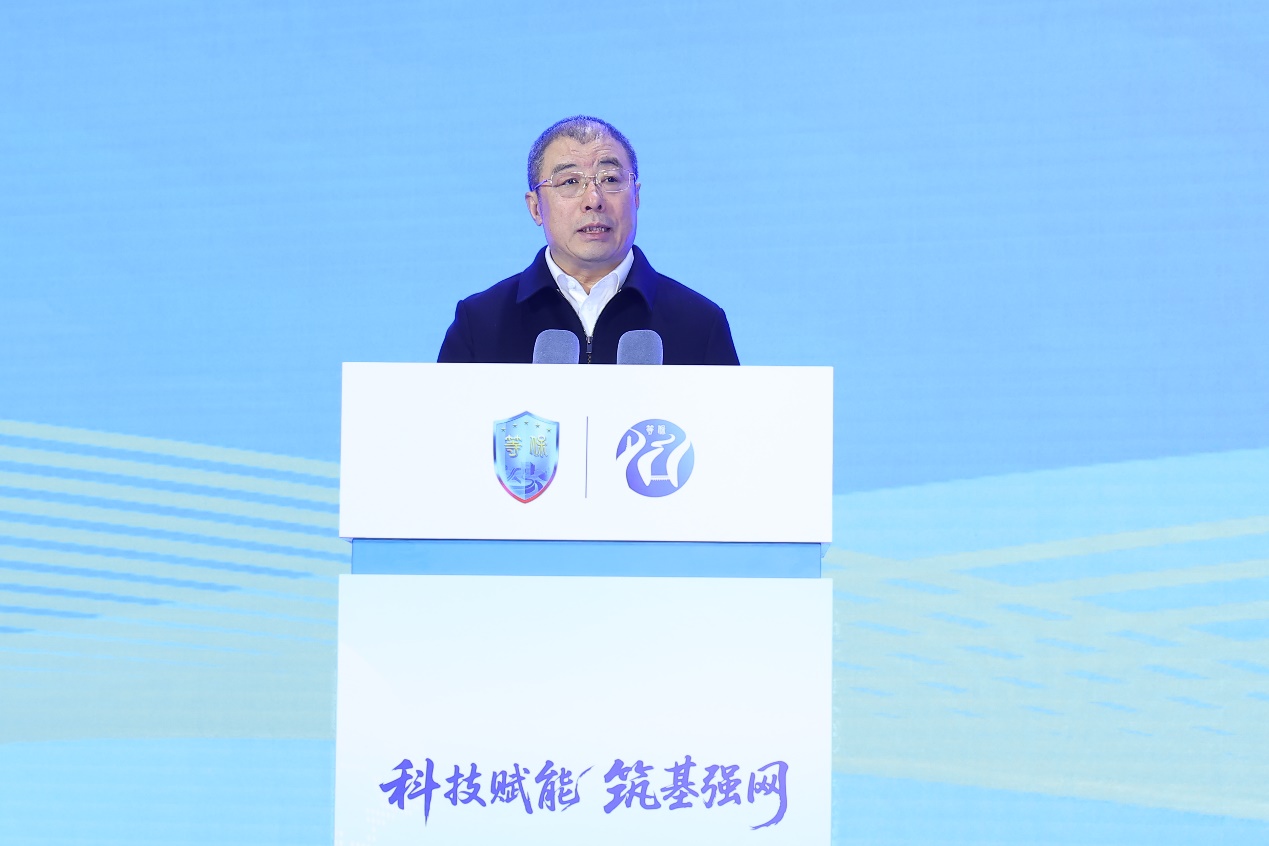
齐向东聚焦“三个认识” 解析“十五五”期间的网络安全变局
Jin Rong Jie· 2026-01-30 07:32
Core Insights - The speech by Qi Xiangdong emphasizes the need to enhance understanding of vulnerabilities, attackers, and losses to effectively address new threats during the 14th Five-Year Plan period [1][4]. Group 1: Understanding Vulnerabilities - The core of cybersecurity issues lies in vulnerabilities, which can be categorized into six types: software, hardware, machine, human, system, and operational vulnerabilities [2][3]. - Machine vulnerabilities are particularly concerning as they can proliferate with extended scenarios, such as vulnerabilities in drone management systems that could lead to significant public safety incidents [3]. - A study by Qi Anxin revealed that 93.3% of major domestic automotive manufacturers' cloud platforms have security vulnerabilities, with 76.7% classified as critical or high-risk, posing direct threats to data and vehicle safety [3]. Group 2: Understanding Attackers - Current attackers include cyber armies, government intelligence agencies, black and gray market organizations, and individual hackers deeply embedded in attack chains [4]. - An example cited involves the NSA's long-term exploitation of mobile SMS vulnerabilities to monitor key personnel, highlighting the organized nature of such penetrative attacks [4]. Group 3: Understanding Losses - Cyberattacks can lead to military, national, corporate, and personal losses, with examples ranging from large-scale power outages due to attacks on substations to the leakage of military secrets [4]. - The financial impact on companies is significant, with incidents like the "poison textbook" training model leading to a market value loss of billions, and ransomware attacks extracting tens of billions in ransom annually [4]. - Qi Xiangdong stresses that the primary task during the 14th Five-Year Plan is to abandon outdated security perceptions and to build a proactive defense system supported by four platforms and five red lines [4].

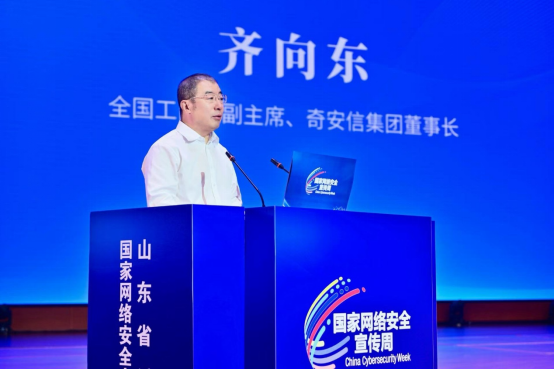
奇安信董事长齐向东出席2025网安周山东省活动开幕仪式
Qi Lu Wan Bao· 2025-09-15 08:52
Core Viewpoint - The 2025 National Cybersecurity Awareness Week emphasizes the importance of building an internal security system to enhance cybersecurity capabilities during the "14th Five-Year Plan" period, addressing new challenges and evolving threats in the digital age [1][4]. Group 1: New Transitions in Cybersecurity - Three major new transitions are reshaping the traditional security landscape: the application of artificial intelligence, the concentration of data, and the deepening of digital transformation, which collectively create systemic security demands [2][4]. - The evolution of security capabilities must outpace technological applications and industrial development to prevent vulnerabilities [2]. Group 2: Security Challenges - Four significant security challenges hinder the advancement of cybersecurity during the "14th Five-Year Plan": - The first challenge is the invisibility of advanced threats, with organized digital groups targeting critical national infrastructure and core enterprise data [3]. - The second challenge is the inability to defend weak links, as disparate systems and lack of unified response hinder effective security management [3]. - The third challenge involves the management of data flow, where internal threats pose significant risks, especially in the context of AI applications [5]. - The fourth challenge is the lagging security measures in various scenarios, particularly in industries like energy and finance, where traditional security solutions fail to adapt [5]. Group 3: Solutions for Cybersecurity Enhancement - To address these challenges, a focus on internal security is proposed through six dimensions: - Breaking down data silos to enhance security system implementation [6]. - Empowering security systems with AI to improve operational efficiency [7]. - Integrating security capabilities across endpoints, networks, clouds, and data to combat multi-faceted attacks [8]. - Establishing a "zero trust" framework to mitigate internal threats [9]. - Strengthening application security defenses tailored to AI scenarios [9]. - Unifying security protection barriers through a coordinated platform to enhance operational effectiveness [10]. Group 4: Commitment to Cybersecurity - The company expresses its commitment to collaborating with various stakeholders to enhance cybersecurity capabilities, ensuring national security and public welfare during the critical phase of the "14th Five-Year Plan" [10].