冬季大三角

Search documents
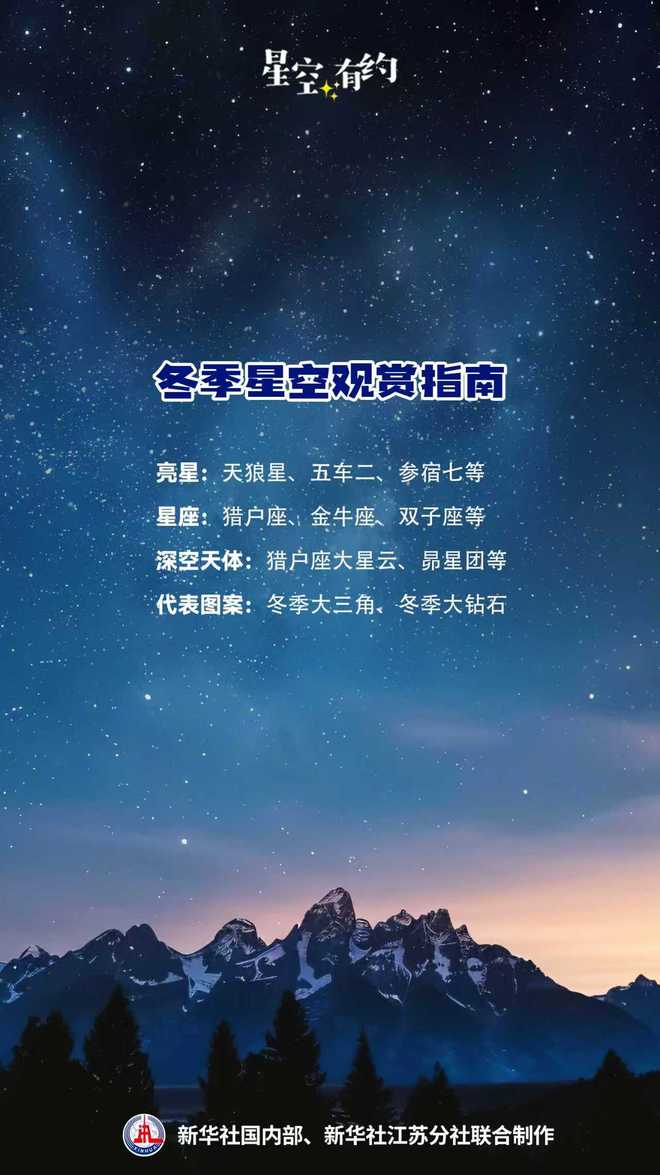
星空有约|冬季“星空大戏”的黄金时段来了
Xin Hua She· 2026-01-22 02:11
Core Viewpoint - The winter night sky offers a spectacular view with numerous bright stars, making it an ideal time for stargazing, particularly with the prominent "Winter Triangle" and "Winter Diamond" formations visible in the northern hemisphere [4][6]. Group 1: Winter Sky Features - The winter sky is characterized by the highest number of visible bright stars, with over 10 stars having a visual magnitude of second or higher [4]. - The "Winter Triangle," consisting of the brightest stars Sirius, Procyon, and Betelgeuse, is a key feature of the winter sky, visible across most of the northern hemisphere [4]. - The "Winter Diamond" includes stars such as Sirius, Procyon, and Betelgeuse, along with other notable stars, showcasing a mix of different stellar evolution stages [6]. Group 2: Notable Celestial Objects - Jupiter has recently moved into the Gemini constellation, joining the "Winter Diamond," which includes both giant planets and various types of stars [6]. - The Orion constellation, particularly the Orion Nebula, is highlighted as a significant feature of the winter sky, serving as a stellar nursery composed of interstellar dust and gas [7][9]. Group 3: Timing and Visibility - The timing of star visibility changes throughout the lunar months, with stars rising approximately 4 minutes earlier each day, affecting their visibility in late January compared to late December [11].