期货及衍生品私募产品

Search documents
私募头部阵营大“起底”:多位大佬旗下不止一家机构
Xin Lang Cai Jing· 2026-02-28 01:20
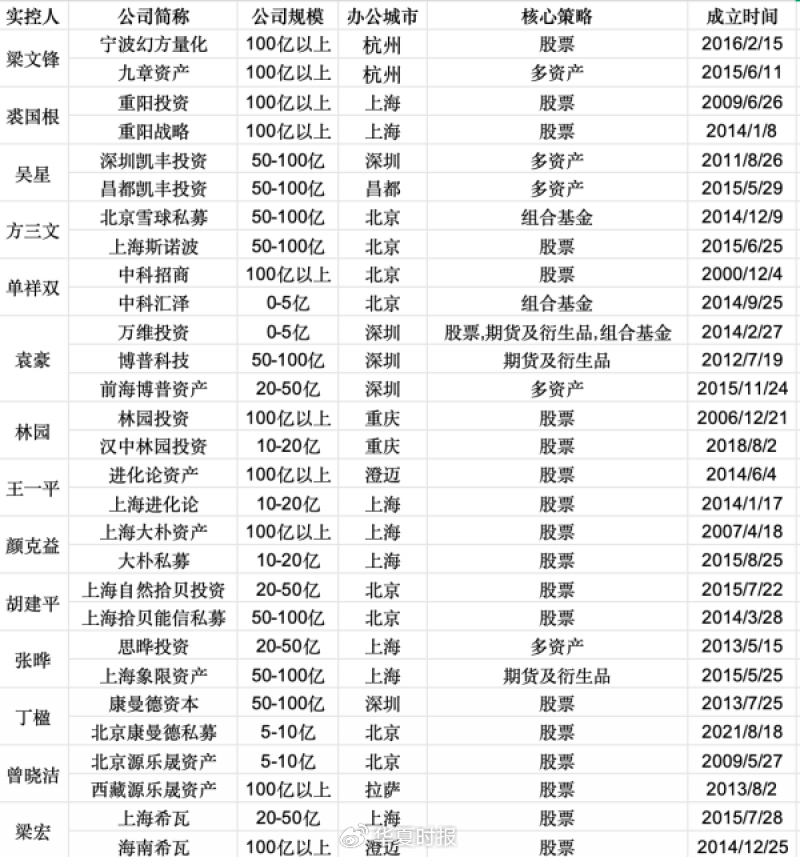
Core Insights - The private equity industry is experiencing significant growth, with 243 private equity managers managing over 5 billion yuan as of January 2026, an increase from 195 at the end of 2024, indicating a continuous expansion of the industry’s top tier [1][14] - The majority of these firms are controlled by individuals, with 227 firms (93.42%) having natural persons as actual controllers, while only 16 firms (6.58%) are controlled by corporate entities [1][14] Team Composition - There is a notable disparity in team sizes among leading private equity firms, with 15 firms having over 100 employees, 38 firms with 50 to 100 employees, and 172 firms with 10 to 50 employees [2][14] - The largest firm, Waimao Trust, has 223 employees, followed by Jiukun Investment and Lingjun Investment, each with 165 employees [4][15] Control Structures - A total of 14 individuals control multiple private equity firms, including notable figures such as Liang Wenfeng and Qiu Guogen, indicating a trend of multi-firm control within the industry [3][6] - Ten firms operate under a dual control structure, with seven of these managing over 10 billion yuan, suggesting a growing trend towards shared leadership in larger firms [8][20] Strategic Distribution - The multi-firm control by individuals often shows a clear differentiation in strategy, with firms like Liang Wenfeng's Ningbo Huanshang Quantitative and Jiuzhang Asset focusing on different asset strategies [6][17] - Many of these firms are located in the same or neighboring cities, indicating a geographical clustering of control [18] Advantages and Disadvantages of Dual Control - The dual control structure offers advantages such as risk diversification and resource integration, enhancing organizational resilience and decision-making efficiency [10][22] - However, it also presents challenges, including potential decision-making inefficiencies and governance conflicts, which can arise from differing investment philosophies or interests between the two controllers [11][23]