电网代理购电服务

Search documents
2026年1月全国分时电价汇总,28省份最大峰谷价差缩小
中关村储能产业技术联盟· 2026-01-07 03:53
Core Insights - In January 2026, 20 regions implemented peak electricity prices, while 3 regions adopted valley electricity prices. A total of 21 regions exhibited a peak-valley price difference exceeding 0.6 yuan/kWh, and 16 regions had a peak-to-flat price difference greater than 0.3 yuan/kWh [3][4] - The top three regions with the largest peak-valley price differences are: Guangdong Pearl River Delta (1.1577 yuan/kWh), Jiangmen (1.1510 yuan/kWh), and Hainan (1.1171 yuan/kWh) [3][4] - Year-on-year changes in the maximum price difference for January 2026 show increases in only 7 provinces, while the remaining provinces experienced declines. Notably, Xinjiang saw a decrease of 93.4%, Ningxia 57.4%, and Liaoning 48.3% [3][4] Price Differences - The maximum peak-valley price difference in January 2026 is as follows: - Guangdong Pearl River Delta: 1.1577 yuan/kWh, down 11.9% year-on-year - Jiangmen: 1.1510 yuan/kWh, down 12.0% year-on-year - Hainan: 1.1171 yuan/kWh, with other regions like Huizhou, Hunan, and Shandong also showing significant differences [3][5] - The year-on-year decline in maximum price differences is particularly pronounced in provinces with ample supply, such as Xinjiang, Ningxia, and Liaoning, while Jiangsu's decline is attributed to adjustments in time-of-use pricing [3][5] Time-of-Use Pricing Policies - Hebei, Shandong, and Shanxi updated their time-of-use pricing policies in January 2026, with specific floating ratios for peak and valley pricing [6][8][9] - The floating ratios for peak and valley prices are set at 70% above and below the flat price, respectively, with peak prices increasing by 20% and valley prices decreasing by 20% [7][8][9] Impact on Energy Storage - Changes in time-of-use pricing policies significantly affect the profitability of user-side energy storage. The CNESA will continue to monitor electricity price trends, with detailed analyses available in the CNESA DataLink global energy storage database [12]


12月电网代购电分析:23省价差同比收窄,天津、河北南网、四川有所上涨
中关村储能产业技术联盟· 2025-11-30 03:46
Core Insights - The article discusses the implementation of peak electricity prices across various regions in China as the country enters the winter peak demand period in December 2025, with significant price differences observed in multiple provinces [3][4]. Pricing Trends - In December, peak electricity prices are being executed in regions such as Guangdong, Shandong, Hunan, and others, with only Shandong and Hebei South Network implementing valley prices [3]. - A total of 22 regions have a maximum peak-valley price difference exceeding 0.6 yuan/kWh, while 17 regions have a peak-to-flat price difference exceeding 0.3 yuan/kWh [3]. - Guangdong maintains the highest peak-valley price difference at 1.298 yuan/kWh, a year-on-year increase of 0.2%, followed by Hunan at 1.065 yuan/kWh and Shandong at 0.985 yuan/kWh [3][4]. Year-on-Year Comparison - Compared to the same period last year, 23 provinces show a trend of decreasing maximum price differences, while 12 provinces exhibit an increasing trend [3]. - The most significant year-on-year increases in maximum price differences exceeding 0.6 yuan/kWh are observed in Tianjin (10%), Hebei South Network (9.1%), and Sichuan (5.4%) [3]. Regional Pricing Details - The article provides detailed pricing tables for various provinces, including the electricity prices for commercial users in Guangdong, Hunan, and other regions, highlighting the differences in peak, flat, and valley pricing [4][5][10][20]. - For instance, the peak price in Guangdong's Pearl River Delta is 1.6084 yuan/kWh, while the valley price is 0.3104 yuan/kWh, resulting in a peak-valley price difference of 1.2980 yuan/kWh [4]. Impact on Energy Storage - The changes in time-of-use pricing policies significantly affect the profitability of user-side energy storage, with ongoing monitoring of price trends by CNESA [4].

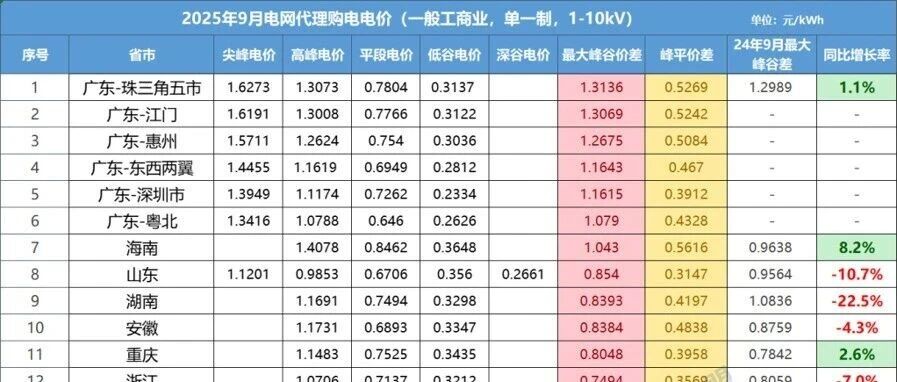
9月电网代购电价:最大峰谷价差1.3136元/kWh!黑龙江/江苏/辽宁/湖南降幅明显
中关村储能产业技术联盟· 2025-08-29 08:47
Core Viewpoint - The article discusses the electricity purchasing prices for September 2025 across various regions in China, highlighting the changes in peak and valley pricing, and the impact of time-of-use pricing policies on energy storage profitability [2][4]. Summary by Sections Electricity Purchasing Prices Overview - As of September 2025, most regions have released their electricity purchasing prices, with the exception of Inner Mongolia West, Jilin, and Xinjiang [2]. - No new time-of-use pricing policies have been announced for this month [4]. Peak and Valley Pricing - In September, 18 regions have a peak-valley price difference exceeding 0.6 yuan/kWh, while 16 regions have a peak segment price difference exceeding 0.3 yuan/kWh [4]. - Guangdong has the highest peak-valley price difference at 1.3136 yuan/kWh, followed by Hainan at 1.043 yuan/kWh and Shandong at 0.854 yuan/kWh [4]. Year-on-Year Comparison - Compared to the same period last year, the maximum price differences have generally decreased, with only 9 regions experiencing an increase [4]. - Notable decreases in price differences were observed in Heilongjiang (-57.4%), Jiangsu (-40.6%), and Liaoning (-35.2%) due to adjustments in time-of-use pricing policies [4]. Regional Pricing Details - The article provides detailed tables of electricity prices for various regions, including peak, flat, and valley pricing for different voltage levels [5][6][10][19]. - For example, in Guangdong, the non-time-of-use price for 1-10 kV is 0.6893 yuan/kWh, while the peak price is significantly higher during peak hours [5][10]. Impact on Energy Storage - The changes in time-of-use pricing policies significantly affect the profitability of user-side energy storage systems, with ongoing monitoring by CNESA [4]. Future Data Availability - CNESA will continue to track electricity price trends, with detailed summaries and data analysis available in their global energy storage database [4].
最新!同比缩小!最大峰谷价差1.246元/kWh,7月电网代理购电电价公布
中关村储能产业技术联盟· 2025-06-28 07:08
Core Insights - In July, 22 regions in China implemented peak electricity pricing, while 5 regions adopted off-peak pricing. The maximum peak-to-valley price difference exceeded 0.6 yuan/kWh in 20 regions, with 15 regions showing a price difference greater than 0.3 yuan/kWh [2][3] Pricing Overview - The top three regions with the highest peak-to-valley price differences are: - Guangdong - Pearl River Delta: 1.246 yuan/kWh - Jiangmen: 1.239 yuan/kWh - Hainan: 1.220 yuan/kWh [2][5] - Compared to the same period last year, the maximum price differences have generally decreased, with only 10 regions experiencing an increase. Notable decreases were observed in Jiangsu, Northeast China, and Shandong, while increases were noted in Jiangxi, Guizhou, Hunan, and Chongqing [2][5] Policy Updates - In June, four provinces updated their time-of-use electricity pricing policies, reducing the floating range and adjusting midday pricing to either flat or off-peak rates [2][6] - Specific floating ratios and ranges were established in Jiangxi and Xinjiang, with adjustments made to peak and off-peak periods [6][7][9] Time-of-Use Pricing Structure - Jiangxi's time-of-use pricing includes: - Peak: 9:00-12:00, 18:00-21:00 - Off-peak: 0:00-6:00 - Other periods classified as flat [8][16] - Xinjiang's pricing structure includes: - Peak: 8:00-10:00, 19:00-24:00 - Off-peak: 11:00-18:00 [9] Regional Pricing Details - The electricity pricing for various regions in July 2025 includes: - Guangdong - Pearl River Delta: 1.5449 yuan/kWh (peak), 0.7416 yuan/kWh (flat), 0.2990 yuan/kWh (off-peak) [5][19] - Jiangsu: 1.2160 yuan/kWh (peak), 0.7606 yuan/kWh (flat), 0.4760 yuan/kWh (off-peak) [5][19] - The pricing structure is influenced by factors such as transmission losses, system operation costs, and government fees [15][26]