离心泵

Search documents
势银调研 | 湖州三井:配套多个液氢项目,计划将液氢泵能耗做到0.8 kWh/kg H₂
势银能链· 2026-03-23 03:50
Core Viewpoint - The article highlights the development and strategic positioning of Huzhou Sanjing Cryogenic Equipment Co., Ltd. in the low-temperature liquid pump industry, emphasizing its focus on liquid hydrogen pump technology and international market expansion [2][9]. Group 1: Company Overview - Huzhou Sanjing is a national high-tech enterprise specializing in the research, manufacturing, and sales of low-temperature liquid pumps, with over 20 years of experience in the field [4]. - The company has developed a clear product structure with a sales target of 136 million yuan by 2025, featuring a balanced distribution among reciprocating pumps (40%), centrifugal pumps (30%), and submersible pumps (30%) [5]. Group 2: Technological Development - The company has invested in liquid hydrogen pump technology for nearly a decade, focusing on customized designs for research projects rather than mass production [6]. - Key technical challenges include the tendency of liquid hydrogen to vaporize, which can lead to efficiency loss and cavitation; the company addresses this through enhanced insulation and structural optimization [8]. Group 3: Market Expansion - Huzhou Sanjing's products are distributed across more than 30 countries and regions, with recent successful deliveries to Turkey, and plans to pursue DNV certification for marine products to enter a market traditionally dominated by Japan and Europe [5][9]. - The new production base is expected to achieve an annual output of 2,000 low-temperature liquid pumps, generating an estimated revenue of 150 million yuan, and features advanced processing and storage capabilities [8]. Group 4: Strategic Positioning - The company aims to leverage its conventional business to support cash flow while strategically investing in cutting-edge fields like liquid hydrogen, positioning itself favorably for domestic substitution and global competition [9].


全球及中国化学品输送泵行业研究及十五五规划分析报告
QYResearch· 2026-02-26 09:53
Core Viewpoint - The chemical transfer pump market is experiencing steady growth, with significant opportunities driven by technological advancements and increasing safety and environmental compliance requirements. Market Size and Forecast - The global chemical transfer pump market is projected to reach approximately $41.13 billion by 2025, with a compound annual growth rate (CAGR) of about 3.53% from 2021 to 2025, and is expected to approach $51.84 billion by 2032, maintaining a CAGR of 3.28% from 2026 to 2032 [3]. - China holds about 27.89% of the global market share, with a market size expected to reach approximately $11.47 billion by 2025, growing at a CAGR of 3.77% from 2021 to 2025, and projected to grow to $15.30 billion by 2032, with a CAGR of 4.09% from 2026 to 2032 [5]. Industry Dynamics - The top three manufacturers in the global chemical transfer pump industry are expected to have a market concentration ratio (CR3) of approximately 26.54% by 2025, indicating a slight increase from 26.42% in 2024 [8]. - The demand for chemical transfer pumps is driven by ongoing expansions and upgrades in the chemical and fine chemical industries, as well as increasing safety and environmental compliance requirements [14]. Technological Trends - The focus on product quality is leading to technological upgrades in chemical transfer pumps, which will become a key competitive factor in the industry [10]. - There is a growing trend towards "leak-free" and high-reliability pumps, with an increasing adoption of magnetic pumps and double-end mechanical seals in hazardous environments [16]. Mergers and Acquisitions - Recent acquisitions in the industry include Gorman-Rupp's acquisition of Tuthill's Fill-Rite and Sotera for $525 million, and ITT's agreement to acquire SPX FLOW for $4.775 billion, highlighting the consolidation trend among leading manufacturers [12]. Challenges and Barriers - The industry faces several challenges, including high entry barriers for new entrants due to technological, talent, and capital constraints, as well as fluctuations in demand correlated with chemical price cycles [15]. - The rising costs of specialized materials and key components can impact profit margins, while international trade compliance risks are increasing for exporters [15]. Regulatory Environment - Recent regulations, such as the Safety Production Law and the Hazardous Chemicals Safety Law in China, are imposing stricter compliance and safety requirements on chemical transfer pump manufacturers, influencing product selection towards low-leakage and easily maintainable designs [18].
“一带一路”俄罗斯高低温泵市场发展环境及投资建议评估预测报告(2026版)
Sou Hu Cai Jing· 2025-12-11 01:26
Core Insights - The report focuses on the high and low-temperature pump market, emphasizing the need for domestic companies to enhance competitiveness against foreign firms in the mid to high-end sectors due to geopolitical tensions and the evolving manufacturing landscape [8][10]. Industry Overview - The industrial pump sector, particularly high and low-temperature pumps, is characterized by a low market concentration in China, as the industry is still developing [7]. - The market for high and low-temperature pumps is influenced by various industrial applications, including semiconductor manufacturing and other high-end manufacturing sectors [8]. Domestic Companies - Key domestic players in the high and low-temperature pump market include: - **Aode Equipment**: Focuses on innovative designs in the high and low-temperature segment [8]. - **Lio Group**: Engages in various sectors such as municipal, steel, and environmental industries, becoming a leading manufacturer [8]. - **Zhejiang Dayuan Pump**: Offers a comprehensive range of products and has a broad market layout [8]. - **Hunan Naipu Pump**: Specializes in industrial pumps and emergency water supply systems [8]. - **Dalian Kehuan Pump**: Known for magnetic drive centrifugal pumps [8]. International Companies - Notable international companies in the high and low-temperature pump market include: - **Flowserve**: A leader in fluid motion and control products, offering a wide range of industrial pumps [9]. - **KSB**: Renowned for high-quality pumps and valves [9]. - **Iwaki**: Produces a variety of chemical pumps used in multiple industries [9]. Market Analysis - The report includes a detailed analysis of the Russian high and low-temperature pump market, covering aspects such as market size, capacity, sales revenue, and supply-demand dynamics [12][13]. - It also evaluates the investment environment in Russia, particularly in relation to China's Belt and Road Initiative [11][12]. Financial Performance - The report provides insights into the financial metrics of the high and low-temperature pump industry, including sales revenue, profit margins, and overall economic scale [13][15]. - It highlights the profitability indicators and operational capabilities of the industry, assessing the financial health of key players [15]. Investment Opportunities - The report discusses potential investment opportunities for Chinese companies in the Russian market, including a SWOT analysis and barriers to entry [19]. - Recommendations for investment strategies and feasibility assessments are also provided [19].
技能竞赛连发:三场大赛“解码”广东人才新局
2 1 Shi Ji Jing Ji Bao Dao· 2025-12-01 12:32
Group 1 - The core objective of the recent skills competitions in Guangdong is to enhance talent supply to support the development of regional industries, particularly in low-altitude economy and marine sectors [1][2][6] - The Guangdong provincial government has launched a comprehensive plan for 101 vocational skills competitions, aiming to align competition projects with industry needs and promote modern industrial system construction [2][6][7] - The competitions have attracted over 400 skilled talents, focusing on regional specialties such as drones, marine economy, and coffee, indicating a strategic move towards talent cultivation in key industries [1][6][10] Group 2 - The marine economy skills competition highlighted the importance of technical skills in marine oil and gas equipment maintenance, with a significant contribution of 973.8 billion yuan to the province's marine industry [5][10] - The drone skills competition introduced new professional tracks such as precision logistics and emergency response, directly addressing the core applications of the low-altitude economy [6][11] - The ongoing talent strategy transformation in Guangdong is driven by rapid changes in industry demands, emphasizing the need for skilled workers in automation, smart logistics, and other emerging fields [10][11] Group 3 - Guangdong has maintained its position as China's most populous province, with a population of 127.8 million, which is crucial for sustaining its economic growth and talent pool [8][10] - The province's focus on talent development is evident in its "Million Talents Gathering in South Guangdong" initiative and the extensive skills competition plan, aiming to leverage the demographic advantage for industrial upgrades [2][8][11] - Educational institutions are adapting their curricula to incorporate competition standards, fostering a talent training model that integrates practical training with industry needs [11]

沈采厂外委转自营创效逾175万
Zhong Guo Hua Gong Bao· 2025-11-14 02:27
Core Viewpoint - The Liaohe Oilfield Shenyang Oil Production Plant is focusing on transforming outsourced operations to in-house management as a primary strategy for improving efficiency and quality by 2025, having already reduced outsourcing costs by 1.752 million yuan [1] Group 1: Management and Strategy - The plant has established a comprehensive management system from top-level design to on-site execution, with each project led by a designated manager to ensure clear responsibilities and effective progress [1] - The implementation of a "Five Ones" work mechanism ensures that each project has a dedicated manager, team, and blueprint, facilitating accountability and strong execution [1] Group 2: Employee Incentives and Performance - The plant links in-house efficiency gains to employee performance, distributing a total of 230,000 yuan in special rewards for in-house projects, which has stimulated internal motivation and led to the conversion of eight outsourced services to in-house operations [1] Group 3: Technical Innovation and Efficiency - The plant leverages the expertise of technical personnel to create a self-repair list covering six types of services, which has led to over 700 key equipment repairs, generating a total efficiency gain of 3.16 million yuan [1] - The plant balances focus on major equipment repairs with the management of routine minor repairs, completing 396 minor repair projects and reducing outsourced labor by 1,782 hours, saving 396,000 yuan in labor costs [1]
2025年中国食品泵行业发展背景、产业链、发展现状、竞争格局及发展趋势研判:民营企业占主导地位[图]
Chan Ye Xin Xi Wang· 2025-05-13 01:40
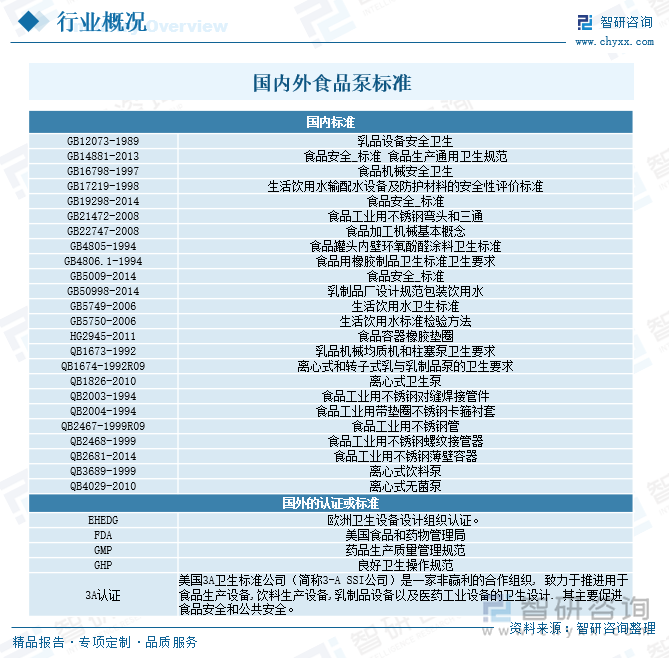
Overview - The food pump industry in China is experiencing significant growth due to rising living standards and increasing demand for food pumps, particularly in emerging sectors like plant-based and functional foods. The market size is projected to reach 10.265 billion yuan in 2024, with a year-on-year growth of 8.42%, and centrifugal pumps accounting for over 50% of the market share [1][14]. Industry Background - The food industry has stringent hygiene and safety requirements, prompting the government to implement and refine regulations and standards. This has led to increased investments in product hygiene design, material selection, and production process control, enhancing overall industry quality. Additionally, government support for technological innovation and industry upgrades is fostering a favorable environment for the food pump sector [6]. Industry Chain - The upstream of the food pump industry includes suppliers of stainless steel, engineering plastics, rubber, and components like motors, control systems, bearings, and seals. These materials must possess corrosion resistance and hygiene characteristics to meet the food industry's specific requirements. The midstream involves the research, development, and manufacturing of food pumps, while the downstream consists of demand markets, primarily food and beverage production companies, catering services, and food storage and logistics [9]. Market Demand - The largest demand for food pumps in China comes from food and beverage production companies, including dairy, beverage, alcohol, seasoning, meat processing, and baked goods. These companies utilize food pumps to transport various raw materials, semi-finished products, and finished goods, such as milk, juice, sauces, and chocolate paste, facilitating processes like transfer, mixing, and filling. The food and beverage industry is projected to have 43,000 large-scale enterprises with a revenue of 9,065.25 billion yuan and a total profit of 643.17 billion yuan in 2024, providing substantial growth opportunities for the food pump industry [12]. Competitive Landscape - The food pump industry in China comprises state-owned enterprises, private companies, and foreign enterprises. Notably, private companies, including Tianjin Huaman Pump Industry Group Co., Ltd., Hebei Hengsheng Pump Industry Co., Ltd., and others, account for over 60% of the market, making them the main players. However, the overall brand concentration in the industry remains low, particularly in county-level markets, indicating a fragmented market structure [16]. Development Trends - The future of the food pump industry in China will see increased automation and intelligence, leveraging IoT, big data, and cloud computing technologies. Food pumps will achieve higher precision, performance, and automation control, enabling automatic adjustments based on production needs and facilitating remote monitoring and fault diagnosis. Additionally, there will be a focus on developing low-noise, low-energy, and corrosion-resistant food pumps, aligning with environmental protection and sustainable development goals [23].