豆包手机nubia M153

Search documents
AI手机路线大分野:当豆包试图“接管屏幕” 苹果和谷歌为何选择“慢半拍”?
Mei Ri Jing Ji Xin Wen· 2025-12-20 05:47
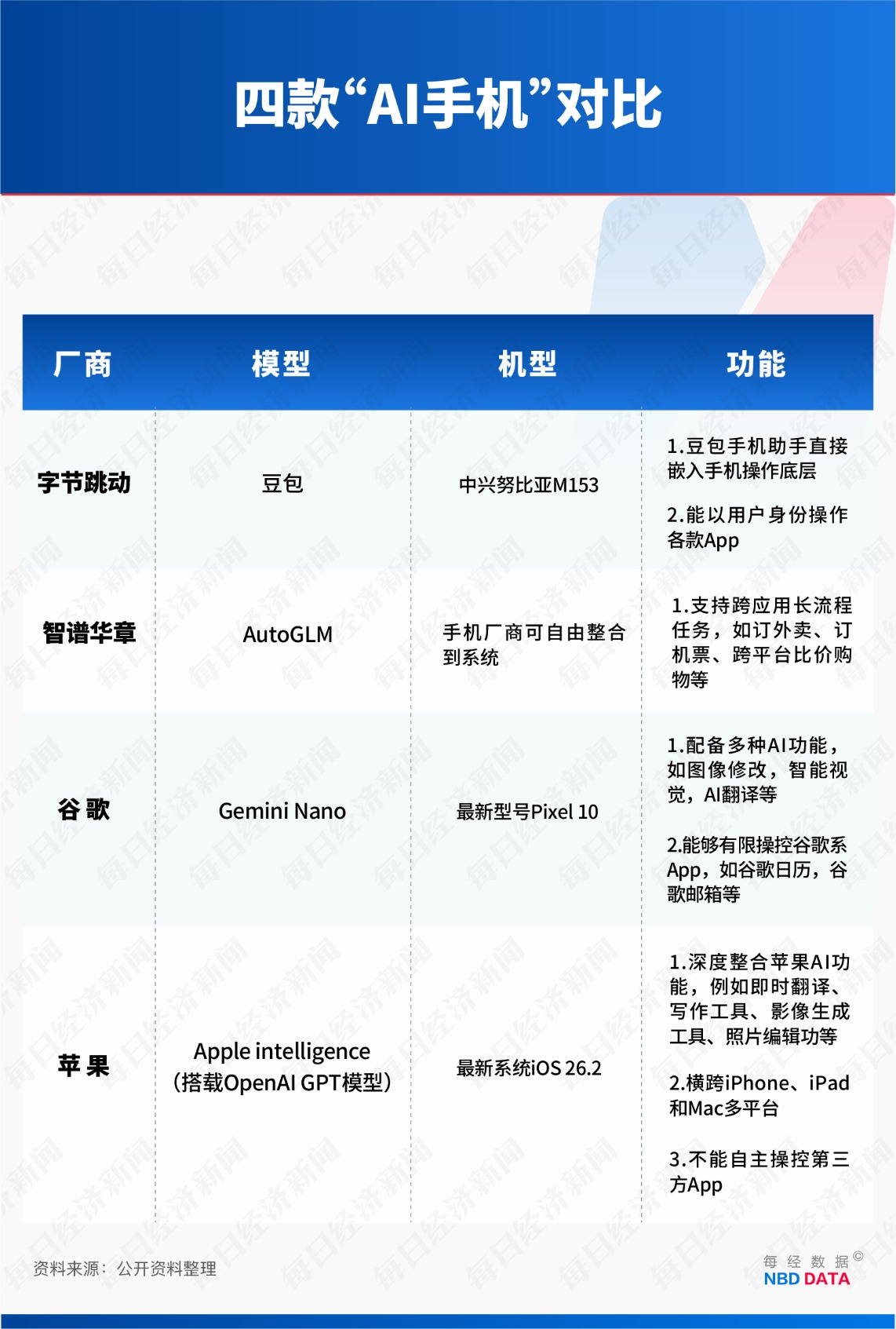
Core Viewpoint - The emergence of AI smartphones has created a clear division in technology routes, with ByteDance's "Doubao Phone" leading a GUI (Graphical User Interface) approach, while Apple and Google maintain a more conservative API (Application Programming Interface) standardization route, resulting in a significant shift in the mobile internet landscape [1][4][8]. Group 1: AI Smartphone Development - ByteDance, in collaboration with ZTE Nubia, launched the "Doubao Phone" nubia M153, which allows AI assistants to perform complex tasks across applications using GUI technology [1][4]. - The Doubao Phone's AI assistant can execute tasks like ordering food and comparing prices through voice commands, showcasing its cross-application capabilities [4][6]. - The technology behind Doubao Phone involves deep integration with system-level permissions, enabling the AI to simulate user interactions with various apps [6][7]. Group 2: Competitive Landscape - The competition between the GUI approach of Doubao and the API approach of Apple and Google highlights a fundamental clash in the mobile internet's business logic and interests [4][8]. - Apple's API approach focuses on building a standardized framework for developers to integrate AI capabilities, which is seen as more stable and privacy-conscious but requires cooperation from app developers [9][13]. - Google is also pursuing an API strategy, emphasizing cloud collaboration and prioritizing desktop applications, while still in the early stages of mobile GUI implementation [13][14]. Group 3: Market Trends and Projections - According to Canalys, the global AI smartphone shipment share is expected to rise from 16% in 2024 to 54% by 2028, with a compound annual growth rate of 63% from 2023 to 2028, driven by advancements in chip technology and increasing consumer demand for AI features [14]. - The introduction of AI assistants in smartphones is anticipated to disrupt traditional business models, as they may directly intervene in transactions, raising concerns among major internet companies [14][15]. Group 4: Future Ecosystem Dynamics - The future of AI smartphones is likely to see a "layered governance" structure, where major apps like WeChat and Taobao may develop their own AI agents to maintain control over user interactions, while smaller apps may be directly managed by system-level AI [16][17]. - The shift towards AI-driven ecosystems is expected to transform the competitive landscape from a focus on traffic acquisition to value co-creation, with smartphone manufacturers taking the lead [16][17].